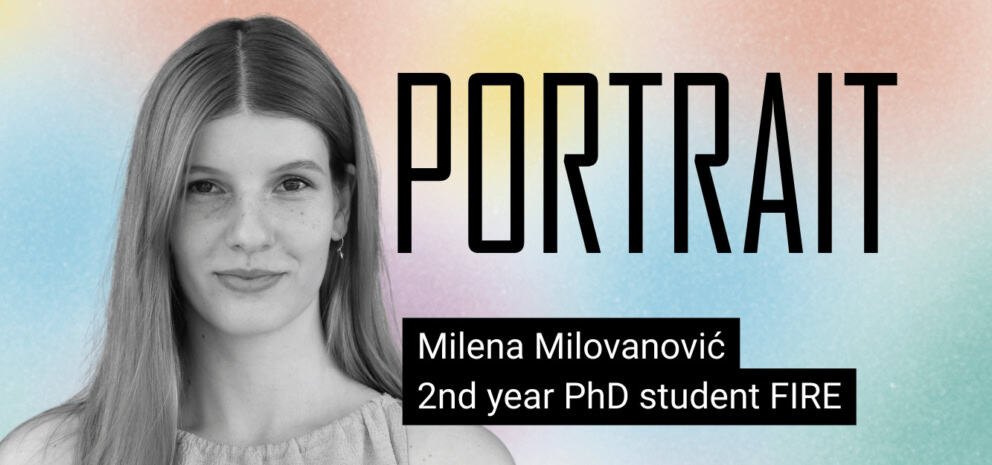
I’m a 2nd year PhD student with a background in Molecular Biology and Physiology and keen interest in understanding what life is. When not in the lab, I tend to my plants and walk around Paris.
The title of my thesis is “Gaining insight to intrinsic phage genotype-phenotype coupling to drive disruptive novel protein selection system” co-supervised by Dr. Ariel Lindner (ELiS labs, Sorbonne Université) and Dr. Claude Loverdo (Laboratoire Jean Perrin, Sorbonne Université).
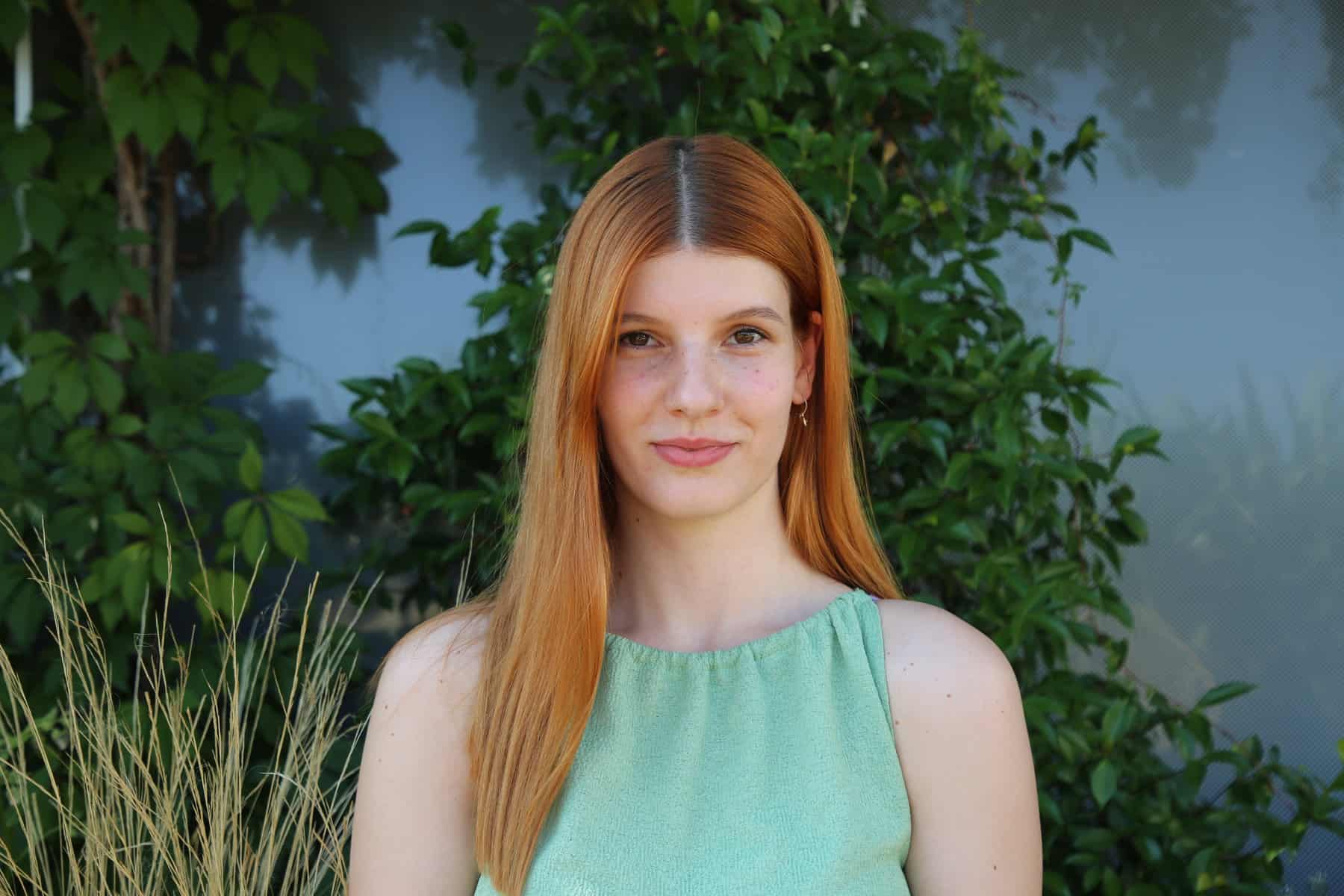
Milena Milovanović
2nd year PhD student FIRE
Lab 1: ELiS labs, Sorbonne Université
Lab 2: Laboratoire Jean Perrin, Sorbonne Université
Background: MSc in Interdisciplinary Approaches in Life Sciences, Université Paris Cité; BSc in Molecular Biology and Physiology, Faculty of Biology, University of Belgrade, Serbia
Can you explain your PhD thesis to a non-specialist audience?
The title of my thesis is “Genotype-Phenotype Linkage of Bacteriophages Independent of Cellular Compartmentalization“, and it investigates one of the most fundamental questions in biology: how does a virus “know” which proteins belong to it?
Bacteriophages — or phages — are viruses that infect bacteria. They are the most abundant biological entities on Earth, outnumbering all living organisms combined. Each phage is essentially a tiny molecular machine: a package of DNA instructions (its genotype) wrapped in a protein shell that determines what it can do (its phenotype). For a phage to work properly, the right proteins need to assemble around the right DNA. But how does that match-up happen?
The classical answer is compartmentalization. One phage infects one bacteria, replicates, and its DNA and proteins are physically confined together by the bacterial membrane, ensuring the match. This is also the principle behind phage display, a Nobel Prize-winning technology used to develop antibodies and diagnostics.
A surprising recent finding from my lab changed this picture. When phages were assembled entirely outside a cell – using a test-tube system called PHEIGES (PHage Engineering by In vitro Gene Expression and Selection), developed in collaboration with the lab of Vincent Noireaux (University of Minnesota Twin Cities) – phages still matched their own DNA to their own proteins, even without a cell to confine them. This challenges the dogma.
My PhD investigates why and how this happens. Is it a physical effect; do proteins produced near a genome simply don’t have time to drift away before assembly? Or is it an evolved trait, a built-in molecular “loyalty” that maximized phage fitness over billions of years of evolution? I approach this question through a combination of experiments and mathematical modeling, under the co-supervision of Dr. Ariel Lindner and Dr. Claude Loverdo, both at Sorbonne University. Although this project tackles questions of fundamental science, understanding the underlying mechanisms could have implications for biotechnology and medicine, including phage therapy for antibiotic-resistant infections and improving next-generation protein selection platforms used in drug discovery.
Why did you choose the FIRE PhD programme?
My lab, the Engaged Life Sciences (ELiS) Collaboratory / INSERM U1338, has a long-standing relationship with FIRE, with a lineage of shared students who have gone on to excel in their fields. However, it was not just a plain act of my lab’s loyalty, but also a personal closeness to the LPI as I’ve completed my Master’s degree in Interdisciplinary Approaches to Life Sciences here.
From that experience, I was sure that I was choosing the programme which would allow me to build my own curriculum and satisfy my curiosities, while filling in the gaps in my academic training. One of the examples would be the Philosophy of Science, which I had always been interested in. This course rekindled my enthusiasm and was perfectly timed as to reconsider even the most fundamental questions I was posing at the very beginning of my thesis.
In what ways has FIRE helped you develop your personal and professional project?
The most formative aspect of FIRE to date has been the attentiveness. I sincerely appreciate how tightly-knit and human-scale our community is. Because the cohort is small, the team knows each student individually, and each teacher can sense and adapt to us promptly. Every question that crossed my mind has been answered. This attentiveness extends into tangible support too, such as funding available for conference and workshop attendance.
Therefore, I attain a playful approach to my project which proves very beneficial when experiments run a little slower than expected.
Who should apply to the FIRE PhD programme, and what advice would you give future applicants?
Very few of my colleagues – myself included – comfortably conform to the standard definition of any field. For most of academia this is a liability, but FIRE treats it as a qualification. In short, I would say that the programme is meant for risk-takers.
There is a particular sweet spot between old-school academic isolation, where fundamental research lives with no burden of application, and the modern pressure for ready-made, consumable outputs. FIRE supports us to pursue your research within this niche. However, it does ask for something in return. If you are looking for a clearly defined, single-discipline PhD with a clean methodological lane, this is not that. If you see yourself conducting research which is transgressive, crossing boundaries and challenging paradigms, and ultimately moving from the lab / office to real world, then this could be a match.
My advice is this: be particular about your perspective on the future of science and the world. Try and imagine where you and your work fit in this future, and how one should contribute to this ideal. And be prepared to speak, write, discuss about it — not only to fellow researchers, but to the policymakers, practitioners, and communities who will ultimately shape the future.
Applications for the FIRE doctoral school are open. Spread the word!
> FIRE Doctoral School – open applications until 3 April 2026: https://phd.learningplanetinstitute.org/en/join-us