Questions frequent
Here you'll find answers to the most frequently asked questions.
The Learning Planet Institute
Who are your current partners?
The Bettencourt Schueller Foundation is our founding sponsor.
The City of Paris and UNESCO are our two major historical partners.
Université Paris Cité, CY Cergy Paris Université, Inserm and Université PSL (Paris Sciences & Lettres) are our academic and research partners with whom we develop our teaching and research programmes.
Our financial partners, both private and public, enable us to fund our high-impact projects.
Our institutional partners enable us to have an impact on a much larger scale.
And our project partners enable us to work alongside them on practical, ambitious projects.
What is your governance system?
Our governance structure is divided into six main bodies
- An Executive Committee
- An Executive Committee
- An HR Committee
- A Monitoring Committee
- A Board of Directors
- Scientific Advisory Board
How do you operate?
- Learning through research - We question the world and develop original methods based on scientific approaches.
- Developing unique communities - We create physical and digital spaces that encourage encounters and co-construction.
- Experiment and share - We prototype and learn from our successes and failures
- Thinking outside the box - We dream up and think creatively about our projects, methods and tools.
- Redefining the rules of the game in a sustainable way - We implement practices that can accelerate large-scale transitions
- Using digital innovation to spread - We use technology to explore and share knowledge on an unprecedented scale
What are your values?
- Promoting interdisciplinarity - We cultivate critical thinking and exchanges between fields of knowledge
- Drawing on collective intelligence - We facilitate peer learning, creativity and cooperation
- Caring for ourselves, others and the planet - We bring kindness, consideration and respect for people and the environment into the life of our community.
- Welcoming diversity - We celebrate the richness of our multicultural and inclusive community
- Cultivating enthusiasm and optimism - We believe in the virtues of positive thinking as a lever for hope and success.
- (Self) Empowerment - We encourage our communities to think freely and take initiative
What are your links with the United Nations?
The United Nations University and the Institute are working closely together on the «United Nations University Hub on the Future of Learning with Youth in the age of Artificial Intelligence (AI)» project. This UNU Hub, the 1st in France, focuses on creating transformative learning experiences that inspire and enable young people to shape global peace. It aims to empower learners to become global citizens.
Learn moreThe Learning Planet Institute is also a Category II Institute (C2C) under the auspices of UNESCO in France. This designation is an exceptional recognition of the Institute and its two decades of educational innovation, excellence and commitment to transforming education on a global scale.
Learn moreWhat's your raison d'être?
The Learning Planet Institute is a player in the world of academia and social entrepreneurship. Based on an interdisciplinary approach, the Institute combines research, teaching and technology to help individuals, groups and organisations build a learning society for a more sustainable world.
We are convinced that youth, lifelong learning and collective intelligence are the best levers for change in our societies.
What's your ambition?
Co-creating a learning society to meet the challenges of our time.
Where did you come from?
In response to crises (social, environmental, economic), researchers are François Taddei and Ariel Lindner launched the Centre de Recherches Interdisciplinaires (CRI) in 2006, with the mission of training the next generation of scientists working at the interface of life sciences, learning and digital technology. Their conviction? A new and unique approach to teaching through research is necessary and possible.
The CRI then underwent a phase of exponential growth. It has grown from a handful of people to an internationally renowned institute and a global community with several hundred partners on every continent.
At the end of 2021, in order to increase its impact and respond to the ever-growing number of requests from public and private players, the CRI will transform itself and become the Learning Planet Institute. Its renewed ambition? To co-create a learning society capable of meeting the complex current and future challenges we face.
Who are you? What do you do?
Since 2006, the Learning Planet Institute has been using collective intelligence to reinvent learning at all ages in order to build learning societies that are sustainable and inclusive, and capable of meeting the complex challenges we face.
The Institute's mission is to explore, experiment with and share new ways of learning and cooperating to meet the needs of young people and the planet. It encourages and disseminates a culture, methods and tools of empowerment to transform organisations. Finally, it leads communities and supports «Learning Planetizens», citizens of the planet who learn to take care of themselves, others and the planet.
To achieve its objectives, the Learning Planet Institute creates research and teaching programmes based on interdisciplinarity, diversity and the initiative of the people involved. It draws on the synergies between its activities: R&D, Education, International Alliance, Organizational transformation and Digital ecosystems.
What is your status?
The Learning Planet Institute is a non-profit association created in France in 2006 under the French Law of 1901:
- Exploring new ways of learning, teaching and collectively developing digital methods and tools to train a generation of citizens who, together, can create and share their solutions; ;
- Developing open and participatory research at the interface between life sciences, learning sciences and digital technology; ;
- Helping to transform committed communities and educational and research institutions so that they can tackle the challenges of our time.
Your plea
Who is François Taddei?
Co-founder and chairman of the Learning Planet Institute, François Taddei is a general engineer at the Ecole des Ponts des Eaux et des Forêts.
An internationally-renowned researcher at Inserm, he now devotes his time to the science of learning, and in particular to the notion of "learning by doing". Planetizen (planétoyen - citizen of the planet) to enable each and every one of us to learn to take care of ourselves, others and the planet.
Since 2014, François Taddei has also been co-director of the UNESCO Chair in Learning Sciences, attached to Université Paris Cité.
He is the author of two books Et Si Nous?, published by Calmann-Lévy (2022) and Learning in the 21st century, published by Calmann-Lévy (2018).
What are the Sustainable Development Goals?
In 2015, to meet the challenges facing the world, 193 countries adopted 17 Sustainable Development Goals (SDGs) to the United Nations, pledging to eradicate poverty, protect the planet and ensure peace and prosperity for all by 2030.
In order to leaving no one behind», the 17 MDGs are closely interconnected. No. 4 - which aims to « Ensuring equitable, inclusive and quality education and lifelong learning opportunities for all» - is particularly cross-cutting and crucial: achieving it is a prerequisite for achieving the other objectives.
The SDGs call for the mobilisation of everyone: the international community, governments, NGOs, local authorities, businesses and citizens. The Learning Planet Institute is part of the response to this global call to action.
A Planetary Academy?
We are convinced that it is more urgent than ever to give young people the means to think and act in order to build desirable futures, where everyone can develop their full potential and thus contribute to meeting the major challenges of our time, where young people can participate in the decisions that concern them, where education is focused on acquiring the skills needed for the world ahead...
The Learning Planet Institute aims to transform the way we learn and teach, so that every learner becomes an agent of change committed to peace and sustainability.
What are you defending?
The Learning Planet Institute advocates large-scale collaboration with a view to co-constructing a learning society capable of meeting the complex current and future challenges facing us. A society in which «Learning Planetizens» learn to take care of themselves, others and the planet.
To achieve this, the Institute encourages large-scale collaboration to build a learning planet and develop new ways of learning and cooperating, as well as communities working together to find sustainable solutions in both the education and health sectors, and to achieve the Sustainable Development Goals (SDGs) by 2030.
Your activities
What does the “Organisational Transformation” activity involve?
Our 20 years of experience in co-construction, collective intelligence and project-based learning are assets we are keen to share.
The Organisational Transformation division helps to develop education systems and transform organisations - both public and private - as well as educational institutions, to make them more effective learners.
Its activities are based on a two-pronged approach: 1/ support based on the research process 2/ a range of training courses in the form of joint workshops.
Do you have any international initiatives?
Created in 2019 by the Learning Planet Institute and UNESCO, the’LearningPlanet International Alliance leads a global community dedicated to transforming education and co-constructing a learning society.
It brings together a wide range of complementary and committed players (NGOs, public bodies, cities and regions, schools and universities, social entrepreneurs, businesses, students, youth movements, activists, artists, etc.) with a common goal: to teach people to «take care of themselves, others and the planet».
Together, they share their knowledge, their teaching practices and their experience in the field (creating new ways of learning, teaching, doing research and mobilising collective intelligence), to better prepare individuals and organisations to understand and collectively meet the challenges of our time.
The LearningPlanet Alliance has hundreds of partners around the world.
What are the Learning Planet Institute's activities?
The Learning Planet Institute creates research and teaching programmes based on interdisciplinarity, diversity and initiative.
It draws on the synergies between its businesses:
- R&D (search)
- Education (form)
- International Alliance (federate)
- Organizational transformation (accompany)
- Digital ecosystems (tool)
R&D at the Learning Planet Institute
How long has the Institute been welcoming researchers?
- In 2007, the Learning Planet Institute, then the CRI, hosted the Chaire Université Paris Descartes-Orange «Innovative approaches to research and teaching».
- In 2012, the French National Research Agency's (ANR) Initiatives of Excellence in Innovative Training (IDEFI) supported research programmes focusing on learning.
- In 2013, we hosted activities dedicated to citizen science (Citizen Science - European funding).
- From September 2018, thanks to the support of the Bettencourt Schueller Foundation, the Learning Planet Institute welcomed researchers and enabled the creation of laboratories.
- Inserm University of Paris Joint Research Unit (UMR) - U1284 - has been created in January 2020. Housed at the Learning Planet Institute, it welcomes researchers - and their research projects - selected by the Scientific Advisory Board.
- As part of the new national five-year plan (2025 - 2029), the Learning Planet Institute is exploring new partnerships to host researchers in connection with our R&D topics.
What are the main thrusts of R&D at the Learning Planet Institute?
To encourage the transformation of learning - and thus have a positive impact on the planet - R&D Division mobilises research and technology for its projects focusing on :
- Artificial Intelligence
- Learning and collective intelligence
- Frugal innovation
- Individual and collective transitions
Its projects are considered and carried out according to their purpose.
The Learning Planet Institute is also incubating the ELiS (Engaged Life Science) project, which coordinates all life science initiatives until the end of 2024.
Education at the Learning Planet Institute
Do you have any executive programs?
The university diplomas (DU) that we have deployed for several years within the’Université Paris Cité confirmed the need for a specific training offer dedicated to professionals or professionals in transition.
With a new range of executive education courses - comprising short programmes, a professional Master's degree and a professional Doctorate - the start of the 2023 academic year should see an expansion of our educational offering.
National diplomas are developed as part of initial training in higher education. Our executive courses are designed as mid-career courses, based on the principles of scientific research. Their credibility is assured by our academic expertise.
These courses are part of high-level continuing education.
University School for Interdisciplinary Research in Paris (EURIP) ?
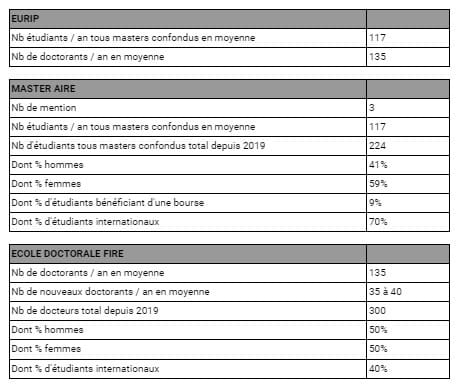
The Paris University School of Interdisciplinary Research (EURIP) was co-created by Université Paris Cité and the Learning Planet Institute. It is supported by the French National Research Agency (ANR) and is unique in that it bridges the gap between fundamental and applied research at the interface of life sciences, learning sciences and digital sciences.
Interdisciplinary, based on collaborative learning, educational innovation and scientific research methods, EURIP trains excellent multi-skilled students and researchers to meet the Sustainable Development Goals (SDGs) for health and education.
EURIP brings together the Interdisciplinary Approaches to Research and Teaching (AIRE) Master's programme, the Frontiers of Innovation in Research and Education (FIRE) Doctoral School and a number of high-level laboratories. These programmes are being renewed as part of the next five-year contract.

What are your milestones in terms of educational programs?
- 2006: creation of the first interdisciplinary doctoral school «Frontières du Vivant» with the Universities of Paris Descartes and Diderot (merged in 2020 to become Université Paris Cité)
- 2009: introduction of an interdisciplinary Master's degree in «Interdisciplinary Approaches to Life», with Descartes and Diderot Universities (merged in 2020 to become Université Paris Cité)
- 2011: introduction of an interdisciplinary «Frontiers of Life» degree with Paris Descartes University
- 2012: IDEFI (Initiatives d'excellence en formations innovantes) label awarded by the French National Research Agency (ANR), leading to the creation of a new Master's track, known successively as «FOSTER/Edtech» and now «Learning Sciences».»
- 2013: introduction of in-school and out-of-school activities («Savanturiers - École de la recherche», now run by AFPER); development of learning by doing with the MakerLab; development of MOOCs (Massive Open Online Courses).
- 2014: awarded the UNESCO Chair in Learning Sciences«, renewed in 2018 and 2022
- 2017: accreditation of the doctoral school by the Université Paris Sciences et Lettres
- 2018: creation of the École Universitaire de Recherche Interdisciplinaire de Paris (EURIP)
- 2019: creation of the Institut des Défis by Université Paris Cité and the Learning Planet Institute and launch of the track Master dedicated to digital sciences.
- 2020 launch of training programmes for people who are not in employment
- 2022: hosting of the CY Cergy Paris Université/ESSEC Bachelor Act and development of the «Bâtisseurs de Possibles» programme for students and teachers
- March 2025: the United Nations University and the Institute - wishing to strengthen and deepen their cooperation - have embarked on a close collaboration around the project «United Nations University Hub on the Future of Learning with Youth in the age of Artificial Intelligence (AI)». This new UNU Hub, the 1st in France, will focus on creating transformative learning experiences that inspire and enable young people to shape global peace. It aims to empower learners to become global citizens.
Learn more - November 2025: The Learning Planet Institute has officially become a Category II Institute (C2C) under the auspices of UNESCO in France. This designation is an exceptional recognition of the Institute and its two decades of educational innovation, excellence and commitment to transforming education on a global scale.
Learn more
What legitimacy do you have in education?
Nearly 2,000 alumni, in initial or continuing education, with international backgrounds and trajectories, as well as an average of 350 students every year. So many ambassadors of our legitimacy in this field.
- « The Learning Planet Institute breaks down the barriers to daring. There's an audacity, a latent madness in us, and it comes out! They try to de-form us so that we can build ourselves in our own way. » Flora, alumna.
- « The Learning Planet Institute really made me curious. I already had it, but in small doses. Learning Planet Institute increased it tenfold. » Julien, alumnus
The quality of our projects and education programmes is recognised and assessed by independent teams:
- University degree courses are assessed by Haut Conseil de l'évaluation de la recherche et de l'enseignement supérieur (High Council for the Evaluation of Research and Higher Education) (Hcéres), for the renewal of our accreditations. Extract from the 2018 report on the Frontiers of Innovation in Research and Education (FIRE) Doctoral School:« This doctoral school (ED) is quite remarkable and the committee has no specific recommendations. The institution's Doctoral College could draw inspiration from the ED's principles of governance and how they could be applied to other doctoral schools on the site. »
- The international jury for the Initiatives of Excellence in Innovative Training (IDEFI) of the’French National Research Agency (ANR). Extract from the 2015 report « In short, this crossroads for innovation in education and research is a whirling spiral that has generated extraordinary momentum from the outset. A wide range of projects have been carried out, reaching out to a wide range of audiences, from primary school children to employees and doctoral students, in both diploma and qualification courses. »
- AIRE Masters, FIRE Doctoral School, EURIP: academic programmes hailed in ANR and Hcéres evaluation reports
- Savanturiers - École de la recherche« evaluation, publication of the 2016-2018 evaluation report, In August 2018, Marc Demeuse - Director of the Institut d'administration scolaire (INAS) at the University of Mons and member of the Conseil scientifique de l'Education nationale - and Emilie Carosin - researcher at the Institut d'administration scolaire (INAS) at the University of Mons - carried out a research-intervention evaluation of our «Savanturiers - École de la Recherche» scheme. Since April 2022, the programme has been run by the association l’AFPER.
- The project Make your dreams come true (RtR), winner of the call for projects 100% inclusion, The French Ministry of Labour, Full Employment and Integration's Remobilisation Factory, launched in 2018 as part of the Skills Investment Plan (PIC), has been published in scientific journals and conferences.
The Learning Planet Institute (formerly CRI - Centre de recherches interdisciplinaires) has also contributed to a number of major publications on education, including :
- Report Rethinking our futures together: a new social contract for education, published by UNESCO in November 2021
- Report A plan to co-construct a learning society, submitted to the Minister for Labour, the Minister for Education and the Minister for Higher Education, Research and Innovation in April 2018.
- Report Towards a learning society - Report on lifelong learning research and development, submitted to the Minister for National Education, Higher Education and Research in March 2017.
- Report Towards a learning society - Proposals for a national higher education strategy (StraNES) submitted to the President of the French Republic in September 2015
Finally, we have been awarded the following labels:
Public or private institute of higher education?
We are an association that works mainly with French public universities (Université Paris Cité, CY Cergy Paris Université, Université Paris Sciences & Lettres), which are among the most advanced in terms of transforming higher education to serve the ecological, civic and societal transitions.
The Learning Planet Institute also works closely with international universities (University of Geneva - Switzerland, Tsinghua University - China, Harvard University - United States, Arizona State University - United States, UCL - United Kingdom, etc.) which are also carrying out projects to transform higher education.
Your financing
How are your accounts audited?
Our accounts are certified by KPMG statutory auditors.
They are published in the Journal Officiel within 3 months of their approval by the Board of Directors.
What's your budget like? Where does your funding come from?
How can you support our actions?
You can finance education for tomorrow by becoming a patron and/or supporting our initiatives.
Support us!The Learning Planet Academy
What is the Learning Planet Academy?
The Learning Planet Academy is the Learning Planet Institute's global model for educational transformation. It aims to train today those who will change the world tomorrow, by enabling them to acquire the essential skills to meet the challenges of the 21st century that matter: Environment & Climate, Peace & Democracy, Mental Health & Well-being.
What is Learning Planet Academy's main mission?
Our mission is to equip the people who will build tomorrow's world today. We don't want to train learners to be the best in the world.
INthe world, but FOR the world, and give them the means to become citizens of the planet.Why reinvent learning now?
The advent of AI has revolutionised the way we learn and work; global crises are accelerating and require urgent action; and “traditional” education remains stuck in 20th century ways. We believe there is an urgent need to reinvent learning for the 21st century.
Find out more.1st French Hub of the United Nations University ?
The United Nations University and the Institute are working closely together on the «United Nations University Hub on the Future of Learning with Youth in the age of Artificial Intelligence (AI)» project. This UNU Hub, the 1st in France, focuses on creating transformative learning experiences that inspire and enable young people to shape global peace. It aims to empower learners to become global citizens.
Learn moreWhat is the Learning Planet Academy's pedagogical approach?
Our approach is based on three pillars:
- Learning that works (AI for teaching, project-based learning, active research)
- The skills that learners really need (critical thinking, communication, collaboration, creativity, professional, intercultural and digital skills)
- Issues and challenges that matter (Environment & Climate, Peace & Democracy, Mental Health & Wellbeing)
What makes Learning Planet Academy unique?
Our unique model combines 7 distinctive pillars:
- Accredited diplomas
- Global learning, co-created with and for young people
- Research-based initiatives
- A global focus aligned with the SDGs
- Impact-driven social entrepreneurship
- Personalised learning at scale through the ethical use of AI
- The support of 2 major UN organisations: UNESCO and the United Nations University (UNU)
What is Learning Planet Institute's expertise?
We have over 20 years' expertise in educational innovation and research, during which we have transformed education to meet the global challenges of today and tomorrow.
20 years of expertise.Who is Learning Planet Academy for?
The Learning Planet Academy is aimed at four main audiences:
- Young learners: developing key 21st century skills for peace and sustainability
- Education professionals: to equip them to guide students in acquiring these skills
- Institutions and decision-makers: looking for evidence-based strategies to achieve the SDGs
- Companies: to develop the key skills of the 21st century and attract young talent in search of meaning
What are the main programs and tools on offer?
Discover, Ideate, Build
Internationally or in France
On campus or online- Our (inter)national youth engagement programmes
- Training in education for sustainable development and active learning for education professionals
- Our digital tools for education in sustainable development and active learning
- MOODs?
What is the LearningPlanet Festival?
It's the annual global meeting place for transformative education, organised every year around International Education Day (24 January), in partnership with UNESCO and thousands of students and young activists from all over the world.
Learn more