
In October 2018, CRI Research organized its fourth advanced workshop at CRI, focusing on Open Health. During the workshop, participants-a mix of researchers, students, educators, healthcare professionals, policymakers and patient advocates-examined the current state of knowledge as well as the key challenges facing the Open Health movement.
The workshop resulted in a joint document, published this week in PLoS Computational Biology, which sets out “Ten simple rules for open research in human health.”
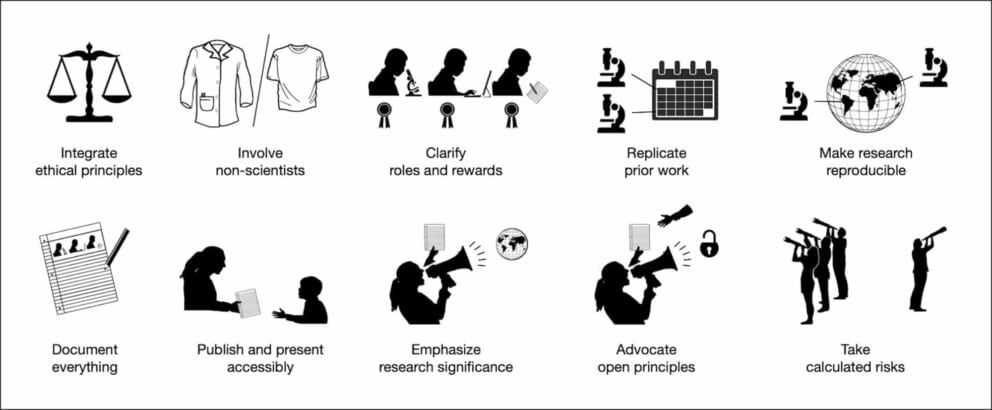
The ten simple rules we jointly defined during the workshop, while not exhaustive, offer guidance for conducting health research with human participants in an open, ethical and rigorous manner. They are challenging and may not be implemented all at once, but they are intended to speed up and improve the quality of human health research. Work that does not respect these rules is not necessarily of poor quality, especially if the reasons for breaking them are carefully considered and openly formulated. Although the responsibility for complying with these rules lies primarily with researchers, anyone involved in human health research, in whatever capacity, can apply them. The rules we propose are as follows
Rule 1: Integrate ethical principles
Rule 2: Involve non-scientists
Rule 3: Clarify roles and rewards
Rule 4: Reproduce previous work
Rule 5: Make research reproducible
Rule 6: Document everything
Rule 7: Publish and present in an accessible manner
Rule 8: Emphasize the importance of research
Rule 9: Defend the principles of openness
Rule 10: Take calculated risks
We hope that these simple rules will serve as a useful guide to best practice in open research in human health. More importantly, we hope that the wider community around human health research will use them as a starting point to address conventional scientific practices that are not being followed and, where these rules are not sufficient, share their own rules to improve the state of open, ethical and inclusive human health research. This is our call and challenge to all colleagues working in health and related fields: be the change you seek in science, and strive to make human health research a more humane, efficient and, above all, open enterprise.
See full article here.