How evolution and chance jointly define cellular aging and population longevity.
Two main, seemingly contradictory explanations are often used to describe the aging processes of living organisms:
- Aging as a stochastic process of damage accumulation and redundancy reduction; ;
- Aging as part of a life-cycle strategy refined by natural selection.
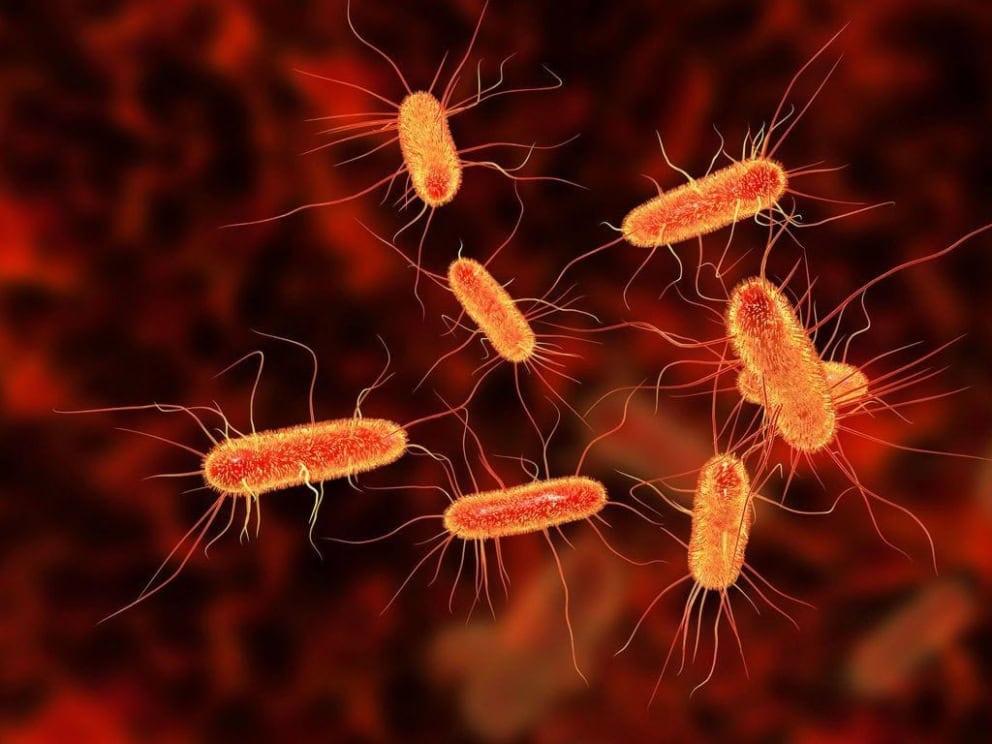
These two theoretical postulates make quantitative predictions about how aging increases the probability of death. To date, studies of the various aging processes in living beings have been carried out mainly on animal models, although the two theories mentioned above are not restricted to metazoans alone. However, using the Escherichia coli bacterium as a model organism to study the mechanisms of aging would offer a number of advantages:
- work on a simple organism with a well-known physiology and a relatively short lifespan;
- to carry out experiments on a clonal population and thus free themselves from genetic diversity;
- carry out experiments in a controlled, homogeneous environment, identical for all experiments;
- follow studies over the entire life cycle of the organisms studied.
- significantly increase the size of the cohorts monitored;
In an article published in Science Advances, lrs Yifan Yang, Ariel Lindner and colleagues (INSERM, CRI, University of Paris), describe the mortality dynamics in the elderly. E. coli under the prism of the two theories of aging, focusing on the dynamics of death probabilities. They show that the Gompertz law of exponential aging already observed in humans (and other animals) also applies to protozoa like the bacterium E. coli.
For this study, the interdisciplinary team developed a new approach lab-on-chip on a submicron scale for insulation and’observation of several thousand individual bacteria in real time (see graphs). Thus, by dissociating the aging rate from the age-independent components of longevity, the researchers demonstrate that increased cell maintenance through the general stress response pathway reduces the rate of ageing at the expense of cell growth.
For this study, the interdisciplinary team developed a novel submicron-scale lab-on-chip approach for the isolation and observation of several thousand individual bacteria in real time (see graphs). Thus, by dissociating the rate of aging from age-independent components of longevity, the researchers demonstrate that increasing cell maintenance via the general stress response pathway reduces the rate of aging at the expense of cell growth.
This compromise between aging and growth underpins the evolutionary adaptation of the aging rate to the bacterial lifestyle of feasting and famine, as well as to its environment.
(see chart).
This study opens the way to new possibilities for interdisciplinary research on ageing, using systems biology, evolutionary biology and population dynamics to extend the results observed to higher living organisms, thus paving the way for new advances in ageing research. understanding the fundamental mechanism behind Gompertz's universal law of aging.
This study was carried out within the framework of the Axa Chair. A systems approach to individual differences in longevity.
Graphic illustrations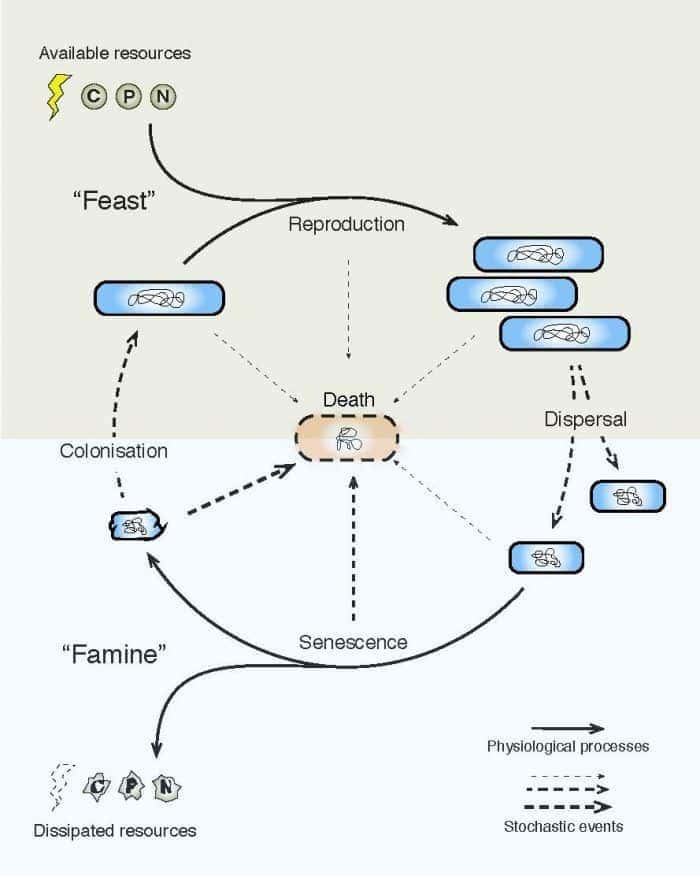
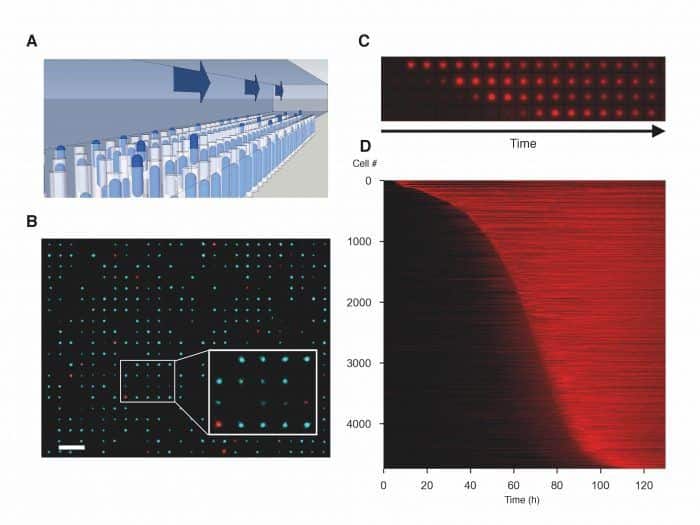
[Left] Bacterial life cycle in the “feast and famine” mode [Right] (A): Laboratory-on-chip cell network (blue bacteria kept in individual chambers under flow)
(B) Cellular networks - top view (green/red - live/dead cells); white scale bar = 10 microns
(C )Time series of four cells (D) E. Coli survival curve (time in hours). Video available on request
About CRI
The Centre de Recherches Interdisciplinaires (CRI) experiments with and promotes new ways of learning, teaching, doing research and mobilizing collective intelligence in the fields of life sciences, learning and digital technology to meet global challenges.
CRI fosters innovative pedagogy by placing students at the heart of their own learning through pedagogical research experiences in various programs that range from kindergarten to high school with Savanturiers - Ecole de la recherche, and from bachelor's to doctoral degrees and extend throughout life, within the University of Paris. At the heart of CRI's activities are the laboratories of the IIFR -Institut Innovant de Formation par la Recherche, which advise, design, prototype and produce tools for research projects and innovative teaching methods.
Its research collaboratory, affiliated with the University of Paris, aims to transcend the barriers between disciplines, science and society by facilitating the transition from closed scientific research to an open scientific model. Research Fellows pursue research projects aimed at addressing global health and education challenges, bridging the gap between basic research and social impact, with a focus on: the Open health (from data-rich research to the development of frugal software and hardware solutions), the Open synthetic and systems biology (from fundamental understanding of living systems to open biotechnology and pharmaceutical solutions), the’Open learning (from understanding learning to man-machine paradigms), the’Open AI (understanding and shaping the current digital transition in the context of learning, health and/or man-machine models) and open Phronesis (meeting today's ethical challenges)
The CRI community, with over 40 researchers, 350 students and 1000 alumni, is located in a self-contained building in the heart of Paris. It was founded by François Taddei and Ariel Lindner in 2005 to create an open environment where students, partners and researchers can collaborate to build a world where lifelong learning is at the heart of our society.
The Bettencourt Schueller Foundation has been a long-standing strategic partner since the creation of CRI. CRI is supported by a number of partners, including the Mairie de Paris, and receives grants from the Fondation Axa, the European Union, the Avenir investment program, the Agence Nationale de la Recherche and MSD Avenir.
Read more : http://cri-paris.org/
About INSERM
Inserm, Science for health
> Improving human health
Inserm is the only French public research organization entirely dedicated to human health. Under the dual supervision of the Ministry of Health and the Ministry of Research, Inserm has a budget of 957 million euros and brings together 15,000 researchers, engineers and technicians, with a common goal: to improve the health of all through the advancement of knowledge about living organisms and diseases, innovation in treatments, and public health research.
> Offer first-rate research capabilities
Inserm has over 350 research facilities throughout France and abroad. They are supported by 13 regional delegations for local management. Scientific leadership in the major fields of biomedical and health research is provided by Inserm's 9 thematic institutes.
> Producing excellence
Inserm is Europe's leading academic research organization in the biomedical field, with more than 13,000 publications per year, and ranks 2nd worldwide behind the National Institutes of Health (NIH) intra-mural.
Read more : www.inserm.fr
About the University of Paris
Created by the merger of the universities of Paris Descartes and Paris Diderot and the integration of the Institut Physique du Globe de Paris, the University of Paris covers all disciplines. Its educational offering is one of the most comprehensive and ambitious in France and internationally.
A «research-intensive» university, its objectives place it on a par with the most prestigious French and international establishments: top-level research in compliance with ethical and deontological rules, excellence in higher education, dynamic student life, support for innovation and transfer, building the European research and education area.
Read more : u-paris.fr
Press contacts
CRI .Victoria Maria Diez : victoria.diez@cri-paris.org
Tel. +33 188 328 389