Article written by François Taddei, first published in The Conversation.
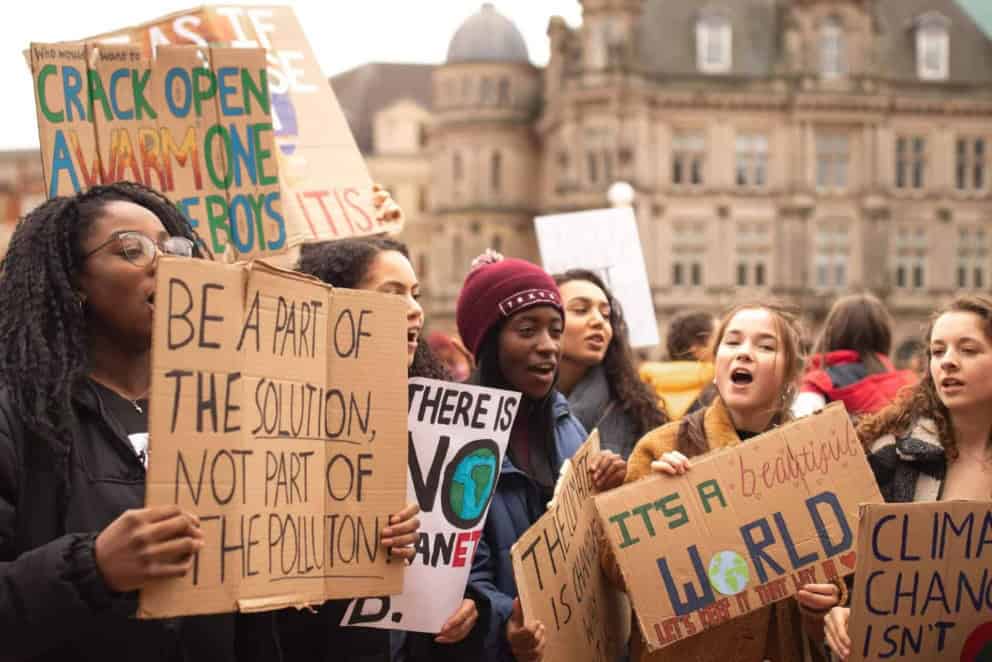
COP 26 ended with a 26e failure. Too few decisions, too late, once again. This year, it was young people, torn between anger and hope, who were heard from the most. For Greta Thunberg, spokeswoman for the «climate generation», this summit is just another stage show, a "show of hope". «A »festival of green washing from the countries of the North".».
More and more adults, teenagers and children around the world feel that governments are not doing enough to combat the scourges of climate change, threats to biodiversity, resistance to equality between men and women, persistent racial and sexual discrimination, and violence against the most vulnerable? But how can we ensure that the voices of young people are heard when they don't have the right to vote and we don't have a global democratic body?
Violence heightened by the pandemic
Need we remind you that young people face a bleak future? At the very start of the pandemic, in February 2020, Unicef, WHO and the magazine The Lancet published a report entitled «A future for the world's children», which stated that ’no country is adequately protecting children's health, their environment and their future«, not only because of climate problems, but also because of various addictions (junk food, screens, etc.), created by unscrupulous multinationals seeking to get young consumers hooked, and using advertising that increasingly manipulates them with artificial intelligence.
Digital networks: three barrier gestures to cultivate as a family https://t.co/biXVXHBwY2 pic.twitter.com/5jmexmmoQT
- LeSocial (@lesocialfr) December 28, 2020
According to Tedros Adhanom Ghebreyesus, Director-General of the World Health Organization (WHO), this report «shows that decision-makers around the world too often fail children and young people: they fail to protect their health, they fail to protect their rights, and they fail to protect their planet». The report concludes that we need to rethink global priorities 17 sustainable development goals (SDGs) in line with the new generations, and that we should evolve the rights of the child, which are celebrated on November 20, in line with the SDGs.
The pandemic has further exacerbated their plight: unequal access to health care, an increase in forced marriages, physical, psychological and sexual violence, dropping out of school, an upsurge in forced labor, and so on. As in previous crises, large numbers of girls will never be able to return to school, as they are increasingly assigned to domestic chores and become the victims of early and unwanted pregnancies.
And what about the revelations of the Sauvé report on the systemic nature of sexual crimes against children on the part of the Church? Or the sports federations that «have trained, twisted, insulted, humiliated, exploited, raped and threatened hundreds of teenage girls», as in Le Monde sociologist Caroline Ibos. Unfortunately, examples abound. It would be impossible to list them all.
Breaking the vicious circle
Should we give up? Absolutely not. But how can we take effective action? The task is immense, and awareness must be widespread. We need to better inform young people and their families of their rights, but also systematically train all professionals, especially those who interact with children and teenagers, to detect and report such violence as early as possible, while improving support for victims in terms of both their physical and psychological health.
Judicial follow-up and administrative sanctions must be stricter and better evaluated for perpetrators of child abuse. We also need to become collectively aware of the dramatic consequences of childhood trauma, especially if it is kept quiet, minimized, ignored or denied. Indeed, the major studies carried out on the consequences of violence suffered in childhood point to a loss of at least 20 years' life expectancy.
Over the past 25 years, the United States has developed an approach based on adverse childhood experiences (ACE) or «adverse childhood experiences». According to the Center for Disease Control and Prevention (CDC), the cost of illnesses resulting from childhood disorders runs into billions of dollars. In addition to a significant increase in school failure, cardiovascular disease in adulthood (times 3), diabetes (times 4), respiratory disease (times 3), suicide attempts (times 12) and depression (times 5), there is a high probability of transgenerational reproduction of abuse by those who suffered or witnessed it.
However, this is not inevitable, as the vicious circle of violence can be broken by a caring approach that identifies, takes charge and, by accompanying the child victim on his or her path to resilience, helps him or her to understand that the traumatic past experienced was not part of the norm. Helping victims therefore also means showing them what is acceptable and what is not, and protecting other potential victims.
Taking young people seriously
Caring for children is as much a legal obligation as an ethical one. In all socialization institutions, children learn to be in the world, to understand it and to become autonomous. However, these places remain largely unsuited to the needs of new generations. If young people are aware that the planet is being destroyed, their expectations are immense. We need to support them, and to do so, we need to build new apprenticeships with them.
As for young people of voting age, they are turning away from the ballot box. The political offer doesn't suit them. And yet, as we know and see, many are committed to defending the common good. The massive abstention of young people is therefore a trompe-l'oeil, as Tom Chevalier and Patricia Loncle explain in Sacrificing youth?. Indeed, they note, « Young people don't vote in elections because they have to, they vote when they feel the issue is important, and are more sensitive to cultural and societal issues than economic and social ones. The rest of the time, they invest in other forms of political and civic participation. So this is certainly not a sign of democratic devitalization. It remains to be seen how we can imagine a form of democracy for the future that makes room for these young people and their new spaces for political expression, so that they can have an effect on public action. »
Young people need to be taken seriously. Researchers like Alison Gopnik at Berkeley, have shown that from early childhood we demonstrate an astonishing capacity for innovation, experimentation and adaptation, with peaks of creativity as early as age 5. France is teeming with public schemes designed to introduce children to citizenship and, in principle, to give them a voice. But all too often, their deliberations go unheeded, even though they express the same expectations as adults: not to waste time in sham democracy.
New democratic mechanisms
Children's rights specialist Nicolás Brando notes that the arguments put forward against giving young people the right to vote have already been used for women, the poor and ethnic minorities: inability to formulate an informed choice due to lack of cognitive faculties; absence of sufficient social or economic experience to support a choice; too great a malleability of young minds in the face of manipulation; risk of unbalancing the democratic game. At what biological capacity or age does one become a citizen? At one time it was 21, but in some countries it's already 16. What if we were to give children the right to vote from birth, a right that could be enforced by their parents until they felt capable of voting on the issues that concern them?
In addition to the right to vote, deliberative bodies could be set up to enable young people to give their opinion on a regular basis on issues that concern them, and to be truly listened to, as advocated by the UN Declaration of the Rights of the Child and as the City of Paris has done with its its charter of children's rights written by young people - and used as the basis for new public policies.

It's not a question of giving children all the rights, but of ensuring that the rights they are given are indeed given, and of granting them new ones, through high-impact projects, new democratic mechanisms, and ways of taking into account their view of the world and their expertise, whatever their background, their level of education or the area in which they live. School is one of the essential places to do this. Young people have ideas for tomorrow's world, demands for today, and are eager to be heard. We too can learn from them, so that together, we can ensure that the future is synonymous with hope.
What if this generation was the first to become citizens of the planet? If the Greeks invented commitment to the service of the City, if the Enlightenment reinvented citizenship on a national scale, they denied the rights of women, migrants, slaves and young people. While women were the last to become citizens, the youngest are still not. In the digital age, it's time to reinvent the legacy of the Enlightenment, to make it more inclusive, more ecological and to do so on a global scale. How can we hope to deal democratically with global issues such as climate change without inventing a fractal democracy that works on all scales and gives a voice to the youngest?
François Taddéi's next book, «Et si nous? How can we meet the challenges of the 21st century together?e siècle» will be published by Calmann-Lévy in January 2022..
Read the article on The Conversation
 François Taddei