The device Bâtisseurs de Possibles®, adapted from Design for Change to the French school context, today federates a network of committed teachers, teaching resources and tools, and support (training, follow-up, etc.).
As registration for the program reopens for the 2024-2025 school year, teachers involved in the Bâtisseurs de Possibles adventure have agreed to talk about their experience(s) with this educational method.
Ramona Coupel Dulgheru has been teaching at the school for 15 years. Emilie Brandt, Ramona's school, in Levallois-Perret, is a so-called «new» school that advocates an active pedagogy in which students participate in their own learning. This year, Ramona not only carried out "Bâtisseurs de Possibles" projects in the classroom, but also introduced the method to parents in a co-education workshop. An adaptation of the Bâtisseurs approach that goes beyond the simple framework of the classroom or even the school.
Hello Ramona Coupel Dulgheru, thank you for agreeing to this interview. Could you start by introducing yourself and your school?
My name is Ramona Coupel Dulgheru, and I've been teaching at the Emilie Brandt school for 15 years. The school is private, secular and adheres to the philosophy of new schools - it's part of the’ANEN - Association Nationale d'Education Nouvelle. Visit new schools are derived from a pedagogical trend that aims to ensure that individuals actively participate in their own learning. Dewey (learning by doing - « learning by doing »), Freinet, Decroly,...
In concrete terms, this means that in this school we advocate a Montessorian-inspired pedagogy using the tools of positive discipline, discovery and experimentation, socialization and the development of critical thinking. I myself have been trained in the Montessorian teaching method and tools.« Montessori »when I started kindergarten.
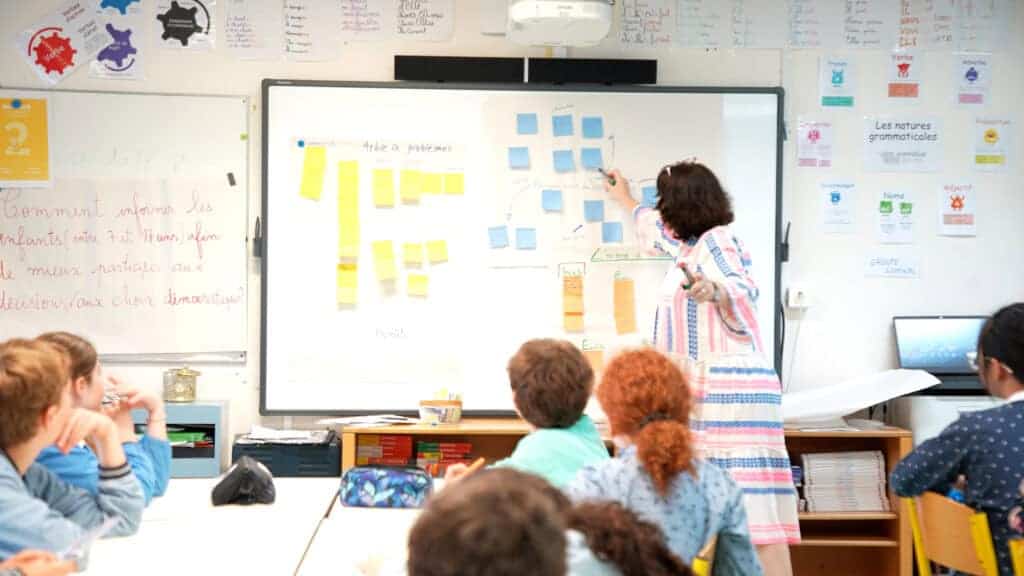
In addition, we are under contract with the French state, so we comply with national education curricula. But what sets us apart is our commitment to continuous innovation in our teaching methods. The Emilie Brandt school was among the first to adopt positive education methods; today, many schools are also training in this type of tool.
I taught kindergarten for 9 years, then moved on to first grade for about 7 years. For the past 2 years, I've been teaching CP 3 days a week and CM2 one day a week.
We can see perfectly how the Bâtisseurs de Possibles method can fit in with the approach advocated by new schools: a change in the teacher's posture, innovation through classroom projects, building on learners' centers of interest, etc. How long have you been involved in the program?
I discovered Bâtisseurs de Possibles about six years ago. When I started teaching first grade, I was looking for a new method to do something different with my class. That's when, at a trade fair, I met Katarina, who was part of the Bâtisseurs teaching team at the time. She invited me to take part in the network's working groups and meetings, and the rest came naturally.
I embarked on the year of containment [of Covid], in 2019. And I've been at it ever since!
You run Builder projects with both first and second graders. What differences and/or similarities do you observe between the levels in these projects?
With the CM2s, I can start as early as September and the group generally manages to make good progress throughout the year and even finish on time. With the CPs, I noticed from the very first year that investing a whole year in a project was more complicated. So I tried to run a project over 3 months, and I find that this is the format that works best for this level!
For both levels, I often have difficulty with the sharing phase - the fourth and final stage of the Builder's method. Time is often short, especially in June, which is a very busy period for teachers and schools in general. Last year, I found that the end-of-year get-together online between several groups - from different schools around the world - organized by the Bâtisseurs team, was a good way to take this sharing step.
I also had the chance to work with Martin Meissonnier - initiator of the Happiness at school - 2 years ago, a video with my CM2 class about the Bâtisseurs method. It was a wonderful sharing of their work!
Last year, we discovered the CM2 project: « Troc Monsieur et Troc Madame: everyone trades a little bit! »to combat overconsumption and pollution in the textile industry and on the oceans (in response to the Sustainable development goals 12 and 14). The CM2s organized a clothes and games barter sale, with proceeds going to the Sea Cleaners association and its ocean-cleaning boat, the «Manta». Will the project continue?
Indeed, the «department» concerned within the school has kept the initiative going.
A ministry within the school?
At the Émilie Brandt school, we have a government of students and ministries. The Ministry of Ecology has kept the idea of bartering and organizes it twice a year: before the vacation break and at the school fair.
This student government was created just under ten years ago. It had previously begun with presidential elections, held every five years to reflect the political reality outside the school. There were several candidates who campaigned; one of them was elected as the students« representative. This was already a way of working on students» civic education. About eight years ago, the president-elect put forward the idea of creating ministries, "just like in real life". The men and women who created those first ministries are now in college, in ninth grade!
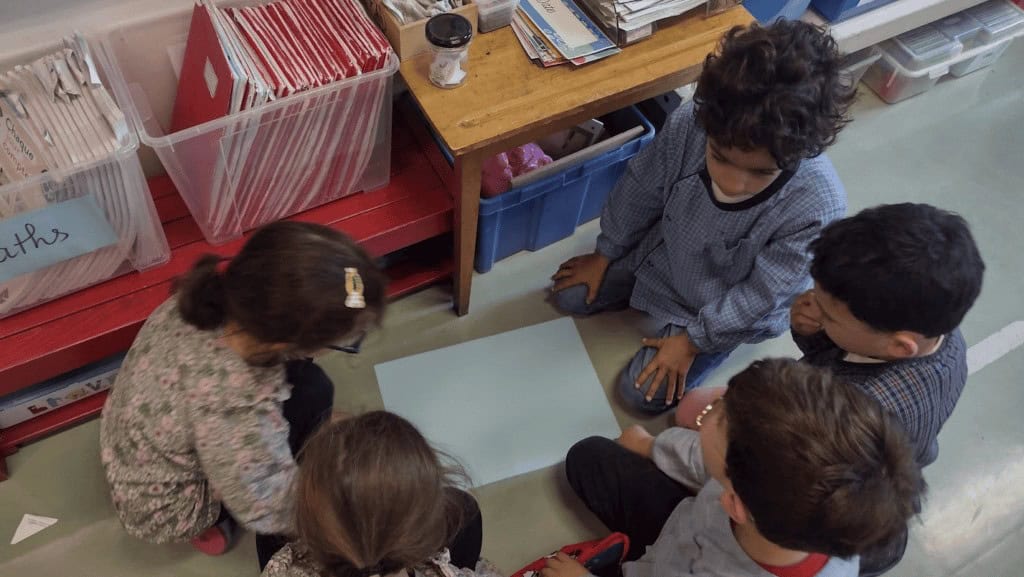
We have ministries for Solidarity, Ecology, Organization, School Life and Culture. All schoolchildren, from CP onwards, can take part in these ministries. However, kindergarten students are also heard by the Ministry of School Life, whose mission is to improve the daily lives of all students within the school, based on requests made by students, including those in kindergarten.
Each department has a minister, a collaborator and an honorary member. In general, ministers are in CM levels, collaborators in CE1 and CE2 levels, and honorary members in CP. This allows for a smooth handover from year to year when ministers go off to college, for example.
These are great responsibilities! We can see that students are involved and committed to school life. The Bâtisseurs de Possibles projects take on a whole new dimension in this environment. What projects are you working on this year? It seems to me that you yourself have adapted the Bâtisseurs methodology for a rather special case?
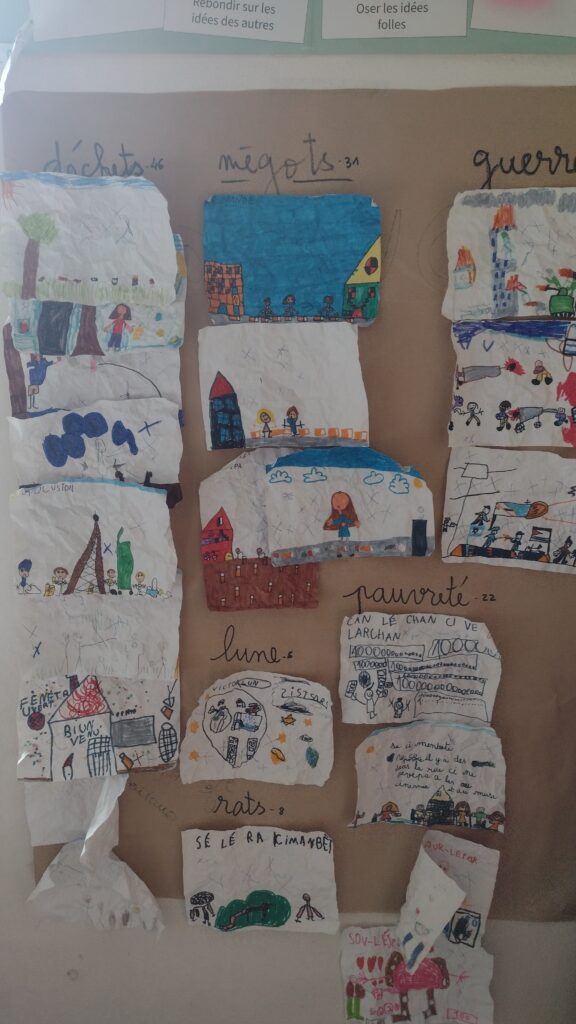
This year, the CPs have decided to tackle the issue of overconsumption, with a particular focus on reducing toy consumption. The CM2s are working on poverty. They are currently putting together an exhibition to raise funds to help people living on the streets.
At the same time, I had the idea of applying the method to a case of co-education, with the pupils' parents.
What is «the« co-education»?
The co-education, is how parents and teachers work together to support children in their schooling and learning. We are co-responsible for our children's educational and pedagogical development; although these roles are quite separate, they can - and must - complement each other.
With the Covid, the confinement and all that this implied for learning and the relationship with institutions, I felt a loss of habit in the parent/teacher relationship. I had the impression that parents were asking for more pedagogical sharing. I also had the feeling that we were trying - teachers and parents - to (re)form a collective to serve children's learning.
How did you plan to carry out this project using the Bâtisseurs method?
In my view, it's precisely the opposite - individualism and service-oriented thinking - that is promoted by the Bâtisseurs de Possibles method. Students work together in groups to identify and solve problems. Through projects, they become aware that they have the power to act, that together they are stronger in imagining solutions to their achievements.
Professionally, I was disturbed by the discrepancy I observed with parents. I wanted to work with volunteer parents to identify what was «sticking» and move forward. On the one hand, this would enable us to co-construct the pedagogical framework together, and on the other, it would allow parents to experiment with the method that their own children apply during the year.
We launched the project with the parents of my first-grade class. My two classmates from CM2 and CP were interested and helped me with the initiative.
So last March, we organized a co-education workshop based on the Bâtisseurs de Possibles approach, with parents. We had to adapt the method, with the help of Philippa-Jane Blein from the Bâtisseurs de Possibles team, for a short period of time. The first session was devoted to defining and selecting the issues, and the second to finding workable solutions.
What issues emerged from this consultation? What solutions have you chosen to implement?
One of the issues we explored was «How can we better support children at school by encouraging the sharing of teaching tools? Our starting point was the observation that parents were a little »lost« when faced with tools shared by teachers. Or »How can we involve children in their school careers?.
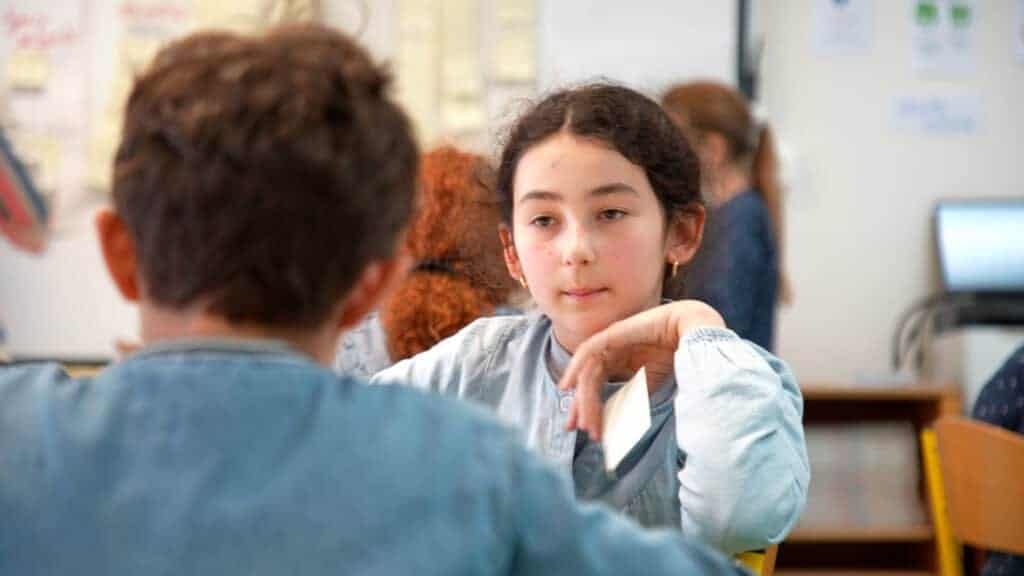
Some solutions were not adopted because they were too difficult for teachers and/or parents to implement. But we ended up identifying workable solutions, with commitments on both sides. For example, I translated the competencies - according to the time of year - into a table to make them easier for parents to understand. For their part, they undertook to consult this chart with their children, precisely to better engage them in their school career and give meaning to their learning.
I'd like to repeat this workshop next year, but earlier this time, to get the dialogue and collaboration going right from the start of the school year. I'm also thinking about tackling more concrete learning issues in short, dedicated workshops. For example: how can I get my child to read at home? These are issues that are common to several families and that come up in individual interviews, and which can be partly dealt with in group sessions.
I understood a lot thanks to this workshop. Even though I won't be dealing with the same parents, I was able to question a number of things. I'm delighted with the parents' participation in the workshops - it's a good first step!
A fine program in prospect, which will probably take time to put in place. But you're not stopping there. It seems to me that you've got one last Bâtisseurs de Possibles project this year, and yet another adaptation of the method?
The management at my school values and encourages innovative initiatives in the classroom, and I'm very lucky to be able to do that. In particular, it gave me the opportunity to imagine, for the end of the year, a creathon over two half-days, with my CM2 colleague Sophie Macquaire (whom I thank!).
Over the course of these two days, 23 CM2 pupils will discuss children's rights, what this means to them, what challenges them, and even choose a particular right on which they would like to take action, at their own level. They will follow every step of the design thinking as defined by Bâtisseurs de Possibles :
- step 0: setting the framework for the classroom climate, changing posture
- step 1: identify an issue that affects them
- step 2: imagine all possible solutions and select the most appropriate one
- step 3: prototyping the solution
- step 4: share the solution with others and take stock.
We hope to tell you more soon!
Editor's note: at the time of this interview, the workshop had not taken place. Since then, we know that the students have chosen to work on children's right to vote, and more specifically: how can we be better trained to better participate in democratic choice?
Among the solutions put forward, the students mentioned: more civics classes, clubs to discuss and debate civic, political and social issues, and posters to explain why they want to take part in the country's democratic life.
GET YOUR CLASS INVOLVED IN A "BUILDERS OF POSSIBILITIES" PROJECT
«How will children change the world?
- That's right! With what powers?
- Only wizards have power.
- And witches.
- Yes, we do! We have the power of intelligence!»
Kindergarten discussion at Notre-Dame school
Would you like to set up impact projects in your classroom? Your students are asking a lot of questions: how can we work better in our classroom? Why do people live on the streets? Would you like to empower your students to take action on the world around them?
Join the Builders of Possibilities program for the 2024- 2025 school year!
The Bâtisseurs de Possibles® system, adapted from Design for Change to the French school context, today federates a network of committed teachers, teaching resources and tools, and support (training, follow-up, etc.).
Whether you want to discover the process step by step or launch a project with your students, the Bâtisseurs de Possibles network is there to help you!
Beyond the benefits for student skills such as cooperation, empathy, speaking up and creativity, the fact of making students actors in their own lives is a key factor in the success of the project. reduces eco-anxiety.
Read more testimonials:
Anne-Lore Greter-Traoré - CM1 class
Béatrice Poignonec - CE2 class
Virtual meeting between participating classes 2024
This publication is part of the UNESCO Chair in Learning Sciences«, established between UNESCO and Université Paris Cité, in partnership with the Learning Planet Institute. The ideas and opinions expressed in this publication are those of the authors. They do not necessarily represent the views of UNESCO and do not commit the Organization.