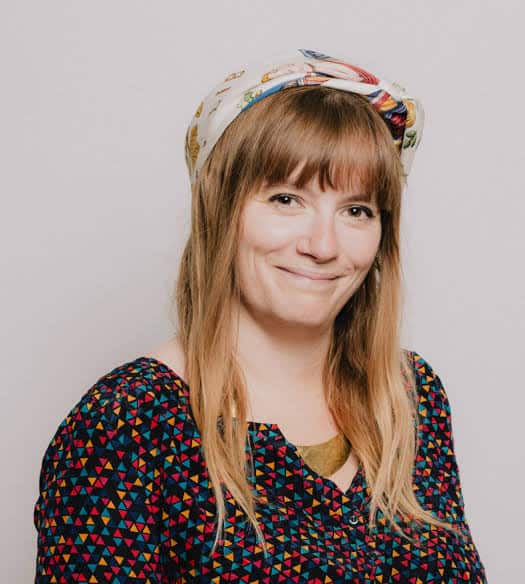
Aude Bernheim is a microbiology and genetics researcher and head of the Molecular Diversity of Microbes team (Molecular Diversity of Microbes Lab) within the SEED «Evolution and Engineering of Dynamic Systems» unit (U 1284) directed by Ariel Lindner at the Learning Planet Institute (Université Paris Cité, Inserm). A look back at her career and work as a researcher, and her commitment to open science for all.
When I was 20, I said that the only job I didn't want to do was to be a researcher...
We all change our minds!
Bacterial immune systems in the spotlight
From his studies at AgroParisTech, to his thesis at the Institut Pasteur, via the Master AIRE - Life Sciences AIV (Université Paris Cité/Learning Planet Institute - at the time CRI), followed by a post-doctorate at the Weizmann Institute of Sciences, Aude Bernheim has built her own career path.
There's no need to follow a straight path to become a researcher, today.
Determined and passionate about microbiology and its field of possibilities and advances (bioinformatics, genomics), Aude Bernheim is currently working on bacterial immunity, i.e. the way in which bacteria, just like humans or plants, defend themselves against their viruses, phages. To find out more: see “What is bacterial immunity?”MDM Lab video.
We are in the process of understanding that all these systems found in bacteria also exist in other organisms such as plants and humans. And by using our knowledge of bacteria, we'll be able to predict new antiviral genes. And that would be extraordinary!
This work is carried out by the interdisciplinary research team she - created and - has been leading since 2020, the Molecular Diversity of Microbes Lab (MDM Lab). In this team, researchers work as a collective, and interdisciplinarity plays a central role. The result is an “intellectual ferment” that sometimes goes off the beaten track, and - at least to some extent - keeps an open eye on current research. Together, the MDM Lab team seeks to answer major questions in the field of bacterial immune system diversity:
- Describe, document and understand how such a diversity of systems emerges (in the last 6 months, the number of known systems has doubled!).
- Understanding the role of these systems in nature
A work that Aude Bernheim herself explained perfectly in her lecture at the Collège de France on December 13:
A talk that reflects his commitment to and work in the sciences: accessible to all, passionate and already looking ahead to the work to come.
Interdisciplinarity and inclusiveness at the heart of his research practice
As a Master's student in AIRE - Life Science AIV at the Learning Planet Institute (CRI - Centre de Recherches Interdisciplinaires - at the time), Aude Bernheim approached research and laboratory methods from an original angle: interdisciplinarity.
This meant learning about different disciplines and methods, but also collaborating in a wide-ranging way (...) we were confronted with the human sciences, design and art, which inevitably led us to develop projects at the interface between science and society..
In particular, she became aware of “scientific production as a non-objective social construct”She is committed to shedding light on the tendency to exclude some people from science in favor of others. Since then, she has been questioning, raising awareness and striving to practice inclusive, stereotype-free science.
In March 2013, she and Flora Vincent (another former CRI student) - now head of a research team (the European Molecular Biology Laboratory), after completing her post-doctorate in marine microbiology at the Weizmann Institute of Sciences - set up the association WAX Science (What About Xperiencing Science), which aims to promote science and the scientific spirit among young people, gender equality and gender diversity in science to make it more accessible, and to raise awareness of stereotypes in the scientific professions. A little later, in 2019, and still with Flora Vincent, she co-wrote “Artificial intelligence, not without them!”.
How can we make science more participatory and inclusive? I've been thinking about this for 10 years. There's no miracle solution. But it does mean opening the laboratory doors. It means asking citizens to do things they can help us with. It also means changing the scientific world and its organizations to allow everyone to be there, and not just a reproduction of the same people over and over again.
Going further with citizen science
Aude Bernheim's commitment - and that of her team - to opening up the world of science was recently illustrated by one of the MDM Lab's projects, carried out with Vincent Libis - the project's scientific manager and a researcher in research unit 1284 - and Helena Shomar - co-responsible for participatory science on the project with Aude Bernheim and a researcher in research unit 1284 : Science in spades (read our article on the here). In addition to blending bioinformatics and experimental research methods, the research team called on participatory and citizen sciences to seek out a greater diversity of bacterial molecules.
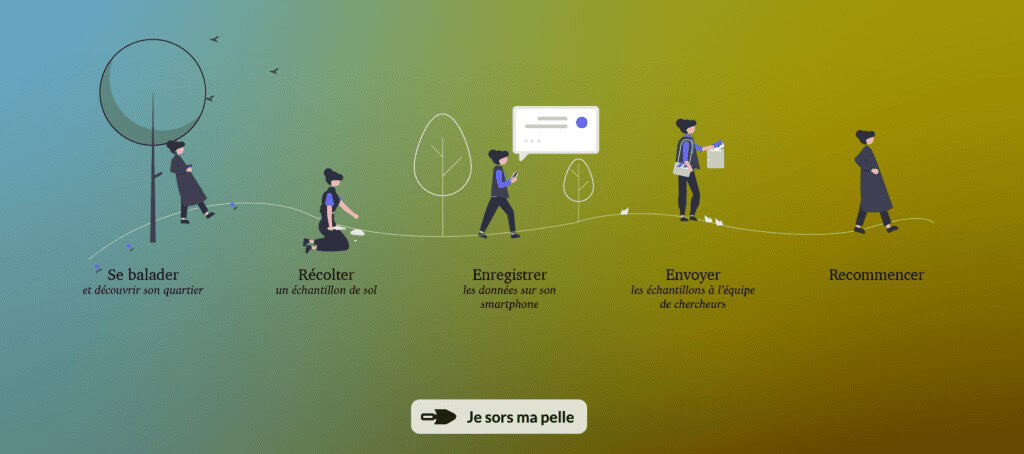
During the summer of 2022, every citizen was invited to take part in the project and to collect and send soil samples throughout France (in mainland France - France's overseas territories - France's overseas territories - France's overseas territories). view map) to identify new molecules from soil bacteria.
The samples received are currently being processed in the laboratory to isolate the various bacteria and perhaps discover new chemical defense systems! Ultimately, the aim is to discover new drugs... To be continued.
By combining her passion for her field of research with her desire to make science more participatory and inclusive - which she defines as inseparable - Aude Bernheim is shaking up the world of research. Last June, the Collège de France awarded her the Awards for young researchers a distinction that honours both the excellence of his research work and his commitment!
Learn more
Aude Bernheim Aude Bernheim is a researcher in microbiology and genetics, and head of the «Molecular Diversity of Microbes» team within Inserm's «Evolution and Engineering of Dynamic Systems» unit, headed by Ariel Lindner at the Learning Planet Institute (Université Paris Cité, Inserm).
Portrait by the Collège de France.
Molecular Diversity of Microbes Lab A team of researchers who put interdisciplinarity at the heart of their research, currently focused on bacteria, their diversity and phages (bacterial viruses).
Collège de France The Collège de France is an institution for fundamental research in all fields of knowledge, and a place for disseminating «knowledge in the making», open to all. Lectures, seminars and colloquia are recorded and made available to the public on the Collège de France website.
Université Paris Cité Université Paris Cité : An intensive, multi-disciplinary research university with the «Initiative d'Excellence» label, Université Paris Cité is at the top international level thanks to its research, the diversity of its training courses, its support for innovation, and its active participation in the construction of the European research and training area. Université Paris Cité has 63,000 students, 7,500 professors and researchers, 21 doctoral schools and 119 research units.
Inserm Founded in 1964, Inserm is a public scientific and technological establishment under the dual authority of the Ministry of Health and the Ministry of Research. Inserm is the only French public research organization entirely dedicated to human health. Its aim: to improve the health of all through the advancement of knowledge about living organisms and diseases, and through innovation, thanks to our 300 research units and 150,000 employees.
Inserm values exchanges between researchers, patient associations, healthcare professionals, support groups and civil society in general. Reinforcing the Institute's commitment to participatory research is an integral part of its strategic plan.
Flora Vincent Flora Vincent now heads a research team (the European Molecular Biology Laboratory), after completing his post-doctorate in marine microbiology at the Weizmann Institute of Sciences. Read our article published in 2021.
- Artificial intelligence, not without them!, Aude Bernheim and Flora Vincent (Editions Belin): https://www.belin-editeur.com/lintelligence-artificielle-pas-sans-elles
- Association WAX Science, created in 2013 by Aude Bernheim and Flora Vincent : https://www.wax-science.fr/wax-quest-ce-que-cest/