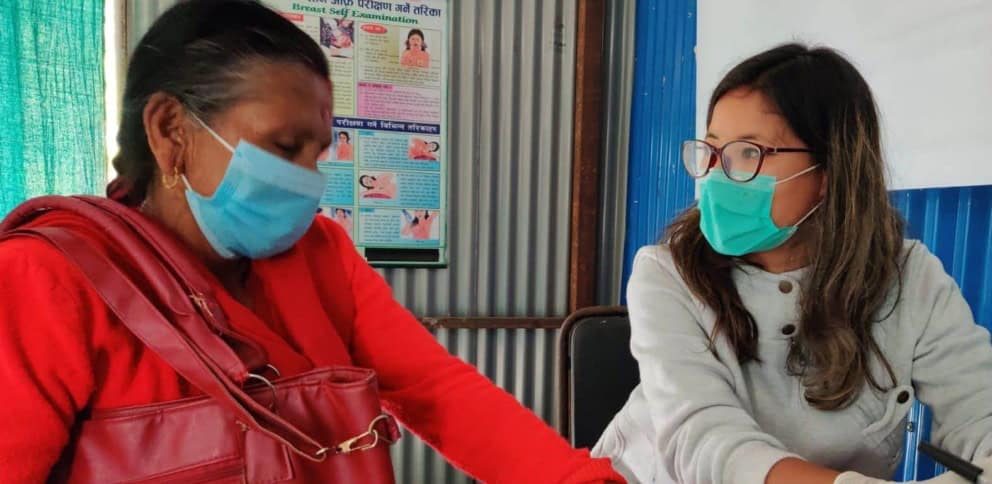
In Nepal, four women are diagnosed with breast cancer every minute, and one dies from it, making it the most common cancer among women worldwide and the second most common cancer overall.
Aware of this situation, Sweekrity Kanodia, doctoral student at the Learning Planet Institute (formerly CRI), came up with the idea of creating the mobile application BreMo(BreastHealth in Nepal Monitoring& Awareness) to help prevent and diagnose breast cancer in Nepal.
All research and development of the application was based on open source. In addition to its commitment to accessibility for all, Sweetkrity works directly in the field of prevention, raising women's awareness of the use of BreMo.
️ Interview with this brilliant student full of altruistic ambition.
*This interview was conducted in 2021 - all references to “CRI” refer to what is now the 'Institut Planète Apprentissage”.
-------------------------------------------------------
Hello Sweekrity,
Can you introduce yourself?
I'm Sweekrity Kanodia, doctoral student at CRI Paris. I was born and raised in a small village in Nepal, near the Indian border. Growing up, I was very intrigued by biotechnology and the vastness of this field. As I delved deeper and deeper into this sea, I realized its potential to improve people's lives. Having experienced the difficulty of obtaining medical care (I was often sick as a child) and observed the poverty all around me, I wanted to develop frugal medical technologies. And so my journey began.
Can you tell us more about the project? How did it come about?
My project aims to improve breast health in Nepal using open and portable digital innovations. The 2 aspects of the project are as follows
- An open source application to educate women about breast health and breast cancer: it's a platform whose source code is easily accessible and can be modified or enhanced by anyone.
- A portable, open-source remote monitoring system for monthly breast surveillance
Can you explain what #Open-source is and why it was so important for your project?
“Open source” means accessible to all, without individual rights. I'm in favor of open source or open science because all innovations and improvements in science and technology belong to everyone. Having rights and a monopoly on these innovations makes them less accessible and less affordable. If healthcare innovations become costly, they will not be useful to the half of the world's population living in poverty, which fails to achieve the goal of healthcare innovation and reform.
What role did CRI play in the process of building your project?
CRI has been with me from the start of this project. What's more, as CRI is a research laboratory, I was lucky enough to be supervised and supported by the Dr Jean Christophe Thalabard - An experienced professor emeritus, the Dr Kevin Lhoste - MakerLab project manager, and the Dr Bastian Greshake Tzovaras - Research Director and Long Term Fellow at CRI.
They also helped me get in touch with experts in the field, such as Dr Fabien Reyal - PhD in Translational Research, to develop this project and apply for the FIRE PhD program. The Dr. Ariel Lindner, co-founder and research director of CRI, and the Dr Amodsen Chotia , CRI Labs' Scientific Director, have also been a great source of motivation and support throughout the project. CRI's MakerLab and GameLab are still helping me to develop the monitoring device and application respectively.
What are the next steps in the development of your project, your application...?
The next step is to work with app developers and make BreMo a reality. Once the first version of the app is ready, I want to take it into the field. I'll be training women volunteers in Nepal to use BreMo and, through them, teaching BreMo to the community. I'll also conduct a survey using a questionnaire before the training and six months afterwards, to understand the evolution of knowledge due to BreMo. This will help me improve the application for the target population. I'd also like to extend it to other developing countries.
What are your plans for the future?
During my PhD, I would like to create a social enterprise focused on breast health in developing countries. This organization will support women in education and cancer treatment. BreMo will form the basis of this organization. At the same time, I'd like to pursue UX/UI design, a new interest I found while designing BreMo.
Note:
This interview was conducted in 2021. Since last year, Sweekrity Kanodia has conducted a study to understand current and existing breast health apps, their shortcomings and benefits. It is currently working on integrating this feedback into the new version due to be released soon.
At the same time, she is studying the development of frugal synthetic breasts to inform women about the different types of lumps, cancerous or benign.
*CRI is now the’Planet Learning Institute