While the EU-funded Crowd4SDG project launches its third call for projects The public's commitment to science for a sustainable future is growing all the time. For several years now, the Learning Planet Institute has been mobilizing collective intelligence through European citizen science projects, and affirming its commitment to open, participatory science.
In recent years, citizen science communities and projects have been springing up all over the world. Citizens monitor pollution, collect data by taking millions of photos of flora and fauna, or use telescopes to help astronomers detect objects in space... Citizen science enables everyone to take part in the research process and learn more about science. Many projects require little or no prior experience and minimal equipment, so participants come from all walks of life. By relying on simple protocols, citizen science approaches are increasingly effective and relevant sources of data for increasing knowledge in fields such as biodiversity, astronomy or medical health.
At the Learning Planet Institute, we are convinced that citizens have a major role to play in meeting the challenges of a sustainable future. In order to act on this conviction, we have participated in and led numerous projects related to citizen science. After a successful European project on citizen science called Citizen Cyberlab (2012-2015), led by our team at Paris Descartes University with a total of 7 partners and supported locally by the CRI (now Learning Planet Institute), three major European projects have been and are being led at the Institute:
Doing It Together Science (DITOs) (2016-2019) whose aim was to empower and engage citizens and policymakers in open scientific research and innovation.
Since 2020, the Institute has also been one of the six partners of the interdisciplinary consortium Crowd4SDG, which promotes the development of citizen science projects focused on climate action. This ongoing project has received funding from the European Union's Horizon 2020 research and innovation program.
Thanks to the European Citizen Science (ECS), which also received funding from the European Commission this year, the Learning Planet Institute will continue its commitment to mobilizing citizens in open science. The project focuses on supporting, expanding and strengthening the European citizen science community.
The Doing it Together Science project, promoting citizen science and DIY science across Europe
From 2016 to May 2019, the Doing It Together Science (DITOs ) has organized a number of innovative events across Europe for promote awareness of citizen science and do-it-yourself science. A whole range of activities were organized, including interactive and travelling exhibitions, debates, round tables, seminars, film evenings and DIY workshops. All activities focused on two themes: biodesign (the use of living organisms such as bacteria or plants in the design of products or works of art) and environmental sustainability.
As part of Doing It Together Science, a number of universities and research institutes have collaborated with scientific galleries, museums and art institutions in order to involve as many people as possible. No experience or technical skills were required to participate. All participants needed was the enthusiasm to explore and research. The DITOs enabled people from all walks of life to contribute to scientific research, whether by taking part in meetings, carrying out DIY experiments or using a crowdsourcing application. The aim was to move away from a traditional model in which scientific research is mainly conducted by institutions, to one based on active public participation.
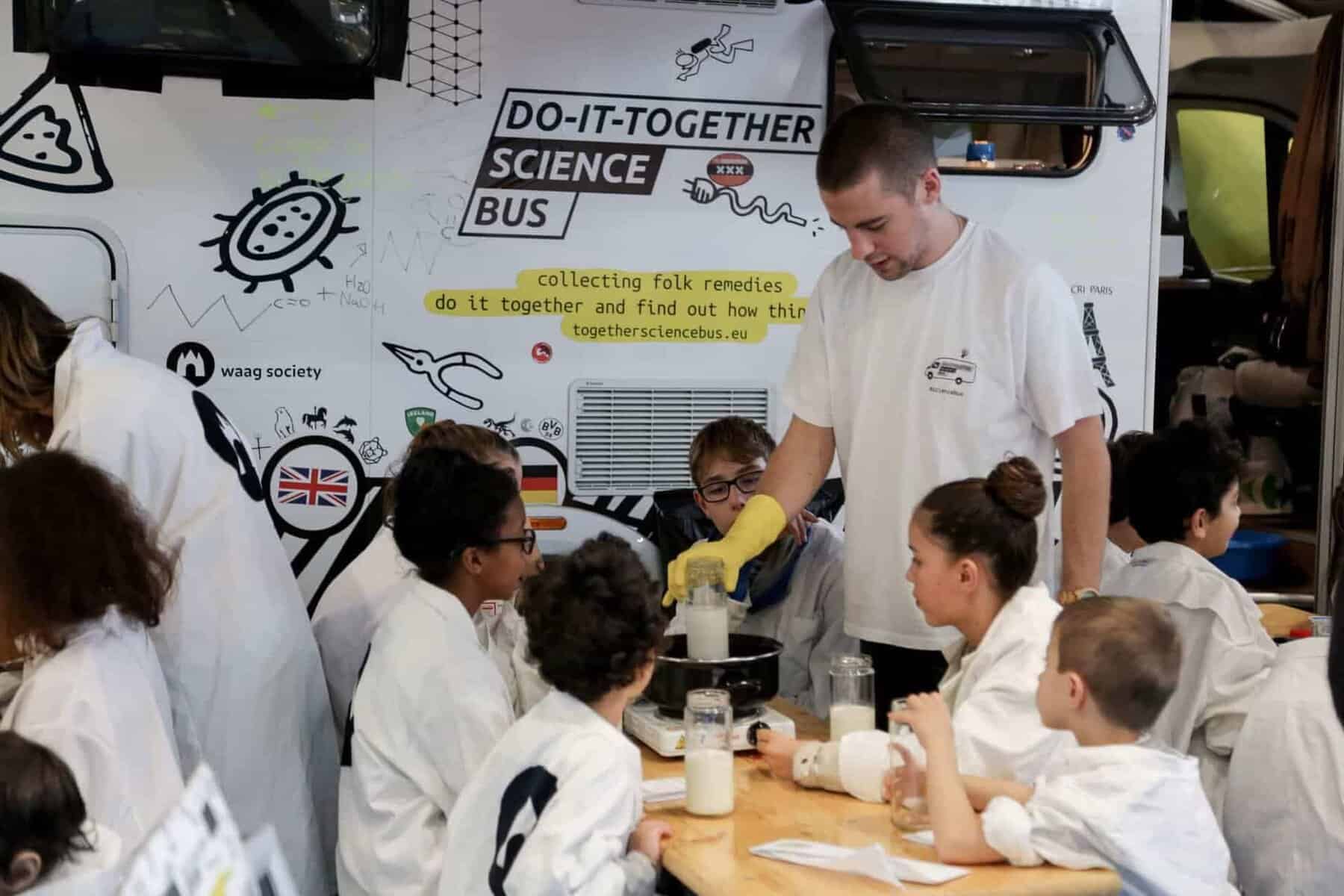
As part of this European project, the CRI (Centre de Recherche et d'Interdisciplinarité), now the Learning Planet Institute, has organized some 100 events. These included debates, seminars, biodesign workshops, a MOOC on synthetic biology, and bioart masterclasses. In secondary schools, the workshop introduced students to the world of citizen science, digital fabrication and genetics. The project included a science bus that toured Europe for three months, stopping at 17 locations and encouraging do-it-yourself science activities, such as making your own yoghurt, sun cream or pH meter, or testing air quality.
With DITO, European partners have shown that citizen science is an accessible and fun way to explore the world around us. L ‘he aim was to empower and involve citizens and political decision-makers in open scientific research and innovation.. Eleven partners were involved: a pan-European network(European Citizen Science Association), companies(Tekiu and eutema), universities(UCL, Paris Descartes University; University of Geneva), science galleries, museums and arts organizations(Kapelica Gallery / Kersnikova; Medialab-Prado; Royal Belgian Institute of Natural Sciences) and NGOs(Meritum Association; Waag Society). In three years, the project has organized over 860 events and reached more than 500,000 people across Europe.
The Crowd4SDG project, using citizen science to tackle the SDGs
Launched in May 2020, the interdisciplinary consortium Crowd4SDG(University of Geneva, CERN, CPISC, Politecnico Milano, UNITAR, Université Paris Cité and their associated research laboratories, including the Learning Planet Institute) promotes the development of citizen science projects aimed at achieving the Sustainable Development Goals (SDGS). Adopted by all UN member states in 2015, the Sustainable Development Goals are 17 targets aimed at improving health and education, reducing inequality and tackling climate change. The Crowd4SDG project focuses on goal 13: climate action. The aim is to explore new ways of applying citizen science to the issue of monitoring the impacts of extreme weather events and building community resilience to climate-related disasters.
The project offers three one-year cycles following the GEAR methodology: Gather, Evaluate, Accelerate and Refine. In addition to climate change (SDG 13), each GEAR cycle explores other SDGs: during the first GEAR cycle, launched in 2020, participants worked on projects addressing the following issues water issues (SDG 11), such as droughts, access to drinking water and floods. The second GEAR cycle, launched in autumn 2021, has focused on the climate resilience and gender (MDG 5). Projects had to address specific challenges, such as measuring the differential impacts of disasters on women and men, or assessing women's vulnerability to the effects of climate change on natural resources. For the third and final GEAR cycle, the current call for projects invites participants to address the following issues climate justice issues (ODD 16).
GEAR methodology
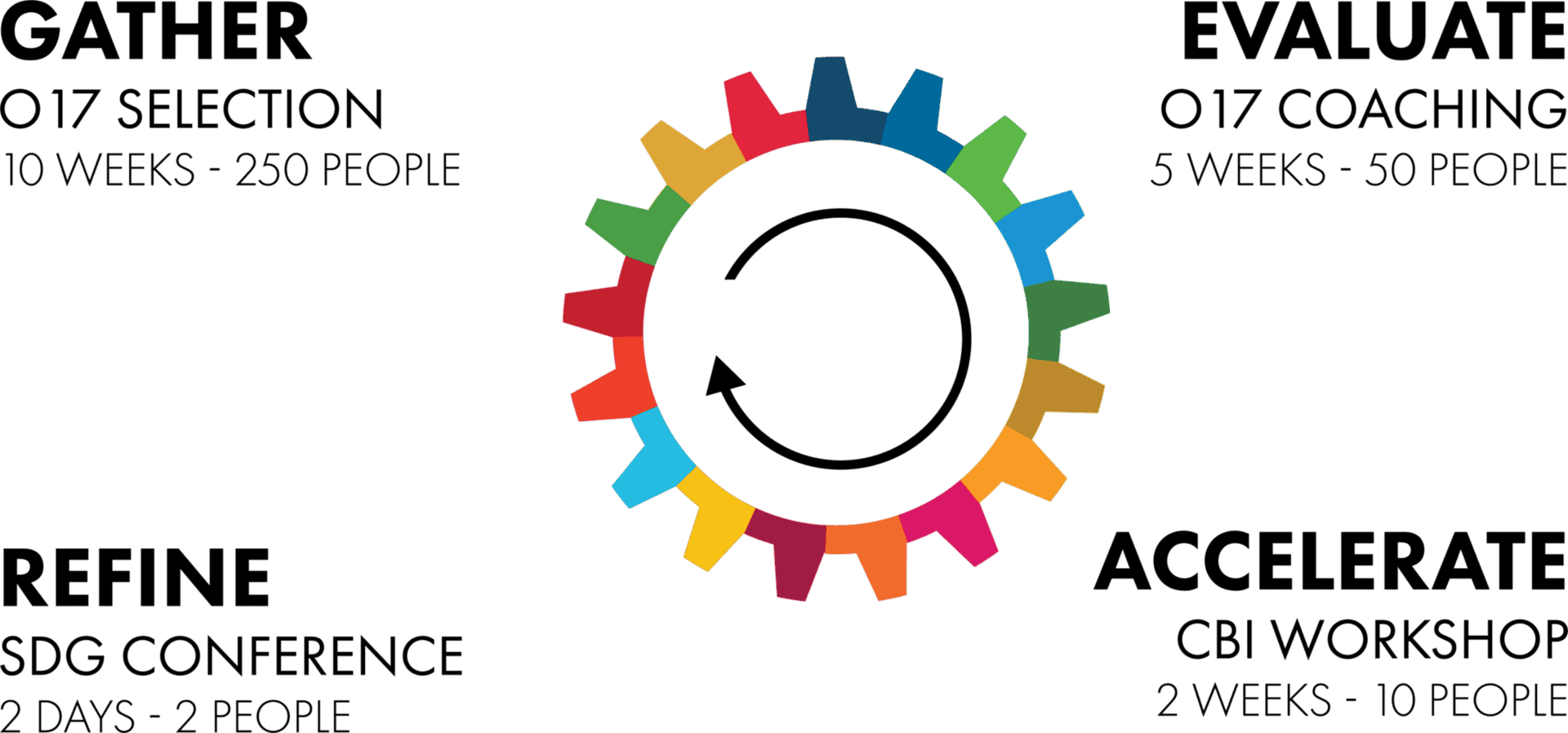
In the first phase (GATHER), a call for projects is launched via the Open 17 Challenge. The challenge is to develop a project that addresses the SDGs using crowdsourcing: information gathered by a large number of citizens. A group of participants is then selected by a committee on the basis of objective criteria: novelty, relevance and feasibility.
The teams - 14 in 2021 - are then selected to follow the second phase (EVALUATE): they take part in the 5-week online coaching program, during which teams are mentored by experts from the UN and top European research labs, to improve their presentation skills and learn how to use crowdsourcing tools relevant to data collection and classification, decision-making and social media analysis.
The most promising projects were then accelerated during a challenge-based innovation workshop (third ACCELERATE phase). During this workshop, teams learn how to build a working prototype for their project and connect with communities and social innovation experts who can help them launch and sustain the project.
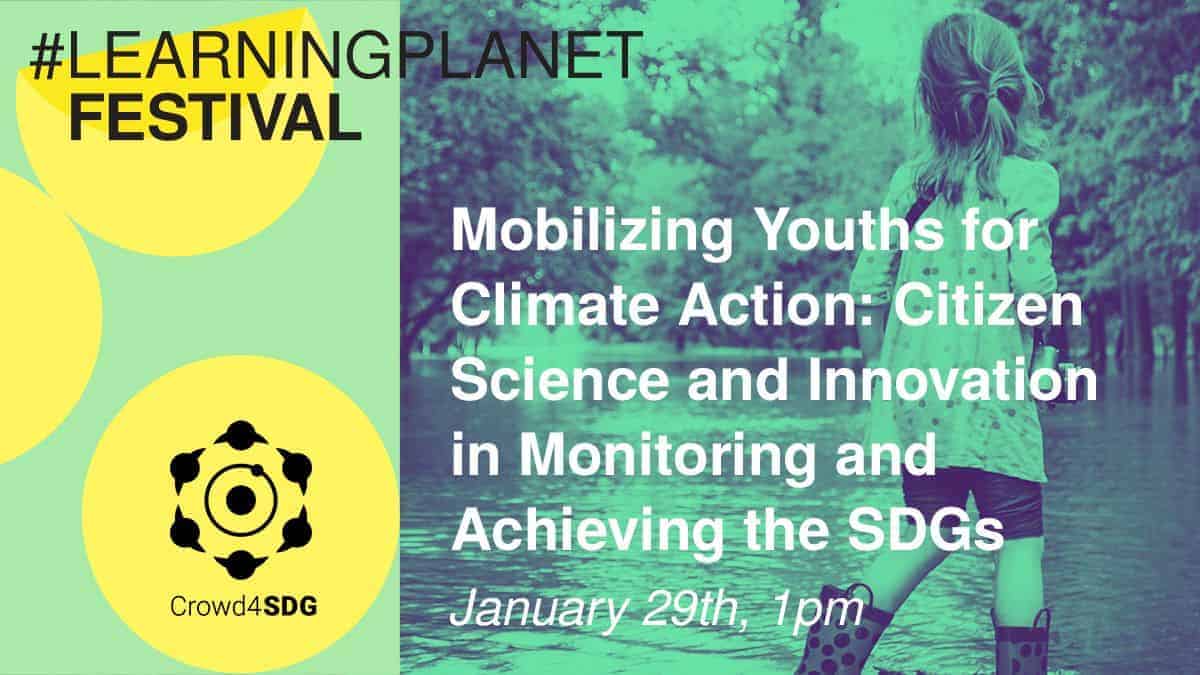
In the final phase (REFINE), the top two teams are invited to present their projects to potential UN and NGO partner organizations and impact investors at the Geneva Trialogue event in Geneva, Switzerland (March 2022), in order to integrate the wider ecosystem and gain legitimacy. For the second GEAR cycle, the’Université Paris Cité - Learning Planet Institute supported participants in the REFINE phase. Once the two teams had been selected, the Institute helped them gain visibility, while assisting with technical implementation. In January 2022, the student teams selected as part of the Crowd4SDG program were invited to thefestival #LearningPlanet and share their work with over 20,000 participants at this global event focused on exploring how young people can learn to become innovators for the SDGs. A specific workshop: “Mobilizing young people for climate action: Citizen Science and Innovation in Monitoring and Achieving the SDGs”presented the progress of the Crowd4SDG project.
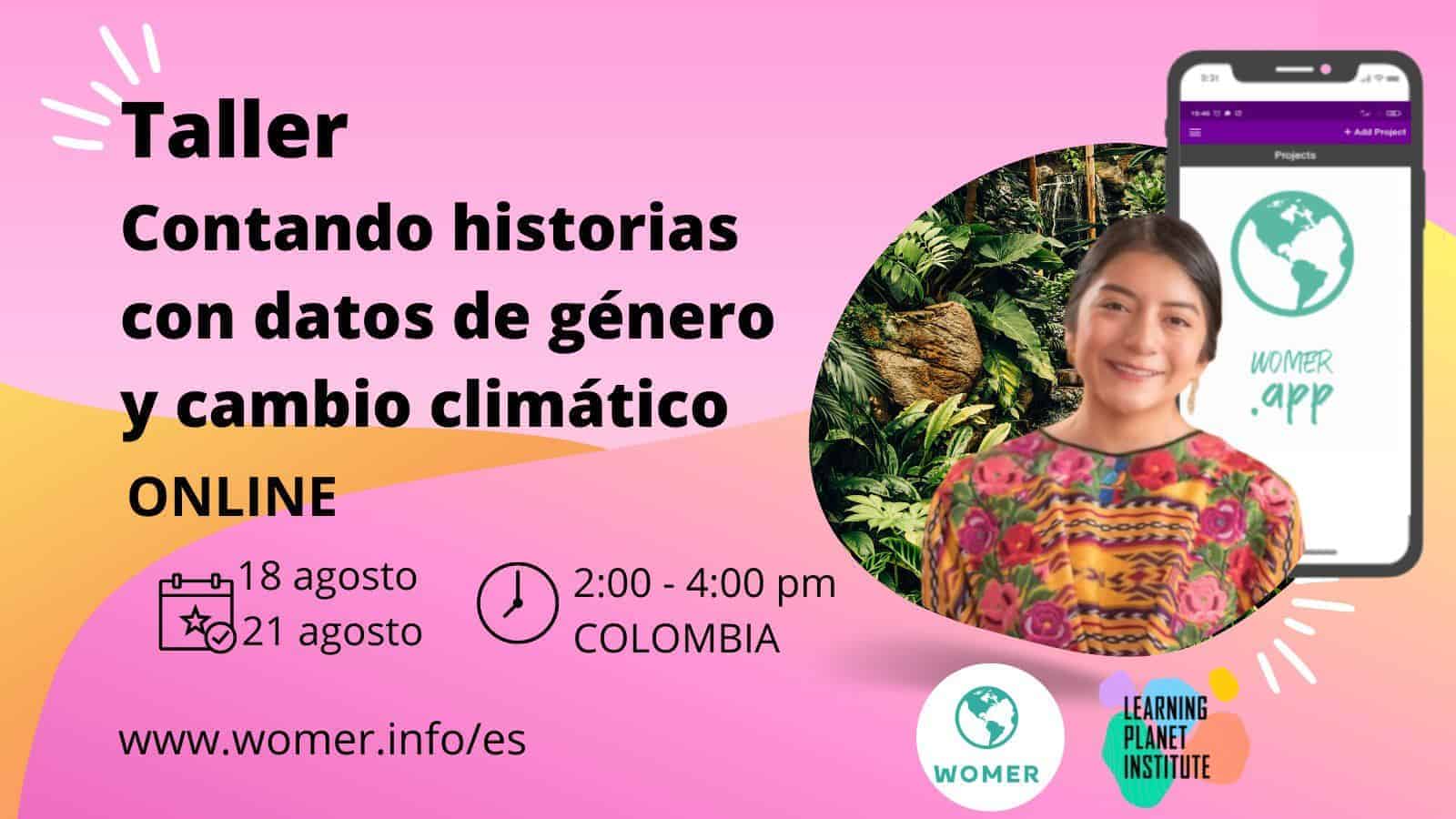
Here are a few examples of promising projects that took part in the GEAR cycle: the DonateWater, which offers solar-powered pumps to provide year-round drinking water to targeted rural communities in Nigeria, and Womer, which aims to make more visible the knowledge of indigenous women who undertake climate actions that contribute to the protection of the planet. Womer is led by Longmun Dawam and Merlyn Hurtado, who is an AIRE master's student at Université Paris Cité - Learning Planet Institute. Combining a mobile and a web application, Womer is a crowd-sourcing solution for indigenous women to collect data on 32 indicators related to access to natural resources, climate impacts, participation in decision-making and climate action.
Quantify team diversity, dynamics, organizational structure and collaborative activity
As part of the Crowd4SDG program, researchers at the Learning Planet Institute are also conducting research into citizen science. This project, led by team leader Marc Santolini and research coordinator Camille Masselot, aims to develop metrics and statistical models to assess the multi-faceted results of citizen science projects developed within the Crowd4SDG consortium. Using surveys and digital traces from online tools, the researchers quantified team diversity (skills and background), dynamics (regularity of activities), organizational structure (division of labor within teams), as well as collaborative activity (advice-seeking within teams), looking for associations with various performance measures.
In particular, the Learning Planet Institute Research Collaboratory team has developed the Coso (Collaborative Sonar) smartphone application to gather information on collaboration dynamics by actively monitoring and contextualizing team interactions through self-assessments and surveys. For example, the analysis of questions such as: “How do team composition, modes of collaboration and communication with organizers promote project success? The researchers then analyzed the results of the committee that assessed the relevance and originality of the citizen science projects, as well as the quality of the discourse. Preliminary results revealed common profiles among top-performing teamsIn this way, participants have a high level of interaction with their mentors, seek information from a variety of sources in other teams, and are able to work regularly on a wide range of tasks. What's more, teams with diverse backgrounds and skills come up with the most original projects. According to Marc Santolini, this work will enable researchers to understand what makes citizen science projects more promising in their initial phase, enabling them to better monitor and advise Crowd4SDG teams and see whether they are on the right track. This is one of the many projects of the’Interaction Data Lab, directed by Marc Santolini, which uses network science approaches to understand how communities organize, expand, solve problems and learn.
European Citizen Science Project, strengthening the citizen science movement in Europe
In Europe and around the world, citizen science is a fast-growing field of research, and citizen science programs are increasingly recognized by the political and scientific communities. Launched in 2020, the eu-citizen.science - an online community for sharing projects, resources and tools - was the starting point for strengthening current citizen science initiatives. It has begun to create a strong community of stakeholders active in the field of citizen science (including universities, non-governmental organizations, local authorities and museums). The European Citizen Science“ project”, which received funding from the European Commission earlier this year, will build on this community to make Europe a leader in the field of citizen science. The project aims to strengthening the european citizen science community while consolidating links and collaboration between existing citizen science initiatives. Other objectives are to increase the participation of citizens from all walks of life, and to raise awareness, support and integrate citizen science among new players, new territories and new scientific fields. One of the key points of the is empowermentan approach that enables communities - regardless of their location, origin, culture or literacy level - to take the lead in research that directly concerns them.“As described by Prof. Muki Haklay (University College of London), who led the design and submission of the project for the Institute for the Learned Planet.
The main mission of the Learning Planet Institute will be to create the’European Academy of Citizen Sciences , The Institute will develop at least 19 new training courses on various aspects of citizen science. The Institute will develop high-quality training resources, activities and events aimed at improving the skills and knowledge of citizen science practitioners, civil society, public authorities, businesses, (in)formal education institutions and research funding and delivery organizations.
European Citizen Science will engage with citizens through co-design activities and community engagement events to creating tomorrow's citizen science community, with a focus on promoting inclusion, gender equality and openness. Citizen science is also a powerful approach to support the SDGs and act together for a sustainable future. Through participatory activities and mutual learning, the program will bring together policy makers and the citizen science and SDO community to serve as a’incubator for new ideas on the world's pressing problems. The European Citizen Science consortium, made up of 12 partners and 9 affiliated entities covering 15 countries, firmly believes that open and citizen science is the future of science in Europe. The project aims to extend its impact beyond Europe by exchanging with citizen science networks around the world, and working closely with the Global Citizen Science Partnership, a network of networks that seeks to promote and advance citizen science for a sustainable world.
An article co-authored by Sophie Vo and the Learning Planet Institute teams