Press release: UNESCO and CRI - Centre de Recherches Interdisciplinaires sign a partnership agreement to contribute collectively, through education, to achieving the United Nations' sustainable development goals
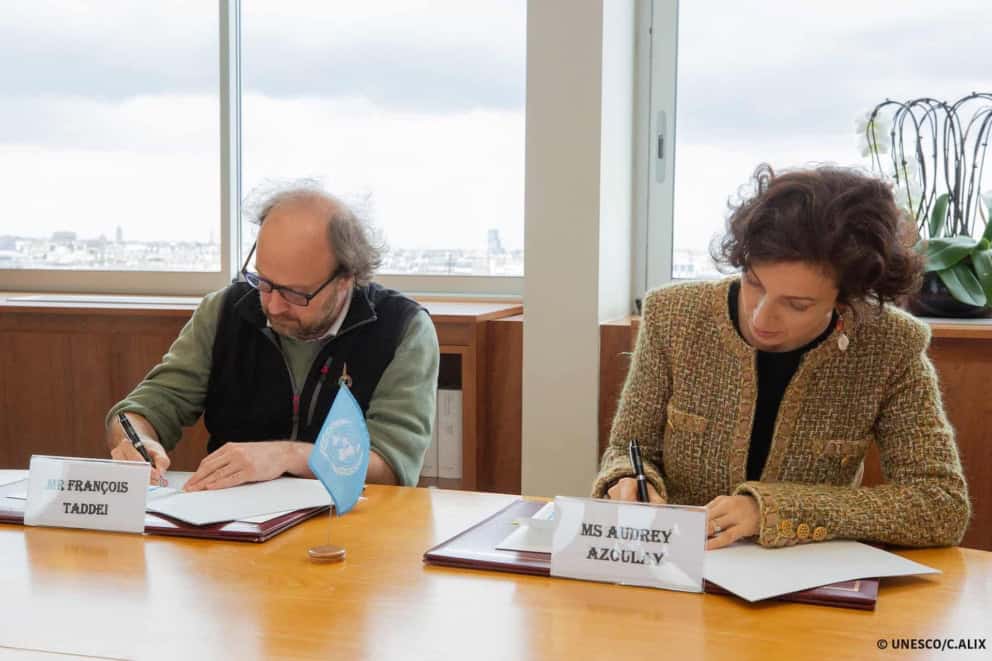
On Tuesday March 5, Audrey Azoulay, Director-General of UNESCO, and François Taddei, co-founder and Director of the CRI, strengthened the ties that already unite the two institutions, through the Chaire Sciences de l'Apprendre held by Sorbonne Paris Cité University, with a view to building a learning planet.
There are over 100 million students in higher education today, and this number could double in a decade, which would be the equivalent of opening a new university every day for 10 years. The challenges are immense, and the need for innovation essential. New technologies, and in particular artificial intelligence, are set to play an important role in meeting these challenges. It's also a question of rapidly evolving learning models to develop critical thinking, the ability to learn how to learn, to ask the right questions, to create, to invent, to innovate, to work together and to know how to catalyze collective intelligence.
With this in mind, and building on the rich collaboration initiated in 2014, the two institutions decided to intensify their joint actions and increase their synergies in favor of education.
Thus, UNESCO and CRI aim to mobilize their resources in order to develop the following major axes:
- The creation of a global summit for sustainable learning on the planet.
The institutions wish to organize an annual summit as part of building a learning planet that would showcase innovative learning programs and pedagogical practices, including the application of artificial intelligence innovations in support of the UN's 17 Sustainable Development Goals (SDGs) - Recognition, dissemination and scaling-up of best practices in education.
In order to promote innovative learning programs and solutions geared towards the SDGs, the institutions wish to work towards their recognition and encourage their scaling-up, as part of a continuous process of learning and educational development. - Creating an interdisciplinary alliance for a learning planet :
This alliance will mobilize countries and voluntary organizations, including research and higher education institutions and centers, to promote and evaluate research and practices facilitating the co-evolution of the three forms of intelligence (human, collective and artificial). This alliance will contribute to the development of education and lifelong learning policies in the age of Artificial Intelligence.
“Together, we want to mobilize collective intelligence and participatory science, so that everyone can learn to take care of themselves, others and the planet,” emphasizes François Taddei.
This new partnership symbolizes the strategic union between UNESCO and the CRI - Centre de Recherches Interdisciplinaires, which will once again be highlighted at the 5th Mobile Learning Week from March 7 to 11, at UNESCO, during which François Taddei will speak on the theme “What collective man-machine intelligence should be developed to enable human beings to live and work with AI?”.”
The synergy between the two institutions will be embodied in the mobilization of collective intelligence in a forward-looking vision serving the general interest and the common good. Writing a report on the future of learning, coupled with current and future intelligences, will be a major step towards building a learning planet.