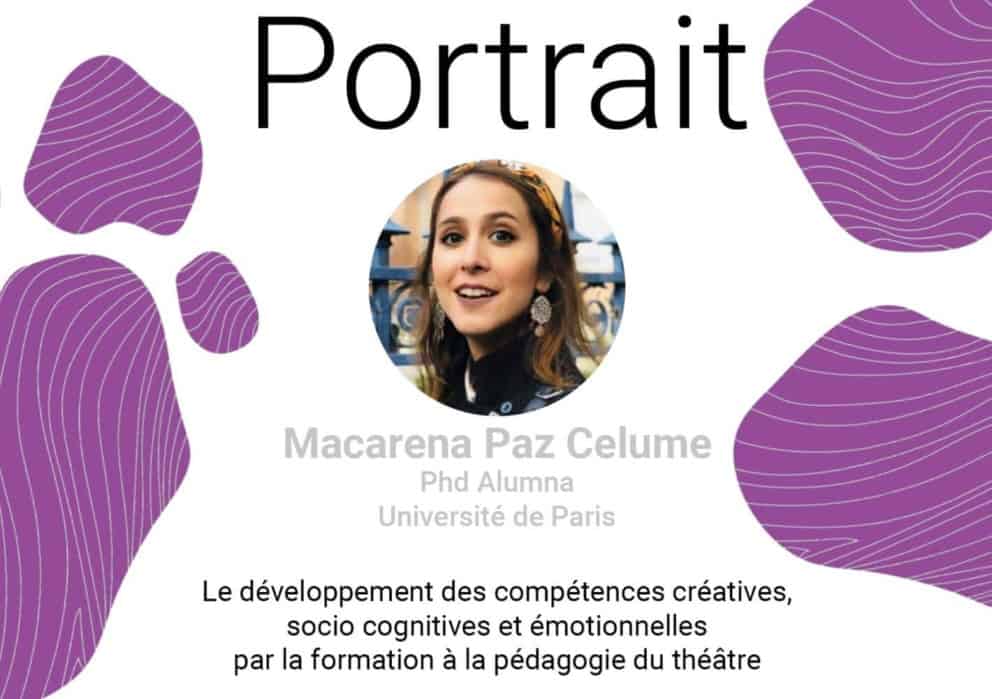
When asked what she wanted to do when she was younger, it's clear that interdisciplinarity was already an integral part of Macarena-Paz Celume's DNA: ““I wanted to be many things: an actress, a singer, a teacher, an astronomer and a psychologist. And I'm very lucky, because that's almost all I do today! I sing with a band, I do theater with a troupe, I teach and I have a PhD in psychology.”
These three ambitions are not coincidental, but serve a single purpose: to “make the world a better place.“contribute to child development and education.” She explains: “I didn't just want to be an actress, I wanted to put pedagogy into theater. I didn't know the word “interdisciplinary”, but I was already into that because I was passionate about everything.”
INTERDISCIPLINARITY AS OUR DNA
While in Paris, she began learning French, became interested in France and planned to write her thesis there. Initially disconcerted by the sacrosanct French bureaucracy, she never gave up. “My main obstacle was the interdisciplinary nature of my research subject. In the theater courses, I was told to present my project in psychology. In psychology, I was told to take it to the Educational Sciences. In Sciences de l'Educ’, I was told to go and see Theatre.”
This same pitfall eventually led her logically to the CRI where the realization of the need for interdisciplinarity is the very impetus that gave rise to it.
“One day, I received a concrete reply telling me that my project was interesting but very interdisciplinary. So I just googled “interdisciplinary research” and came across the CRI. I couldn't believe it existed, and that it existed in France!”
A MASTER'S PROGRAM THAT SUPPORTS ITS STUDENTS
With registration for the Doctoral School already closed, Macarena turned to the master AIRE, specialized in Learning sciences, the’University of Paris, hosted at CRI. She gave herself a year to refine her research project, and took advantage of the opportunity to feed off the CRI ecosystem. The researcher describes the CRI as “a place where it's possible to discover other ways of working, to be open to change, to question one's opinions, to broaden one's horizons in order to seek better ways, in every possible field.”
“This master's degree opened up a whole range of perspectives for me. First of all, what interdisciplinarity really means.” In fact, the program is enriched by the symbiosis of disciplines such as psychology, computer science, educational science, design and more. The master's program strives to avoid top-down teaching and emphasizes peer learning, or learning by doing. “I was able to rub shoulders with people from all over, with completely different backgrounds, and I was enriched by these encounters and projects.”
Macarena's needs are quickly grasped by the teaching team, who are always ready to listen to their students.“As I already had a Master's degree and a research project, the team immediately adapted my year to suit my project.”.
One of the special features of the Master's program is its small class size (34 students), enabling constant monitoring and personalized learning. The curriculum adjusts to the needs of students from different backgrounds, enabling them to create and formalize their projects. It is this personalized relationship that enables a privileged dialogue between the organization and its students: “We, the students, worked to open up the master's program to the international market, as it is today. We explained that it was easier for French people to apply for the master's and be accepted because they already knew the system.” Today, the AIRE master's program boasts 19 different nationalities.
“In this academic journey, everyone is working on different projects, but we all come together around a common desire: to contribute to education.”
COMING TOGETHER TO CHANGE THE FACE OF APPRENTICESHIP
What unites the Master's students is their desire to change the face of education, to innovate in teaching and to change the way we learn.
For Macarena-Paz Celume, it all starts with a simple observation: “In Chile, I saw that children's well-being wasn't really a priority at school. Yet the development of creative, socio-cognitive and emotional skills is key to learning and integration into a group and, more broadly, into society. But these skills are not innate. Who is going to teach us how to manage these emotions, which are fundamental to inclusion in life and society? Not everyone is lucky enough to have parents who have the time and ability to help us blossom.”
The researcher then created workshops combining active pedagogy and theater to enable children and teenagers to express their emotions while playing with their creativity.
LE CRI, A MEETING PLACE
When you enter the CRI ecosystem, you don't leave once you've graduated. Students are encouraged to get involved in student clubs, CRI events and the wider CRI community. “What helped me afterwards was that I was well identified in the CRI ecosystem. Not just as an alumnus, but also because I'm still teaching at the master's in addition to having been able to participate in numerous projects during my studies.”
It was during these years that Macarena-Paz Celume met Franck Zenasni, current director of the course. Learning Sciences master's degree. He agreed to supervise her doctoral research on the development of creative, socio-cognitive and emotional skills through theater pedagogy training in elementary school children, within the “Cognition, Behaviors and Human Behaviors” Doctoral School of the Institute of Psychology at the University of Paris.“Franck was very supportive, I always had a thousand projects in mind and he always encouraged me.”
And there are plenty of projects under the CRI roof, all committed to the Sustainable Development Goals, combining research and educational innovation. For example, the RTR program, supported by the French Ministry of Labor, aims to experiment with new pedagogical approaches to mobilize, support, develop and enhance the skills of people who are far from employment. Aware of his former student's skills, it was Franck Zenasni again who thought of Macarena-Paz Celume to join RTR as Research Manager: “I met the people around the project and there was a feeling. One of CRI's strengths is that you don't have to have an ultra-focused career path, as we like to do in France. But if you come to a project, if you have the right frame of mind, if your skills speak for you, you're taken seriously.”
This is how the researcher joined the “that has three principles: competence, inclusion, education.”
Right from the start, the RTR team decided not to limit their contribution to the operational skills needed to find a job, but also to work on the “emotional and social skills, such as empathy and tenacity. They go hand in hand with more operational skills, for developing a job or setting up a project. They help you identify what you want to do and how you can get there.” This is Macarena-Paz Celume's trademark. ”I'm convinced that tomorrow's businesses will need people who are creative, agile and critical.”
GROWING UP TO MAKE A POSITIVE IMPACT
A journey like Macarena-Paz Celume's requires an incredible amount of willpower.“ If I want to do something, I do it. When I was told no, I insisted. I seize opportunities but I also work a lot, I say yes all the time, which can be a problem.”
It was the accumulation of all this hard work, these projects and these encounters that enabled his research to be consecrated: “I had finished my thesis two years earlier, when I received an e-mail proposing that I apply for the Thesis Prize, awarded by the Cognition, Behavior and Human Behavior Doctoral School of the University of Paris. I sent in my application without really believing it. And then, surprise, I got it! It's recognition of all those years of work, because the Thesis Prize values a whole: the thesis, the interdisciplinarity, the career path and all the projects.”
When asked if she feels “an agent of change”she modestly replies that no, she is not “Greta Thunberg ”and that it works on subjects that are not “in fashion”. And yet it is on a daily basis that she commits herself to the emotional and psychological development of children, to changing the way people look at education and to helping people to blossom so that they, in turn, can change things: “If I had the power, I would go into schools and make sure that teaching staff were trained and had the time and means to help develop creative, emotional and psychological skills. I love getting up and going to work. I have worries like everyone else, but I do what I want to do in life. I wish everyone had that chance. And to change society, we need people who thrive on their projects because they, in turn, know how to pass on their passion.”
LEARN MORE
Find out more about Macarena-Paz Celume's research
Find out more about Réalise Tes Rêves (RTR)
Thanks to Macarena-Paz Celume for taking the time to answer our questions.