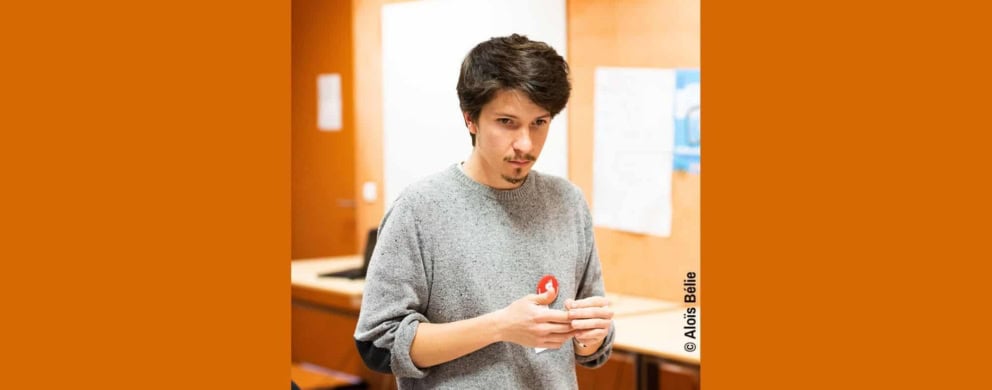
A mathematician and recent graduate of the AIRE Learning Sciences Master's program, Aristoteles Camillo is also a Savanturiers mentor. Here's a look back at his career, his research and his role as mentor.
TRAIL
Can you tell us a little more about your academic background? How did you get involved in scientific studies?
I was born in Rio de Janeiro and went to school in Brazil until I graduated. In 6th grade, I remember trying to solve a math problem for 2 weeks until I found the solution. It was like a revelation for me. From that moment on, my interest and involvement in maths continued to grow. I was lucky enough to take part in the Brazilian Mathematics Olympiad, and even won a gold medal in 2007!
With passion, perseverance and practice, the doors to scientific careers opened up for me. At the time, I had no idea what the life of a mathematician was like; my only reference was the character in the film “Un homme d'exception”, and yet I wanted to become one.
I arrived in France in 2008, where I entered an international stream at INSA Lyon. These two years of preparatory school made me realize that I wanted to dedicate myself exclusively to maths and have the time to really marvel at its enigmas and the human ability to solve them. So I continued my studies in Paris, where I obtained a bachelor's degree and a master's in mathematics applied to medicine and biology.
Why have you turned to education and new technologies?
Four years after my Master's degree, I decided to embark on another Master's degree, this time in Learning Sciences. I joined the Learning Sciences course at the Master of AIRE from CRI, which answers the questions I've been asking myself throughout my training and experience as a private tutor.
How did you view science teaching in schools as a child/teenager?
I remember being fascinated by what we were taught in school and high school: the human body and astronomy were my favorite subjects. On the other hand, I was frustrated that I couldn't carry out any experiments in these classes.
SEARCH
Can you tell us a little more about your research? What is the aim of your research?
During my master's degree, I worked with Sébastien Goudeau, a senior lecturer in Social Psychology at Poitiers, with the aim of understanding the impact of gender and social class on mathematical learning in 5/6 year-olds.
The aim of this research is to help us better understand how social reproduction operates at different levels of the school system. We hope to provide new food for thought, which in turn will lead to the creation of more effective public policies.
EXPERIENCE WITH SAVANTURIERS - RESEARCH SCHOOL
For a year, you worked with 3rd graders from Seine-Saint-Denis as part of The Schools Challenge project.
Why did you get involved in the Savanturiers - École de la recherche program?
Mentoring a group of students within the Savanturiers scheme gave me the opportunity to share my knowledge and experience in mathematics research, as well as my new training in learning.
What does your role as mentor entail? How do you interact with teachers and students?
My role as mentor on the Schools Challenge project was not only to act as a reference and guarantor of the scientific process we had undertaken together, but also and above all to act as a catalyst for their ideas and motivations.
The teachers of this class placed their trust in us completely and assisted us throughout the Challenge. We had the opportunity to meet them before the launch of the project, which enabled us to get to know the class better and decide on our exchange arrangements. Throughout the project, we kept in touch by email, and on a few occasions, we talked to the students after the meeting.
What impact does this relationship have on your professional practices?
Contact with these students has had a direct impact on my work ethic. Those who are sometimes my objects of study, in the Schools Challenge project, have gained a first name, a personality, frustrations and dreams. My work took on a new meaning, and I felt even more motivated to advance research in the field of education.
Has this pedagogical approach to classroom research changed the way you look at science teaching in schools?
I wouldn't say that it changed my view of science teaching in schools, but I would say that the experience confirmed the transformative and formative power of a pedagogy based on autonomy, cooperation and critical thinking, ingredients of a pedagogy driven by research paradigms.
THE SCHOOLS CHALLENGE: THE FILM
Meet Aristoteles in a film that traces the work carried out by 48 students from two Seine-Saint-Denis middle schools during the 2019/2020 school year as part of The Schools Challenge, an educational project around «living your city better».
The Schools Challenge is J.P. Morgan's skills sponsorship program, deployed in eight international cities (Frankfurt, Hong Kong, London, Milan, Paris, Sao Paolo, Singapore and Tokyo), offering young people the opportunity to develop their knowledge and discover the professional world. In Paris, this mentoring program for young people reinforces J.P.Morgan's five-year 30M$ philanthropic commitment to supporting the development of a more inclusive economy in the Ile-de-France region, and particularly in Seine-Saint-Denis.