OBSERVING CELLS, SUPPORTING STUDENTS
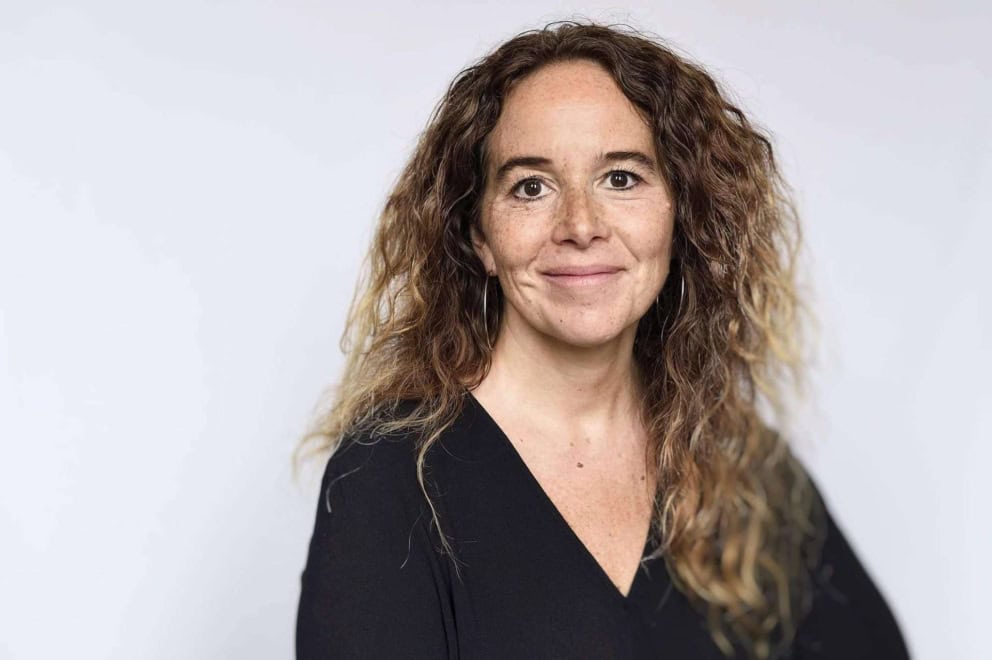
Ana-Maria Lennon-Duménil is Director of Research at Inserm and heads the Institut Curie's Immunity and Cancer research unit (U932). Born in Chile, she grew up in France and became interested in research and science at an early age. Fascinated by the life of cells, she completed a thesis in immunogenetics at the Institut Pasteur, before leaving for Harvard. At the Learning Planet Institute (ex-CRI), between 2012 and 2020, Ana-Maria taught and supported Master's students in their research process. She has fond memories of a particularly rich and open environment. Portrait of Ana-Maria.
Ana-Maria Lennon-Duménil was born in Chile. The daughter of political refugees, she arrived in France at the age of four. She grew up there until she was 18. Very curious, Ana-Maria wants to understand invisible things, anything that moves, is adaptable, flexible and interacts with its environment. She is naturally drawn to the life sciences. It's a good thing she has an aunt who's a researcher at the CNRS, so Ana-Maria has the chance to visit laboratories. It was decided that she too would become a researcher.
At the age of 18, Ana-Maria returned to Chile to study. «It was an ideal, idyllic setting. There weren't many of us, but we did a lot of work in the laboratories. They were certainly less recognized than in France, but the scientists were just as passionate and competent.»
After studying genetics, Ana-Maria returned to France. She did her thesis in immunogenetics at the Institut Pasteur, on the major histocompatibility complex (MHC), MHC in English, group of molecules used to recognize markers of the self). During her thesis, Ana-Maria met her husband. Then they both flew to the United States, to Harvard University, where Ana-Maria is still working on MHC, wondering how molecules present antigens.
“I love cells, I love watching them go about their lives and wondering how they interact with their environment.”
On her return to France, Ana-Maria discovered dynamic imaging at the Institut Curie, which fascinated her. When she saw the first cell film and discovered the qualitative cell imaging approach, it was a real eye-opener. «That's what I was looking for all along. She then began a collaboration with researcher Matthieu Piel on immune cell motility.
This meeting was to prove decisive for his future career. « Matthieu opened my eyes to the physics-biology interface, and it became a passion. Interacting with a cell biology laboratory for the first time, she discovers the mechanobiology. «If I crush a cell, it will modify itself, move, adapt... Immune system cells deform and transform themselves when they move and interact with other cells», she explains.
«I love cells, I love watching them go about their lives and wondering how they interact with their environment. You want an immune system that's very reactive, very alert, that takes into account the physical aspects of the environment. At the same time, the immune system must not be too sensitive, which could lead to autoimmune reactions against the «self». It's a fascinating balance.»
Ana-Maria doesn't hesitate to draw parallels between cell life and her own experience when she arrived in France at the age of four. «It's a good old immigrant reflex, perhaps. That of adapting to a new environment in which you have to survive.»
Ana-Maria Lennon-Duménil, Matthieu Piel and Raphaël Voituriez (a theoretical physicist working at UPMC) have opened up a hitherto unexplored line of research into the mechanisms that enable dendritic cells, the sentinels of immunity, to adapt and coordinate their function with their migration in time and space. Their work has in fact made a significant contribution to the development of the discipline, even if, very humbly, it's not Ana-Maria who's talking about it (they have, however, published in such prestigious journals as Science, Cell, Nature Cell Biology etc.).
Later, at the Institut Curie, she met another researcher, Danijela Vignjevic, who was also a professor at the CRI (now the Learning Planet Institute) in Paris. Master 2 AIRE. Specializing in intestinal imaging, Danijela introduces Ana-Maria to new cells. « I discovered how immune system cells maintain balance, how macrophages protect epithelia from fungal poisoning and so on. Fascinating stuff. »
“CRI is an environment where you can think outside the box and indulge your curiosity, take risks. It's an ideal context for the curious.”
In 2012, Ana-Maria Lennon-Duménil was approached by Ariel Lindner, one of the co-founders of CRI, to become a Master 2 teacher. She thoroughly enjoys working in this open, interdisciplinary environment. Her role is to support students in their research process. Preparation of scientific articles, bibliographies, organization of symposia and other exercises are all on offer. «There wasn't really a specific subject. We were a group of 6-7 teachers and would meet up with the students to help them do the exercises, find the labs, choose them.»
Ana-Maria remembers very pleasant interactions not only with the teaching staff, but also with her students, whom she brought to Curie. «There's a wealth of people and a diversity of profiles at CRI. I've met some incredible people. People are highly motivated, very creative, and ready to give a lot of themselves.»
« There's something extraordinary »says an enthusiastic Ana-Maria. In her opinion, the approach is very different from a classic French university environment. «The CRI offers a lot more than just interdisciplinarity. It offers a different way of thinking, of discovering research, and of making one's own way. It offers a context, an environment where you can think differently, indulge your curiosity and take risks. It's an ideal context for the curious. You can let yourself be curious, without judgment.» All of this is made possible by a caring environment that fosters autonomy and the self-confidence to succeed. «It's an incredible opportunity that CRI gives!»
In 2020, Ana-Maria took over as head of the «Immunity and Cancer» department (U932, comprising 9 teams - around 130-140 people at the Institut Curie) and had to stop teaching at the CRI after 8 years with Master 2 students.
Inspired by people who embody the positive, Ana-Maria is convinced that meeting people who trust you and give you both the means and the freedom to seek yourself out and find your own path, are the keys to building yourself. She is also a firm believer in the diversity of profiles required to conduct a successful search. «That's why I think CRI is so rich. We believe that everyone has something to contribute, something to learn from each other. Teachers and students alike.»
A portrait of Marie OLLIVIER