Shapes-16

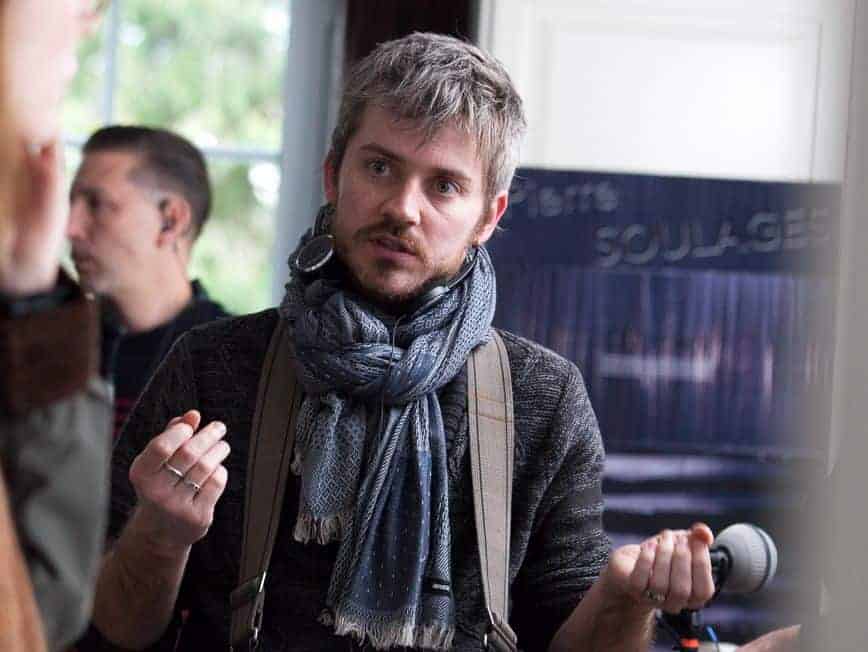
[COMMUNITY] Portrait of Aurélien Peilloux, researcher

  • Community
  • R&D


CONTINUOUS CREATIVITY IN ALL FIELDS


Aurélien Peilloux is a writer-director and researcher. The CRI has enabled him to adopt the global approach he cherishes, without restricting himself. His thesis in research-creation, the first of its kind in France, enabled him to combine his soul as a researcher with his sensitivity as an artist. Today, he makes films and teaches research-creation at various higher education establishments.


A warm, sunny September afternoon. Aurélien Peilloux ties his bike to a tree in the Place du Marché Sainte-Catherine and joins me on the terrace of a shady café. The discussion begins.

Since high school, Aurélien has wanted to become a researcher. He was passionate about physics, and in particular the great theories of the 20th century such as quantum physics. He attended a preparatory class, then entered the École Supérieure de Physique et de Chimie Industrielles de la Ville de Paris (ESCPI - ParisTech), where he studied research in a highly transdisciplinary way for three years. This was followed by a Master's degree in particle physics at the University of Montreal. Back in France, Aurélien decided to broaden his horizons to include biology.

I'd learned the equations I wanted to study, like Feynman diagrams, I had a good level in maths but I wanted to take a more transdisciplinary approach. »

Aurélien began a Master 2 in biophysics, with an internship at the Institut Curie. There, he studied the dynamics of interfaces between tissues, which interested him greatly. At the end of the year, Aurélien realized that he had learned an enormous amount, but felt limited by the ultra-specialized approach inherent in research: «I felt like I'd reached the end of one thing and the beginning of another... .

Meanwhile, Aurélien has discovered a whole new interest. For the past few years, he has been frequenting cinemas in the Latin Quarter on weekday evenings and every weekend. « It became a habit. I learned to love it as I went along, until I became a passionate cinephile. Eager to learn more, Aurélien immersed himself in the industry. While he was in Montreal, he contacted Micheline Lanctôt, a Quebec actress and director working on her tenth feature film. It was a natural fit: Aurélien could attend the shoot and, in exchange, explain particle physics to the director! On the set, Aurélien feels like a fish in water: he talks to everyone, observes every detail carefully. He felt deeply that he belonged here. He then took the competitive entrance exam for the Fémis (École nationale supérieure des métiers de l'image et du son), which he passed with flying colors.

However, the 23-year-old had already won a grant to do a thesis at the CRI*. So he decided to go and see François Taddei to explain that it was the love of cinema that was driving him from now on, and that he was giving up his thesis to devote himself fully to filmmaking. François Taddei replies with a question: couldn't he link science and cinema in his thesis? He lets Aurélien think about it.

« I'll always remember cycling down Mont Sainte-Geneviève after that discussion. I felt light-headed as I realized how lucky I was to be able to link the two without cutting myself off from a part of myself! » says Aurélien, whose eyes are still shining. « I've got CRIp close to my heart ».

And so began four years of exploration. Aurélien began a thesis in research-creation, a field whose vocation is to produce new knowledge through artistic practice in a university environment. This alliance between two fields whose modus operandi may seem antinomic at first glance was a natural fit for Aurélien. It has to be said that he is a fervent advocate of the holistic and complex approach to the world so dear to Edgar Morin - whose work he particularly appreciates. Science with a conscience (Seuil, 1982).

Aurelian deplores the Aristotelian disconnect between being and the world, and even more so in science. « Today, you're either an artist or a scientist. When you're an artist, you're inhabited by what you do, but when you become a researcher, you have no choice but to cut yourself off from the inside. Scientists» relationship with emotions is very complicated, because of the disconnect inherent in scientific methodology". This was the frustration Aurelien felt at the end of his science course. « I had a kind of existential crisis: science wasn't enough to express certain things I felt... ». Yet he is convinced that scientists would benefit from getting closer to their feelings.

François Jacob distinguishes between two sciences: daytime science (rigorous, conquering) and night-time science (in the fog of uncertainty, relying on intuition). You can't have one without the other!  he explains, adding that creativity is an ongoing process.

Aurélien's thesis, an innovation in the research world, consists of four films and a manuscript. « I wrote my thesis in two months, which was pure pleasure. ! » Written in the first person, she allows subjectivity and intuition to express themselves. His films are hybrid objects that question the interface between art and science. Much more than simply popularizing a scientific concept, they have a double reading level: they tell a story tinged with emotion, accessible to all, but they also create knowledge, for example by taking a critical look at the world of science (Researchers, 2015), questioning the nature of the creative act (The Five Wise Men, 2015), or by seeking to make the viewer feel scientific concepts, expressing them through the properties of an aesthetic form (Since Manon left me, 2013).

Today, Aurélien Peilloux continues to make films, one of which is currently being financed. He is also a research associate at SACRe, France's first doctoral research-creation program, created in 2014 (when Aurélien was already a thesis student at CRI). He also teaches at CRI and at the Cycle Pluridisciplinaire d'Études Supérieures de l'Université Paris Sciences et Lettres (CPES), and is deeply moved by the work of his students. Aurélien is moved to recall a sound creation by one of the Master's students on the subject of obstetric violence. « The emotions, sincerity and honesty came through in a very powerful way.».

In perfect keeping with his philosophy, Aurélien opened up completely during these two hours of discussion. A sensitive artist and rigorous researcher, he sees his dual career as a real opportunity, which has given him legitimacy and self-confidence. Above all, we understand that he has found himself fully and has been able to express his emotions, without having to reject science. « I'm very grateful to CRI; it's one of my foundations. »Aurélien also directed the docu-drama A trip to CRI in 2017. You can feel his affection for the CRI, which has since become the Learning Planet Institute.


Visit “Et Si Nous” by Aurélien

What if we were to become one with the world again, and re-establish our ties with it?
We could all benefit from a more fluid, sensitive and lucid relationship with our emotional life. To be more attuned to ourselves and to the world. Knowing the world goes hand in hand with knowing ourselves.

*The CRI became the Learning Planet Institute in December 2020.
Find out all about its transformation : https://news.cri-paris.org/news/le-cri-se-transforme-et-devient-le-learning-planet-institute/


An article by Marie Ollivier
Photo credit: @Marie_Augustin

Shapes-10

Our latest news

Subscribe to the newsletter

Every quarter, we invite you to discover our latest news and the diversity of people and projects that make up the Learning Planet Institute!