CURIOSITY, ENCOUNTERS, EXPLORING LIVING THINGS
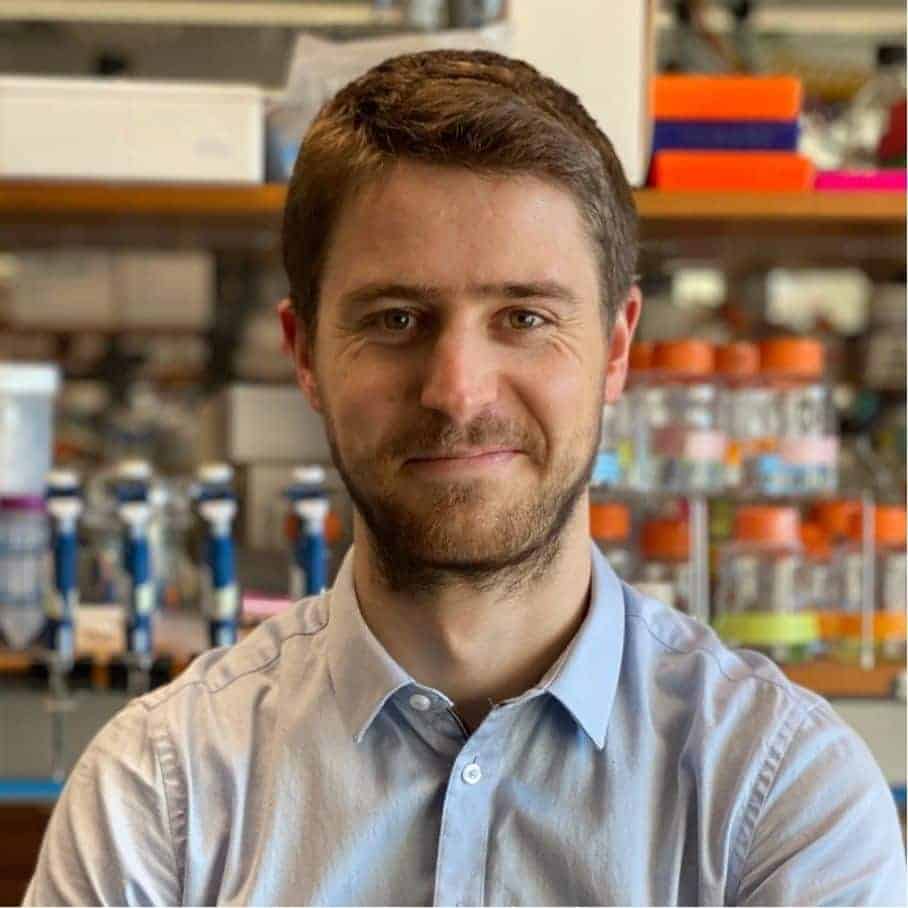
Julien Barrere is in his fifth year of doctoral studies at Harvard University in the United States. Born in the Allier region of France, Julien grew up on the family farm and wanted to take it over after high school. On his father's advice, he nevertheless decided to study. The CRI (now the Learning Planet Institute) inspired him to let his curiosity lead him. Over the years, Julien went from CRI to Harvard, via Canada, Serbia, Zurich Polytechnic and MIT. Meet a brilliant, humble and quiet mind.
Julien Barrere is in the fifth year of his PhD at Harvard, USA. He studies cell biology there, and has now spent more time studying across the Atlantic than in France, something he couldn't have imagined just a few years ago.
Julien grew up on a farm in the Allier region. «In the middle of nowhere!, he says. In high school, learning and knowledge didn't stimulate him much. «I went to school to go to school, I did it because I had no choice, and that was that. Far from the academic world, Julien's aim was not to study, but rather to take over the family farm when he left high school.
His father, however, is keen to pursue higher education, he says, to avoid being pushed around and to develop his critical thinking skills. Julien agrees: «I said to myself: I'm going to study anyway, without putting any pressure on myself. If I don't like it, I can always go back to the farm. If I don't dislike it, I'll carry on...».»
One day, Julien's father hands him an article from the World : «Here, look, this doesn't look bad.» This article is by François Taddei, co-founder of CRI.
Far from being totally convinced, Julien nevertheless had a good feeling. He was accepted at the CRI, in the «Frontières du Vivant» (FdV) degree program, which he joined just after his baccalaureate, following his state of mind: no pressure.
«CRI really gave me curiosity. I already had it, but in small doses. CRI has increased it tenfold.»
At the time, in 2012, the CRI was on the premises of the Cochin hospital. «We were eighteen students. They had recruited a super diverse group of people who were very interested and interesting, recalls Julien, for whom the presence of his comrades was a great source of stimulation. «We weren't the kind of prep school profiles where everyone got honors in their bac (there were only two).». They were people with personality, something really interesting defined them.»
At CRI, Julien discovers the beauty of learning and the stimulation of discovering new knowledge. «CRI really gave me curiosity. I already had it, but in small doses. CRI has increased it tenfold.» In her opinion, the teachers also contribute greatly to this atmosphere, as they are very passionate about what they teach. «The PhD students were quite young, and lectured in quite original and alternative ways. The way knowledge is conveyed also plays a big part in learning.»
Julien identifies with CRI's interdisciplinary approach. «It was a very, very general education: we had physics, chemistry, biology, computing, maths, philosophy, didactics...», he lists. But in the end, what interested Julien was what had already interested him a little before: the general biology course, and ecology. «Growing up on a farm, you see ecology right before your eyes. You don't necessarily put the name ecology on it, but the concept of biodiversity is ingrained in your head.»
Speaking of the farm, Julien still has no intention of giving up his studies... so he's continuing with his bachelor's degree. In his third year, he spent a semester at Concordia University in Montreal, taking courses in English as an exchange student.
An «incredible» experience at the Petnica Science Center in Serbia
Back in France, he returned to Serbia a few months later with Tamara Milosevic, the license coordinator at the time. « We spent two weeks in Petnica Science Center. It was an incredible experience. We had classes on how to do research from A to Z, on bibliography, protocol development, data presentation, report writing... ». Petnica being a small village, Julien spends time at the center with an interesting group of people. «We were all at the center. It was very stimulating, both intellectually and socially.
From this «incredible» experience for Julien, came the idea of an internship between the CRI in France and the CRI in France. Petnica Science Center, in Serbia. Under the supervision and with the help of Tamara Milosevic, Julien is in charge of setting up a course platform in hybrid format, so that students can carry out research and access online resources for learning.
He eventually stayed on for two years as a teaching assistant (teaching assistant).
Tamara Milosevic is one of Julien's mentors. He has learned a lot from her. « I really owe her everything. She gave me advice on how to get ahead in the world of research, and in particular helped me with my Master's applications (I had no idea how to go about it)».
Because, yes, Julien is pursuing a Master's degree. There's no question of stopping his studies straight away. Even if he is still thinking about taking over the family farm.
« I said to myself: well, all in all, that's pretty cool. Yes, okay, I can do a master's. »After hesitating between a master's degree in science and another in education, Julien applied to a number of schools, with the idea of going abroad.
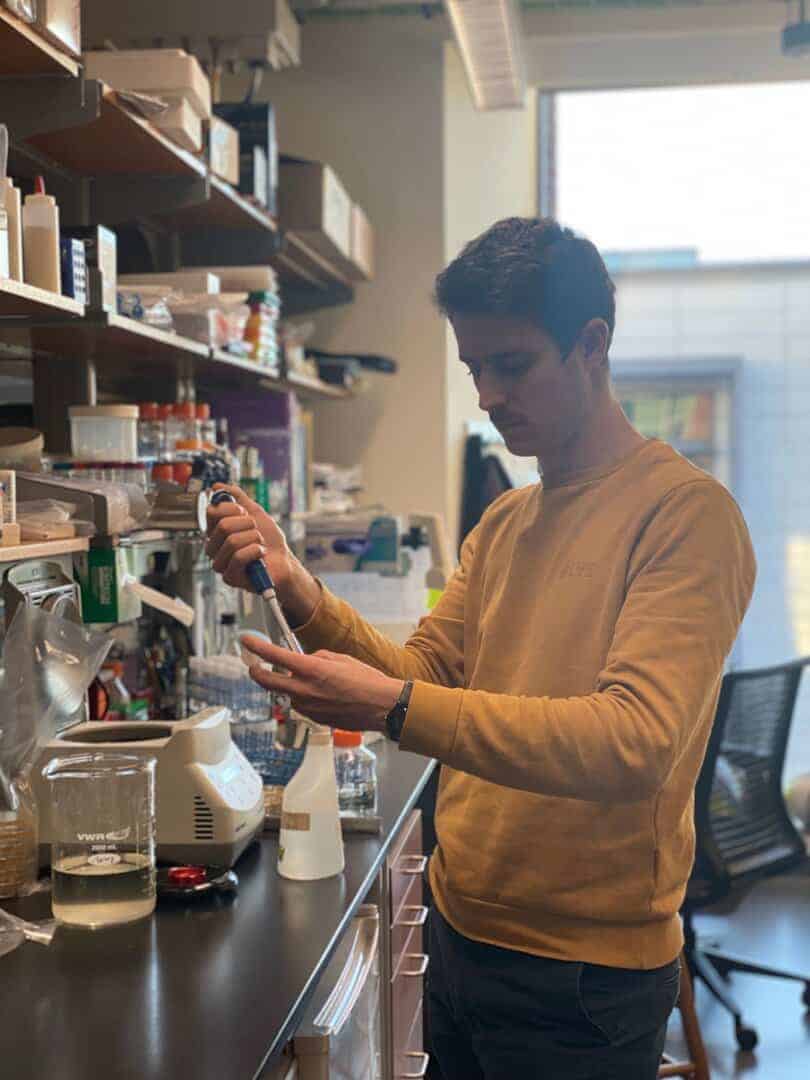
« A teacher at CRI told me about ETH Zürich, and said it was good. So I went there. »His master's degree is called «Ecology and Evolution». Julien studied the evolutionary biology of species and populations of plants, animals, microbes, fungi and ecosystems to understand the environment and the evolutionary development of the various components, and their interactions. The young man then began his first laboratory work, including one - by chance - with a former CRI PhD, Antoine Frénoy, who also helped him a great deal.
Towards microbial ecology
One day, a researcher from MIT, specializing in microbial ecology in the oceans, came to visit Julien's laboratory in Zurich. « After a few discussions, he suggested I do my Master's thesis in the laboratory where he worked. So I ended up at MIT. »Julien did his Master's research on the ecology and biodiversity of the soil microbiome with Otto Cordero. He then spent a year working at the Jeff Gore Lab.
« From that moment on, I said to myself « Why not do a thesis? ». I could have phrased it more romantically, like « What is my passion? »or « What do I want to do with my life? »but no ». Julien is the epitome of quiet strength. And his young university life doesn't stop there. The farm can wait.
« I created opportunities for myself »he explains. « Unconsciously, I searched, I met people. In the environment I grew up in, I had never heard of Harvard...»
And yet... After preparing his thesis applications for MIT, the DOME (Division of Microbial Ecology) in Austria and Harvard, Julien was brilliantly accepted at all three. « It's hard to break away from the image of the great American universities... Plus, Harvard's doctoral school offered more research follow-up. »
Julien will begin his thesis at Harvard in 2018. Over the course of a year, he will meet the professors affiliated with each lab to choose the one that suits him best. «All the places I applied to had microbial ecology».», he explains.
He chose Professor Andrew Murray's laboratory. «He was interested in the evolution of multicellularity, and so was I. I chose him as my thesis supervisor because of his support and commitment. I chose him as my thesis supervisor because of his support and commitment. He also gives me life advice. And he has an incredible way of thinking!. The Learning Planet Institute continues to follow Julien on his journey as Andrew Murray is part of the Scientific Advisory Board research collaboratory. «I didn't choose his lab on purpose, Julien laughs, «it's very unconscious! ».
Today, Julien is working on experimental evolutionary approaches. «Millions of years ago, life on earth consisted solely of individual cells. And at some point, these cells formed more complex groups, moving from one to many cells. I'm trying to study the conditions that may have allowed this transition to take place.» Julien is fascinated by his subject, and manipulates yeast to reproduce these transitions in the laboratory. «We're trying to evolve individual cells into multicellular groups, he explains.
If he wanted to spend another five years writing his thesis, Julien could, but he gives himself another year or two. Despite his brilliant academic career, Julien has never lost sight of his original project: taking over the family farm. «The farm project has evolved. One day, I'd like to create an open space where three subjects can be united: agriculture, education and science. The idea is to bring together people from a wide range of backgrounds in a single structure to reflect on questions such as «How will we feed ourselves in the future? Julien's path is certainly not in vain.
A portrait of Marie OLLIVIER