FIGHTING ANTIMICROBIAL RESISTANCE, RAISING AWARENESS THROUGH PLAY
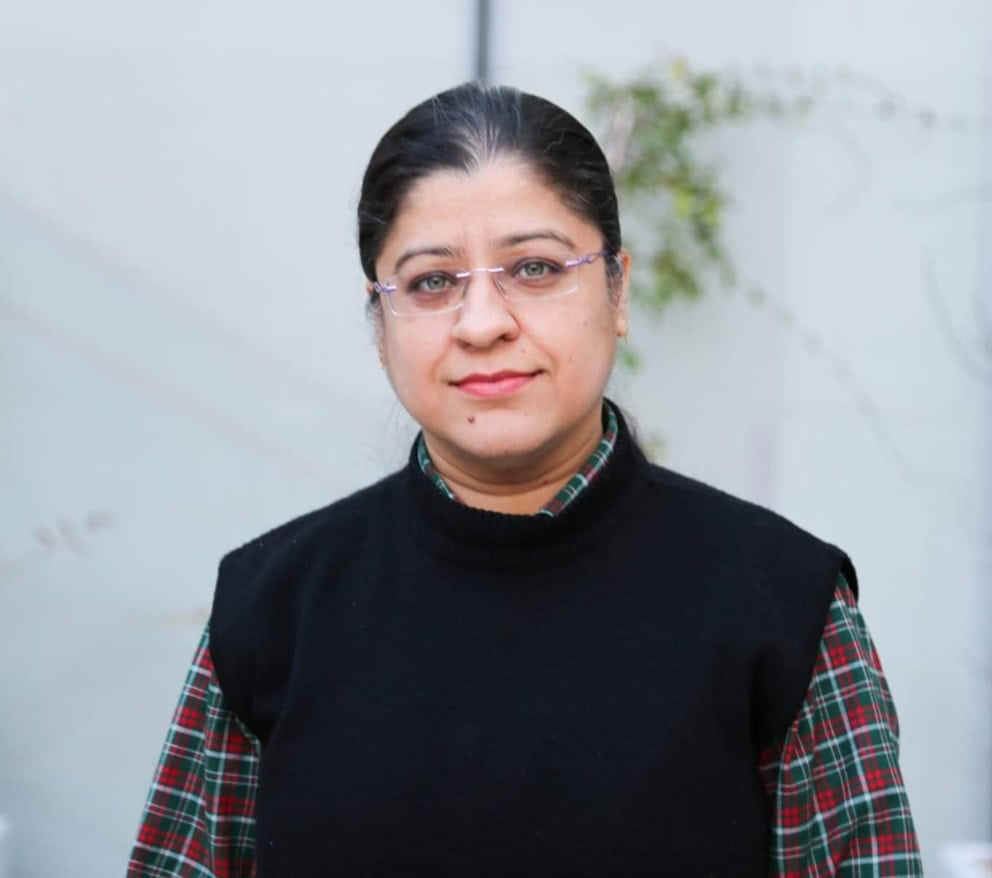
Anshu Bhardwaj is a biology researcher and data scientist. Born into a family of doctors in India, she was keen from an early age to help patients on a larger scale than in the office. Anshu quickly set her sights on research into antimicrobial resistance (AMR), in order to develop tools to tackle it. Holder of a long-term research fellowship at the Learning Planet Institute, She spent a year in Paris in a relaxed research environment open to the world. Portrait.
Anshu Bhardwaj was born in a medium-sized town in India. In the family, it's something of a tradition to be a doctor: Anshu's father, uncle and brother are all doctors. As she grew up, Anshu developed a keen interest in patients and their needs: «How can I help them? How can I reach much wider populations?». For as long as she can remember, it's been to answer these questions that Anshu has always wanted to become a researcher.
«I enjoy working with all those who want to tackle public health challenges».», she says to this day. Anshu's main research interest is to develop tools for combating antimicrobial resistance (RAM).
With a Master's degree in Biotechnology, Anshu showed an early interest in interdisciplinary approaches. Passionate about biomedical data analysis platforms, in particular for understanding the biology of infections and rare diseases, she hopes to use them to improve treatments and diagnoses.
In 2001, she began a doctorate in life sciences (on the understanding of genotype-phenotype correlations in mitochondrial diseases human) to Center for Cellular & Molecular Biology (CSIR-CCMB) in Hyderabad, India. She graduated in 2008.
A month after obtaining his thesis, Anshu co-founded an independent laboratory: the’Open-Source Drug Discovery, where it designs and develops new drug discovery processes using the crowdsourcing.
The recipient of numerous awards, including the UNDP (United Nations Development Programme) Young Innovator Award, Anshu lectures internationally, is editor-in-chief of Frontiers in Systems Biology, Protein Bioinformatics and Computational Genomics, associate researcher at Science Translational Medicine, and member of the editorial board of Journal of Genetics. In addition to her publications, the biologist likes to pass on her knowledge and work with her students.
In 2016, Anshu moved his research laboratory 200km from Delhi, a green location equipped with the latest technology, including a supercomputer. « All students-e-s followed me. They are really interested-e-s through the research we carry out together».» says Anshu, who has trained over 500 students in total. She calls them« SciTechtives »and co-develops data analysis tools with them.
«Over the last twenty years, I've learned to understand data sets.» smiles Anshu, who deals with information on rare diseases and infectious diseases such as tuberculosis, a subject she has been working on for many years.
« Many people, especially in India, go undiagnosed. The problem is that we're using old methods that aren't reactive. We don't know what we've identified: is it a reaction to the disease or to the drug? If we sequence an isolate, this information is available at genome sequence level. This helps us to understand bacterial infections».» explains Anshu, in a clear and pedagogical manner.
This genome research enabled Anshu to obtain a long-term fellowship at CRI (today Learning Planet Institute). «I met François Taddei and Ariel Lindner (co-founders of the Learning Planet Institute) in India a few years ago, when we were working on the same project.»A few months later, Ariel Lindner circulated an email proposing a long-term fellowship at CRI. After 8 months of writing his proposal, Anshu was awarded the fellowship. «Back then, Indian research centers weren't interested in the subject. Today, they are.. »
At the Learning Planet Institute, Anshu has two objectives in line with the global action plan against AMR. The first is to work on genomic signatures to identify priority pathogens, and the second is to develop a game to raise awareness of AMR.
For its first objective - research - Anshu draws on its experience in crowdsourcing, functional and comparative genomics and computational drug discovery. It examines the genome sequence of over 900 clinical isolates in 12 different countries, and discovers that resistance markers are not the same depending on the context. For example, resistance does not take the same form in the UK as in Malaysia. The method of diagnosis and clinical application must therefore be adapted to the local community. «We must now seek to understand the reasons for these differences.» continues Anshu, passionately. «At the Learning Planet Institute, I was able to go very far in understanding these mechanisms, much further than reading many recognized scientific reports.»
Anshu's second objective, at the Learning Planet Institute, was to develop a video game on antimicrobial resistance, to encourage understanding of the issues in the classroom: she creates ArMoR, an attack-defense game where youngsters can study how bacteria attack, how resistance emerges from inappropriate use of antibiotics, and how defense mechanisms are not sufficient to counter them.
«We didn't want a game that was too informative, where kids would get bored. We wanted to create a more engaging game. The current game version has seven levels of difficulty. It is aimed at medical students, and is supported by the WHO in India.
«If I hadn't gone through Learning Planet Institute, the game wouldn't necessarily have taken this form. If I had done the same thing here in India, I wouldn't have made the progress I did at Learning Planet Institute.»
For Anshu, the Learning Planet Institute's researchers are non-traditional, disruptive and very outward-looking. A godsend for the Indian biologist, whose trip to the Learning Planet Institute was a first outside her native country. « To be able to work in an international research center is a great opportunity. And it wasn't just colleagues I made, but friends too, who taught me a lot. »
As Anshu says, the diversity of profiles at the Learning Planet Institute has helped her evolve not only as a researcher, but also as a person. «No one has the same background, but everyone has a lot to contribute. We discover things we didn't even know existed. Everyone makes an effort to explain their work to others. The Learning Planet Institute offers this interface where everyone can exchange, benefit from a more holistic vision and grow, while contributing to the growth of others.»
«It's also an environment in which you feel supported, which is very, very relaxing mentally. We work with good researchers, but above all we work with beautiful people. The Learning Planet Institute is a collection of beautiful people. It's incredible. We always end up having discussions that are both interesting and fun.»
With the pandemic, Anshu only spent one year at the Learning Planet Institute. But she hasn't said her last word: «I'm thinking about other projects. I'd love to come back, that's for sure, she concludes with a smile.
A portrait of Marie OLLIVIER