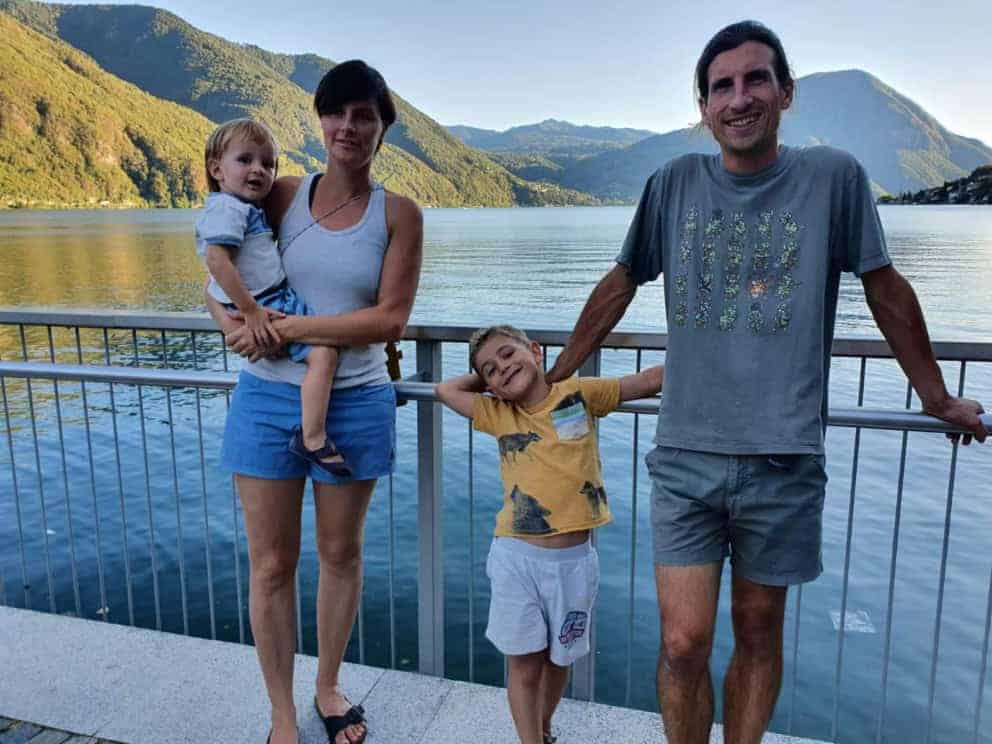
It's a cool autumn Sunday in Paris. I join Livio and his two sons, Haize, 6, and Luzio, 1 1/2, in a square in the 13th arrondissement. «The Learning Planet Institute, I couldn't see myself talking about it without my partner Leïla Périé and my children.»
Livio Riboli-Sasco was born into a family of public health researchers. His Italian father researches the link between cancer and diet, while his French mother focuses on tobacco, the environment and cancer. «My study path is pretty well mapped out».», explains Livio. A good student, he attends the Lycée International Public in Lyon, where he enjoys literature, humanities and science courses. «I loved everything, I was very versatile. Livio chose a scientific preparatory class. «I really missed the humanities and literature at that time.» A few years later, when he joined the École Normale Supérieure (ENS), Livio returned to the humanities, thanks in particular to the history of science courses taught by Michel Morange, but also to the introduction, at students' request, of courses on environmental issues. In 2005, he was part of the first class of the master's program Interdisciplinary Approaches to Life (AIV) at Learning Planet Institute, then CRI. «It was really bric-a-brac, Livio recalls. «At the time, I was elected to the ENS and the boarding school was run by the students. I knew the staff, so I asked them if we could hold classes in the canteen after meals. And we did. That's the way it really worked, there was almost a militant dimension to it.»
«I do activities in the canteen too! We do activities but there's not much space.», says Haize, Leïla and Livio's eldest son, who joins us for a few seconds by the bench, before heading off to play with his friends.
During the year of his Master's degree, Livio founded the Paris Montagne association, which aims to build bridges between young people and the world of scientific research, in particular through the «Science Académie» program for high-school students. Livio continued his studies at the ENS and the Learning Planet Institute, began a thesis in biology, under the supervision of a certain François Taddei (co-founder of CRI). «The idea was to explore information exchange and evolution. I never liked doing manipulations in the lab, but I rediscovered my passion in my thesis, philosophy (and in particular the philosophy of science)». Within the Learning Planet Institute doctoral school, Livio wrote his thesis on biological information (His subject: Evolving information in living systems: a pathway for the understanding of cooperation and other major transitions - The evolution of information in living systems: an approach to understanding cooperation and major evolutionary transitions). After his thesis, he will continue with the philosophy of science, in particular the notion of biological heredity. This work will be carried out in collaboration with Francesca Merlin of the’Institute of History and Philosophy of Science and Technology (IHPST), which he joins as a research associate.
In 2011, Livio creates with Anne le Goff Frontières du Vivant bachelor's degree (FdV) of Université Paris Cité at the Learning Planet Institute, and directs the first year of its implementation. «The Learning Planet Institute is a long story».» says Livio, as his companion Leïla Périé meets us in the park.
A researcher, Leïla joined the Learning Planet Institute via the Paris Montagne association several years ago. «I gravitated a lot to the Learning Planet Institute, which was very stimulating».», she explains. Leïla taught a module in systems biology at the Master's level.
« We had carte blanche to teach. For example, we used board games to give exams to help people understand how biological systems work.»
Leïla is also a doctor, a full researcher at the CNRS and team leader at Institut Curie in the biophysics department. She now teaches cell dynamics at the ENS. «They also let me do what I want, which is really nice.», she smiles. A number of Master AIV from Université Paris Cité, Leïla, who has taught at the Learning Planet Institute, came to work with her, and she has very fond memories of them. -I've always said to Learning Planet Institute students If you're structured, the Institute will do you a lot of good, it will open your mind.» What's interesting about the Learning Planet Institute, she says, is both the emphasis on the impact of research, and a very evolutionary view of things:
«What must survive survives, and what must not survive does not! It's not always pleasant to live, but it's important not to get too attached to institutions for institutions» sake, as Ivan Illich says."
As daylight gradually fades in the park, we set off for the warmth of home. «The best thing about the Learning Planet Institute is its human diversity».». Leïla and Livio have the same opinion on the subject: that's what makes it so rich. As we walk along, they both tell me anecdotes from the early days of the Learning Planet Institute - whose campus is located right in the heart of Paris. In a game of ping-pong, Leïla and Livio recall stories that amused or touched them.
«In the early days of the Learning Planet Institute, in 2005, what I learned was that everything is more or less possible if you know how to organize yourself. It's crazy, you can explore lots of things, do fun things...», Leïla enthuses.
Along the way, we revisit a subject Livio and I discussed earlier: participatory research. It's an approach to research that's close to both their hearts. In creating the « l'Atelier des Jours à Venir »in 2010, Livio, Leïla and their fellow researchers wanted to highlight different ways of doing research. Their observation: the dominant academic model is showing its limits in terms of both reliability and production dynamics. Faced with this, the cooperative is experimenting with and training new ways of doing research: every citizen can be included in the process, and be a player in it.
Livio has been an employee of the cooperative for many years. «We are seven partners and four employees. What brings us together are deep friendships, what we do, a radical feminism in all of us, and the desire to remain human rather than virtual. We have a very professional framework, with job stability and respect for working conditions, which is really important to us.» The cooperative's activities can be grouped under two headings: the first is support for participatory research. «These are things I really enjoy doing».», says a delighted Livio.
«The idea is to carry out research over a long period of time (5 to 10 years), with citizens (groups of sponsors often invited by local players (town halls, local associations, etc.) who ask the scientists questions».
In Lisbon, for example, the cooperative has supported a participatory research project with Joao Cao, a socio-cultural organizer and doctoral student in philosophy, who is working with the inhabitants of a shantytown on marine water incursions, which threaten the habitability of their living space. « This is a key issue for the survival of the region. This kind of approach is great for residents, but also for research. In this particular case, a type of wave has been discovered that is highly destructive but never before described scientifically. Participatory research can therefore lead to fundamental research, and participatory work with local communities can have a significant impact, here on a global level, for all estuaries overlooking a vast ocean!»
L'Atelier des Jours à Venir This has led to requests for research in a wide range of fields: ecology, the environment, hydrodynamics, biodiversity perception, educational sciences... Another research project has recently been carried out with speech therapists in the Basque language. « These projects put research back into the context of people's lives (like the Basque language). We're no longer just dealing with theory, but with something that's useful for local communities. We're doing research on a hyper-practical need (in this case, language disorders) on which we can have an impact and come up with tools.» Basque is now the first language to be equipped with speech therapy tools. license Creative Commons.
Yet this participatory approach sometimes lacks credibility in the eyes of institutions. «The research system is still not decentralized, and the paradigm shift has not taken place. The institutions can't imagine that our approaches can be serious», explains a pained Leïla. «We make sure that our participatory research is at least as good as conventional research. We're very vigilant about this, because if we don't achieve this objective of reliability in the knowledge we produce, it could do people a disservice.», Livio agrees, filling the cups of tea on the table.
The second pillar of the cooperative's work is to support changes in research practices. «We do epistemology in research. From Bruno Latour put into practice!, smiles Livio, who, in addition to his work at the cooperative, is a research associate at a CNRS laboratory in the philosophy of science. «We're working on biological heredity with Francesca Merlin. We're doing science for fun, and I don't know why. publishes, from time to time.».
While we're chatting about education, Haize, highly motivated, does a math exercise suggested by his mom: count the macaroons on the table to find out how many each person will be able to eat! «He goes to public school, his parents explain. «When you're as interested in education as we are, it's not always easy to send them there because there are seriously insufficient resources to ensure that education is fulfilling for all children, but it's a conscious choice so that Haize and - in a little while - Luzio can meet children from all social backgrounds!»
As night falls at the end of the day, I take my leave of the family at bath time.
A portrait of Marie OLLIVIER