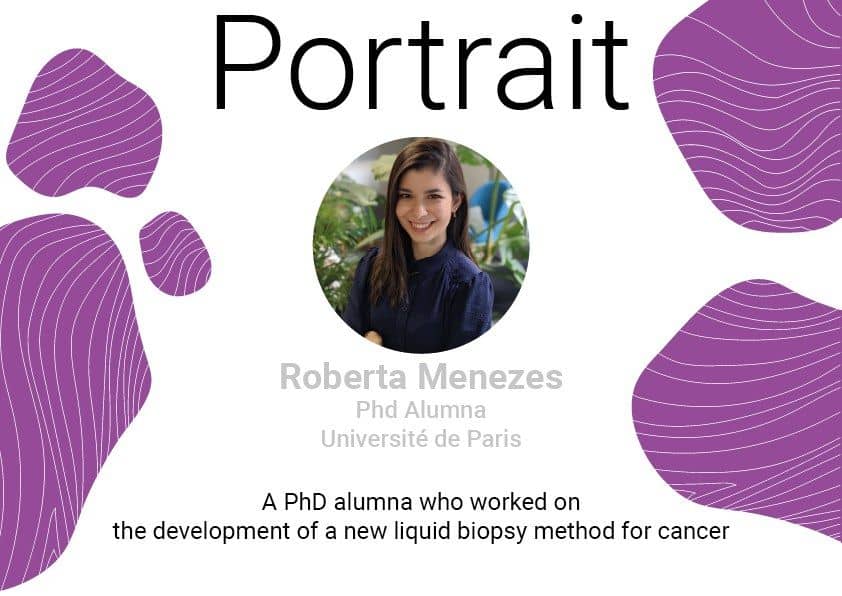
Roberta, of Brazilian origin, obtained her French baccalauréat in France before starting her university studies in the UK. During her undergraduate degree in biomedicine, she discovered the emerging field of synthetic biology - a highly interdisciplinary field, which seeks to standardize biology by fusing biology, physics, engineering, computer science and chemistry... At this point, interdisciplinarity became the theme of her career. This led her to do a Master's degree in synthetic biology at University College London before applying to the CRI doctoral program. She then chose a thesis project focusing on the use of microfluidics and synthetic biology to develop a cancer diagnostic method based on liquid biopsy, with the idea of using microfluidics to miniaturize diagnostic tests down to the palm of the hand.
Her PhD focused on the development of a new method for cancer diagnosis using microfluidics and synthetic biology. More specifically, the aim was to detect and quantify a specific type of nucleic acid molecules, known as microRNAs, which are present in human fluid samples, such as blood, urine or saliva. Their expression levels have been correlated with the development of various diseases, such as cancer. A biomarker signature is then defined by the expression pattern of different microRNAs, which can be correlated to a specific stage of cancer. Roberta believes that one of the most difficult challenges of an interdisciplinary project is clearly the involvement of several disciplines. Although her PhD focused on molecular biology, she also had to broaden her knowledge of synthetic biology and acquire completely new skills in microfluidics, which was not without its challenges. According to Roberta, the best way to overcome such challenges is to be patient and give yourself time to acquire these new skills.
FIRE doctoral school gave her exceptional training in general communication skills. She remembers giving talks and presentations of all lengths and to different audiences, which helped her not only to better understand her thesis project, but also to communicate about science in general.
The CRI and theUniversity of Paris has also helped her to develop a large network around the world due to the international nature of her students. She has met people from all over the world, who have gone on to work in other countries and with whom she is still in contact.
Roberta currently works as business developer and chief marketing officer at Paris-based start-up Eden Microfluidics, Eden, which provides its technology free of charge to CRI students. At Eden, they aim to help researchers and innovators explore the untapped potential of microfluidic technologies to create products or tools that can make a significant difference to healthcare. They develop new microfluidic materials and equipment to help researchers move seamlessly from device prototyping to mass production.
Roberta has always been interested in developing new medical diagnostic tools or researching biosensing for its potential applications in healthcare. During her master's degree at UCL, she worked on the construction of a DNA origami nanopore for protein detection, and took part in MIT's iGEM competition as part of a team tackling toxin detection in settling ponds in the oil refining process.
Although she no longer carries out laboratory research herself, she can now help other researchers to develop their point-of-care diagnostic or biosensing devices into an effective product. Her experience of using microfluidics for these purposes brings her closer to them and the challenges they may face on a daily basis. Her PhD gave her a great perspective on the field and the world, and she felt that her scientific expertise would be of great help to others.
Now that she's working as a business developer in the microfluidics sector, she can't imagine doing anything else. She loves using her scientific expertise to help other scientists advance their research, and to help her company grow. Her goal for the next five years is to build a sales and marketing team and become a market expert, to help her company grow and to see the field of microfluidics finally break through the industry barrier.