ENGAGE WITH SENSITIVITY, FORGE LINKS
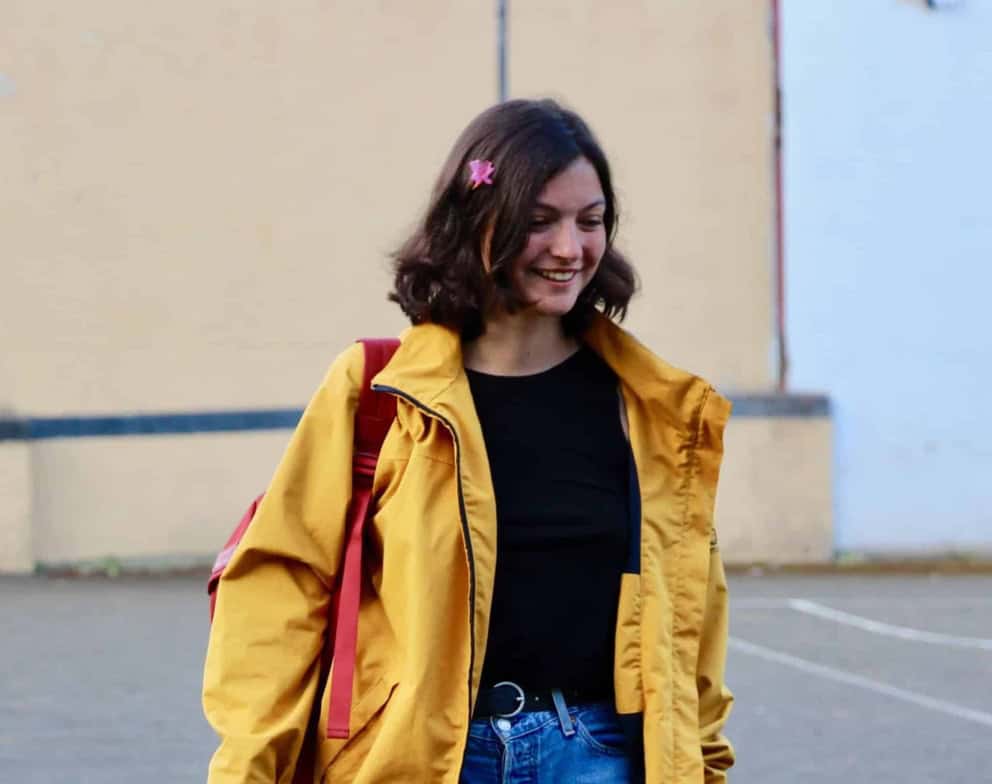
Fanny Gouel is completing her third year of the «Frontières du Vivant» degree program. She's already come away from the course feeling confident, and with a number of projects in mind, for hybrid structures that break down silos. Fanny's aim is to help people live together and build a fairer society. Meet a sensitive and committed student.
Fanny was in Marseille when we met. A city that the native Parisian is particularly fond of: «It's very polluted and wild at the same time. There's a lot of nature in and around Marseille.» Fanny discovered the city last March, when she did her internship at the LICA, Collective and Artificial Intelligence Laboratory. This shared-governance SCOP (société coopérative) raises awareness of social, digital and ecological issues by supporting organizations (associations, companies) and mobilizing collective intelligence to build cooperative and educational projects. LICA's third place, le 15, is a «Tiers-Lab des transitions» under construction, which Fanny co-piloted as part of her internship.
«This place wants to embody a small ecosystem and be a space for experimentation. I really feel at home here. There's a 6,000-square-meter garden and the people who work here are multi-tasking Swiss Army knives, capable of working in groups and curious about everything.»
Curiosity has characterized Fanny from an early age. As a teenager, she was interested in a wide range of subjects, and wanted to join Sciences Po or a BL preparatory school after high school, in order to maintain a certain multidisciplinarity. As a delegate in her final year of high school, she overheard a teacher talking about the Frontières du Vivant bachelor's degree at a class council meeting. A little research later, Fanny decided to apply, and joined the program. At the start of the new school year, she took part in a seminal event: the integration week in Bidart, in the South-West of France. «I didn't really know anyone. The students spend their days and evenings together, doing scientific workshops, design workshops, collective intelligence workshops, playing games, making music, having drinks... In this privileged atmosphere, Fanny resolves some of her discomforts to come out of the week more confident in herself and in the collective.
«Here, we all started from the same level. These moments allowed us to interact, to discuss what was going on inside us... it really touched me (...) On the last day, I cried as a child might at the end of a camp!»
The integration program unites the students of the Oxygen class (8th class and 8th chemical element on the periodic table) and lays the foundations for the work they carry out in groups throughout the year: «We worked a lot and spent time in rooms without teachers until late at night. We shared things that you sometimes don't share with friends you've had for five years. It's very unifying. During Covid, we really helped each other out. For a lot of people, we were real pillars for each other.»
The Frontières du Vivant program is a very special degree, according to Fanny. Students take biology, physics and maths, the courses are demanding and the timetable dense. But they also learn to be autonomous and creative, and to contact researchers...«.« It destabilized me in a good way».». Within the degree, the emphasis is on the path, the scientific method, rather than results and strict knowledge. «It's a stimulating and emancipating experience ». Fanny chose the subject of her research internship at the University of Paris-Saclay last year. the relationship between urban dwellers and the biodiversity that surrounds them. The student has also initiated and organized in 2019 with four other young people a Climate Day : « We went to a lot of trouble. We had a predefined budget and we could do whatever we wanted with it, we had carte blanche.» she says, still enthusiastic. The event, held on the premises of the Learning Planet Institute (formerly CRI), was a resounding success, attracting more than 300 people who attended talks by agricultural engineer Marc Dufumier and cognitive neuroscience researcher Thibaud Griessinger, conferences on 0 waste and the circular economy, and one by the Shift Project. The public also took part in workshops by the Climate Fresco and the «HeatWave in MyCity» role-playing game.
Today, Fanny and other alumni are rallying for the Frontières du Vivant bachelor's degree, whose funding is set to end in 2024. «We know how lucky we are to have experienced this training and to have been able to take part in it, to seize all the opportunities it can offer us, and that this is why we would very much like it to continue for generations of students to come!»
Fanny has developed a real ability to adapt in recent years. «I don't know exactly what I'm going to do, but it doesn't scare me any more than that. We're going to have to change jobs and adapt. I'm learning to take things as they come.» She's also more confident about the future. « I used to be a very stressed person. It's probably because I wasn't in the right place... »With the Learning Planet Institute and LICA, Fanny has found environments that suit her.. «I like hybrid structures that go in all directions, she explains mischievously. She is particularly happy when she can build bridges for a more caring and ecological society: bringing together the worlds of education and business, social issues and ecology, politics and citizenship... And despite an exciting research internship last year, she is also keen to work in the field, to have a real link with other people.
«I need to do something in action, in direct impact.
Fanny loves the role of facilitator, which she discovered during her collective intelligence training at LICA:
« Making sure that everyone has their say, providing a design, putting yourself at the service of the group - it's all very exciting. »Fanny, with her great emotional intelligence, now sees her sensitivity as an asset: «At CRI (Learning Planet Institute), we can do science without putting emotions aside, and I think that's really important. If we could accept each other's emotions and sensitivities, be fully ourselves and proud of our sensitivities, and listen to and share them, the world would undoubtedly be a better place.»
A portrait of Marie OLLIVIER