At a time when the challenges facing our society are increasingly complex and require an interdisciplinary approach, learning to learn is, more than ever, a democratic, economic and scientific issue. In order to increase its impact in the service of the common good through the construction of a learning society, CRI is pursuing its development.
In response to crises (social, environmental, economic) that were already in the making, researchers François Taddei and Ariel Lindner launched the CRI (Centre de Recherches Interdisciplinaires) in 2006, convinced that a new and unique approach to teaching through research was both necessary and possible.
Since then, the CRI has doubled in size every eighteen months, growing from a handful of people to an internationally renowned institute and a global community with several hundred partners on every continent, over 100 teacher-researchers, more than 40 researchers in residence, over 2,500 hosted students, 35,000 pupils, 120,000 online learners, including 40,000 school teachers. Today, CRI is a prestigious, award-winning 7,000 m² research and learning campus, offering a range of programs for all ages and backgrounds (from kindergarten to PhD, from lifelong learning to participatory science and inclusion, etc.).
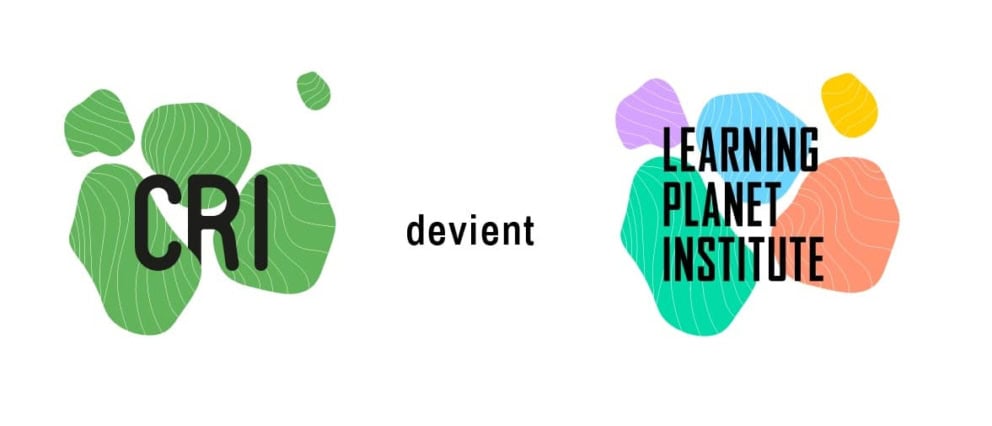
In order to increase its impact and respond to the ever-growing number of requests from public and private players, the CRI has redesigned itself and become the Learning Planet Institute. Its aim: to co-create a learning society to meet the challenges of our time and, thanks to knowledge sharing and learning through research, to become a gas pedal of creativity in the adaptation of individuals and organizations to a changing world.
The Learning Planet Institute represents a new chapter in the development of the CRI, in the continuity of its initial project, but now focused on the learning society. But it's also a new name that reflects not only an ambitious commitment to social impact, but also the necessarily multicultural dimension of an institute whose long experience of international cooperation is a major asset in achieving the goals it has set itself.
“Even if we change our name, we'll remain focused on our fundamentals, the ability to co-design with learners and teachers research-based learning environments that transcend disciplinary barriers, where they can express their creativity and learn to meet challenges. François Taddei.
To achieve this goal, the Learning Planet Institute is both and complementary (each dimension feeding the others within the same learning ecosystem):
- An research and development center on the learning society, with a state-of-the-art campus designed as a “collaboratory” for exploring the interface between learning and collective intelligence
- An learning ground where teachers and students participate equally in advancing knowledge, because every student is a researcher, and teaching is learning to learn.
- An consulting and training centre supporting the transformation of learning organizations: institutions, educational establishments, businesses, local authorities, foundations and associations...
- An digital innovation hub Our goal is to enable everyone to benefit from the combined advances of artificial intelligence and collective intelligence, through a digital ecosystem and a “GPS of knowledge” that opens up unprecedented perspectives for exploring and sharing dreams, knowledge and projects.
- An a place for discussion and sharing on the learning society, in particular via the #LearningPlanet* initiative co-created with UNESCO: an open alliance of change agents whose mission is to inspire and empower learners of all ages to tackle the societal and environmental issues of our time.
- An department of interdisciplinary research in life sciences and synthetic biology on the “Biology for Global Good” initiative, conceived as a middle-ground between different public and private sectors working in favor of health, with a view to achieving autonomy by the end of 2024.
With the help of its long-standing partners, including the Bettencourt Schueller Foundation, Université de Paris, CY Cergy Paris Université, Secrétariat Général pour l'Investissement, Ville de Paris, Inserm and Unesco, it will continue to promote a culture that combines research, entrepreneurship and social impact, enabling us to collectively imagine the means and methods to continually improve our societies.
(*) The Learning Planet Institute is a founding member of the global alliance #LearningPlanet, launched in January 2020, today brings together several hundred partners in the fields of education, training, social entrepreneurship, sustainable development and more. By bringing together these complementary players, this fast-growing international network serves as a catalyst for transformation, working to create a learning society at the service of the common good. Placing young people at the heart of its approach, #LearningPlanet also invites them to “learn to take care of themselves, others and the planet”, thus helping to promote a culture of hope and collective commitment.