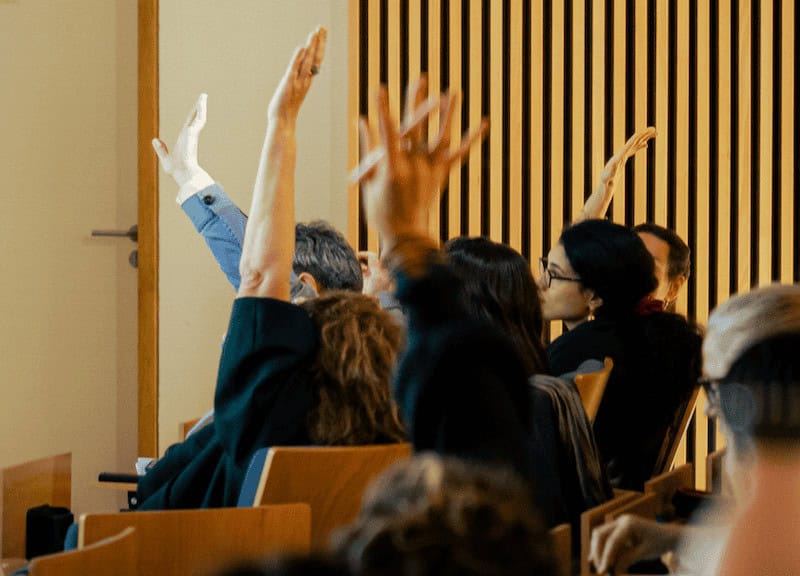
Co-created and hosted by Pavel Luksha, founder and director of Global Education Futures, the session “Nurturing the next generation of young peacemakers ”explores ways of improving and extending peace education by fostering synergies between institutions, researchers, educators, field practitioners and young peacebuilders, to ensure that its transformative impact reaches all sectors of society.
Rethinking peace education
Hilary Cremin, a professor in the Faculty of Education at Cambridge University, sets the tone with a provocative thought:
So many schools around the world are modeled on the military, with uniforms, queues, unquestioning obedience to authority, and a curriculum that valorizes war and conflict and doesn't say enough about the great peacemakers and builders of history.
Professor Cremin stresses the need to move from “peacekeeping” to “peacemaking and peacebuilding” in schools. She advocates restorative techniques and peer mediation to empower young people to resolve their own conflicts. These methodologies, she explains, enable students to be agents of peace by “They pass on their conflict resolution skills in their homes, workplaces and communities, becoming lifelong peacebuilders.
As part of his forthcoming book, Rewilding Education: Rethinking the Place of Schools Now and in the Future, Professor Cremin urgently calls for systemic change:
If we continue to educate as we have done for the past 50 years, we will face collapse on multiple levels - climate, conflict, inequality. Education must become a space for renewal, where young people develop the courage and tools they need to transform the world.
In line with this call for change, she also advocates the creation of lifelong learning centers, pointing out that “education do must not be confined to the classroom or to specific ages. We need to see learning as a lifelong, community-driven process.”
Young people, catalysts for peace-building
Echoing Professor Cremin's peace imperative and emphasizing the need for co-creation in education, Ilgin Pasli-Brombach, a young peacebuilder and founder and executive director of planIMPACT, stresses the importance of holistic, learner-centered methodologies and meaningful youth participation in the design and implementation of peace education.
Peace is more than the absence of violence. It's about transforming the conditions that create conflict. Education should be a tool that equips us not only with knowledge, but also with the skills, values and attitudes that enable us to act as agents of change.
Ilgin's powerful message underlines the importance of empowering young people, not as passive learners, but as active designers.Young people are not only the leaders of tomorrow, they are the leaders of today. We need to provide them with the tools and spaces they need to shape peace on their own terms.
Her experience with youth-led peace education initiatives demonstrates the transformative potential of non-formal education and the value of integrating social-emotional learning into peace curricula. Ilgin also shares valuable resources from the Youth Ambassadors for Peace network, including the Book of Peace Design and the Peace Fellowship Toolkit, which are available here.
A personal story of reconciliation and forgiveness
Candice Mama is a world-renowned freelance writer. She is one of the Top 20 African women named by the African Union and the United Nations, and one of Vogue magazine's 33 most inspiring women in the world. She brings a deeply personal dimension to the debate on peace. Recounting her encounter with Eugene de Kock, the man who murdered her father among countless others during apartheid in South Africa, Candice speaks of the path from pain to reconciliation, and of the role of education in shaping narratives.
Our children spend a lot of time in the school system, where they are taught their own history in a way that can be very difficult, and I would even say sometimes very violent.
Her encounter with apartheid's infamous “assassin number one” not only transformed her personal journey, but also led Candice to dedicate her life to the defense of peace and reconciliation around the world. Since then, she has worked with indigenous communities, victims of sectarian conflict in Northern Ireland and marginalized groups around the world.
Holding on to anger and resentment is like drinking poison, hoping to kill those who hurt us; but if it festers, it destroys us.
Candice's message is clear: peace education must include emotional literacy, storytelling and healing practices. These tools help individuals and communities to rebuild trust and find paths to reconciliation.
Systemic change and the role of institutions
Rina Alluri, Assistant Professor at the University of Innsbruck, UNESCO Chair in Peace Studies, a peace researcher and educator with extensive experience of conflict-affected regions, brought a deeply reflective and critical perspective to the session. Offering perspectives on the decolonization of education and the integration of experiential learning into peacebuilding efforts, she underscored the need for systemic change in the way we approach education, and emphasized collaboration between academia, peacemakers on the ground and conflict-affected communities.
As educators, researchers, activists and practitioners, we really need to unlearn the violence and impression we've been given... whether in our schools, our families or our societies.
Rina also points out that in conflict-affected regions, education plays a dual role: it becomes both a survival tool and a place of resistance.
“In areas affected by colonialism or conflict, classrooms are not always safe or courageous spaces. So it becomes crucial to find pockets of peace that exist in areas where people are free to talk, engage and heal.”.
She describes how socio-emotional learning and experiential learning - through art, poetry and storytelling - can provide students with the tools they need to process their experiences and envision a peaceful future.
Rina presents examples from the Salzburg Global Forum of Innovators for Peace in Asia, In addition, the Group has launched a number of new initiatives in the field of Social and Emotional Learning (SEL), where educators integrate social and emotional learning (SEL) into formal and informal education contexts. From Kenya to Myanmar, these initiatives offer innovative ways of engaging students in transformative learning experiences that foster empathy, critical thinking and conflict resolution skills.
A global framework for action
As Director of UNESCO's Peace and Sustainable Development Division, Christopher Castle brings a political perspective to the conversation. Underscoring UNESCO's commitment to transforming education systems worldwide, his talk highlights the fact that peace education and education for peace must move beyond theoretical frameworks to become a systemic and pragmatic approach.
Countries have recognized not only that peace is more than the absence of war, violence and conflict, but also the incredibly powerful and important role that education can play in preventing the conditions that allow violence, war and conflict to occur..
Christopher points out that UNESCO's Recommendation on Education for International Understanding, Cooperation, Peace and Human Rights, first established in 1974, was substantially revised in 2023. This updated recommendation reflects contemporary concepts, including socio-emotional learning (SEL), decolonization and global citizenship education (GCE). Its contribution shows that education systems must evolve to meet today's challenges, including the rise of global conflicts, environmental crises and social inequalities.
We encourage the co-creation of knowledge and the involvement of young people, who are not simply recipients of education, but play an active role in the education they deserve.
The 14 guiding principles of transformative education, which emphasize participatory, human rights-based and inclusive approaches, are one of the key lessons of Christopher's intervention. He stresses the importance of building ecosystems that integrate formal and non-formal education to ensure that peace education reaches the most vulnerable communities.
To find out more about the Guiding Principles for Education for Transformation, the UNESCO Recommendation on Education for International Understanding, Cooperation, Peace and Human Rights, and other work in this field, visitthe UNESCO resource page on peace education.
To remember : Education as a path to peace
The session ended with a consensus: education must be rethought to meet the complexity of global challenges. The cross-cutting themes of youth engagement and leadership, decolonization, social-emotional learning, peer mediation, AI, technological integration and experiential approaches emerge as fundamental principles for transforming peace education worldwide.
AI offers vast potential in peacebuilding, whether it's identifying early warning signs of conflict, advising teams on integrating diverse perspectives, or suggesting early interventions. However, its development needs to be further explored and co-created with young peace leaders around the world.. - Pavel Luksha
This vital conversation is not only a call for systemic change, but also a celebration of the groundwork already being laid. As we move forward, the question is not just what we teach, but how we teach it - and who we empower in the process.
Towards a peaceful future
In response to these global challenges, the Learning Planet Institute and Global Education Futures are launching a joint initiative - The Learning Planet Initiative. Peaceful Futures: Nurturing the next generation of young peacebuilders. In collaboration with international partners and leading experts, we aim to train and empower young leaders worldwide. Built around the co-design and acceleration of sustainable and scalable peace-building change projects adapted to their local contexts, the program is based on forward-looking strategic thinking, conflict transformation tools and a peace-oriented mindset.
- To find out more about the program, click here
- Watch the whole session
This publication is part of the UNESCO Chair in Learning Sciences, established between UNESCO and Université Paris Cité, in partnership with the Learning Planet Institute. The ideas and opinions expressed in this publication are those of the authors. They do not necessarily represent the views of UNESCO and do not commit the Organization.