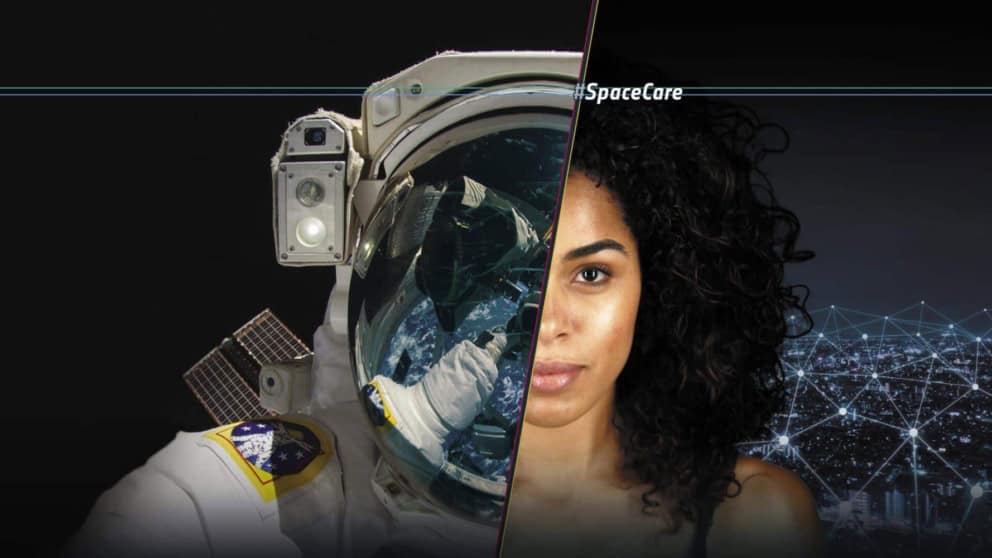
For the first time in eleven years, the’European Space Agency has opened its doors to new astronaut applications. Radoslaw Ejsmont, a long-term CRI Fellow, took the plunge and gave us the opportunity to highlight his research within the CRI Research Collaboratory. The CRI enables its researchers to’exploring the frontiers of science and venture into new territory.
CRI is proud to be a fertile ground for talent to continue growing and reaching for the stars, both metaphorically and physically!
BEING A CRI RESEARCHER

What did you want to do as a child?
I wanted to be a garbage truck driver, it seemed like a cool thing to drive!
But when I was in first grade, I got my first PC. While most kids were playing video games, I got into programming. In my first year of high school, we had an amazing biology teacher. That's why I ended up studying biology. I wanted to keep an interdisciplinary approach at university. So I studied mathematics, biology and chemistry, while continuing to do computer science on the side. I entered medical school and, halfway through, I found out I'd been accepted into my PhD program. I had to choose between medicine and a PhD. I decided that science seemed to be more existing. Before I was 30, I always said I had 48 hours in a day.
How did you hear about IRC?
It's a funny story! I was finishing my post-doctorate and a friend found the announcement on the Internet and said I might be interested. And here I am. I guess it was the right Google keywords at the right time.
What does CRI mean to you?
The house. I really like coming here. And with Covid, I practically live here. The environment is inspiring, the other researchers and students are stimulating, and the students are great.
Speaking of which, I didn't trust teaching at first, but teaching here is different and I really like it.
What are you researching?
My team and I try to create synthetic biology tools to study and recreate genetic regulation networks in vivo, using Drosophila or fruit flies - which are easy to grow and sufficiently complex to study. To do this, we will combine the activation and repression domains of already known transcription factors with DNA-binding domains designed to create synthetic transcription factors capable of precisely controlling the expression levels of a target gene. We want to design these genes to do exactly what you want, when you want. In fact, we want to create a toolbox for synthetic biology..
TO THE STARS

How did you start wanting to get up there, into space?
I started playing with a flight simulator and then got serious about it. I built a real cockpit in my apartment!
An extraordinary researcher overheard me bragging about my installation (which, for the record, took up quite a bit of space in a student apartment). He was a pilot and asked me: “why not do it in real life?” Why not, indeed!
So I got my flying license and started flying quite often. For me, it was a whole new level of freedom - it was freedom in three dimensions!
So being able to fly on Earth inspired you to go into space?
Not at first. I became interested in space fairly recently. I was inspired by the new space movement, when private companies took over, giving themselves the means to innovate very rapidly (like SpaceX, Blue Origin, etc.). We saw the emergence of interesting new technologies, such as SpaceX's reusable rockets. What's more, we now have the means to follow and observe all the experiments and explorations, as if we were watching a live feed aboard a spacecraft as it ascends. It really caught my imagination and seemed accessible. I started thinking that it would be nice to go there one day and that, even though I'm an ordinary person, it might become cheap enough for me to go when I'm old.
How did we go from “I could go there one day” to “Let's apply to become an astronaut”?
Last year at CRI, Didier Schmitt, Space19+ coordinator for human and robotic exploration at ESA, gave us a masterclass. I realized that ESA calls astronauts every 10 years, so I broke the ice by asking him: “Guys, are you still on board for space exploration because your last recruitment plan was 11 years ago?He told me it would happen again and that they were looking for a “researcher”. He encouraged me to apply and told me that “if you don't apply, you'll never know“
This is an optimistic question for you. Aren't you afraid of facing the cold emptiness of space?
I don't like risks, I like calculated risks.. I like to do things that give you a thrill, but you know what you're doing.
Do you consider yourself an explorer?
I like to discover, I like to explore, I like to get out of my comfort zone.
For me, it's above all something that brings together many of my passions: flying, research and the life sciences. Thinking about the long-term life of humans in space is exciting. This represents a wealth of opportunities in the life sciences sector. For example, learning how to grow our own food in space - vegetables, of course, but also meat. Synthetic biology could help us make meat more suitable for space, for example, with a higher concentration of oxygen!
Maybe one day I'll discover how to make fruit flies survive on Mars!
Would you like to become an astronaut?
ESA welcomes applications of all qualified applicants, regardless of gender, sexual orientation, ethnic origin, beliefs, age, disability or any other characteristic.
“ESA is an equal opportunities employer committed to ensuring diversity within our workforce and creating an inclusive working environment. To this end, we welcome applications from all qualified candidates, regardless of gender, sexual orientation, ethnic origin, creed, age, disability or any other characteristic. Female candidates are encouraged to apply
“L‘he most selective stage is deciding whether or not to apply.“, explains Thomas Pasquet. “Itmaybe one person in a thousand will be selected, but one in a million will apply. So please, please, please, apply, apply, apply.“
Would you like to join our research team?
Applications are now open until April 30!
Photo credits: ESA
Logo credit: Rocket by Made by Made & Research by Eucalyp from the Noun Project