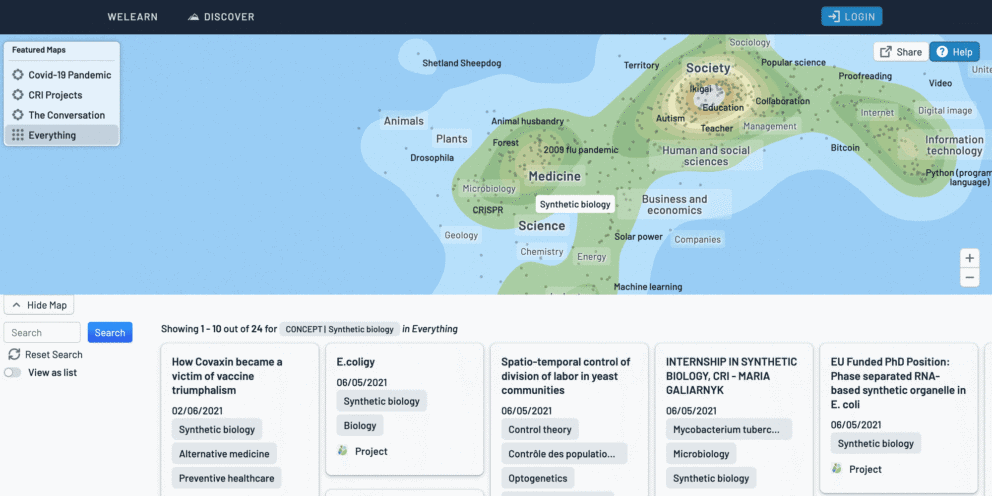
The Digital Intelligence CollectivE platform, based on WeLearn, People and Projects, will facilitate the sharing of resources produced within BioConvergence pour la Santé, a project awarded the "Domaine d'intérêt majeur" label by the Île-de-France Region.
Led by Université Paris Cité and in partnership with Sorbonne Université, Institut Curie - PSL, Université Paris Saclay, INRAE and Genopole, the BioConvergence pour la Santé (BioConvS) project has been selected by the regional scientific council as one of the 9 new Domaines d'intérêt majeur (DIM), as part of the call for projects launched by the Île-de-France region to support research in the region.
The BioConvS DIM aims to structure a territory of excellence, an international reference in bioengineering, bio-production and biotherapy. BioConvS will focus in particular on synthetic biology and genetic, (sub-)cellular and microbiota-based biotherapies. The creation of BioConvS will support synergy, interdisciplinarity and the potential for innovation that lies at the heart of these interfaces, in order to remove technological barriers and build scientific levers for breakthrough innovation.
A digital platform to facilitate resource sharing
At the heart of BioConvS, the “Digitale d'Intelligence CollectivE” (DICE) collaborative platform, steered by the Learning Planet Institute research collaboratory (UMR 1284 Inserm - Université Paris Cité), will be created to design, document and bring together BioconvS research projects. Based on the existing WeLearn, People and Projects technologies developed within the Institute, this virtual research space will encourage the development of collaborative projects and facilitate analysis of community dynamics and key outputs. This platform, open to the general public, will also strengthen the capacity for exchange between DIM partners and society at large.
More than €700,000 of DIM funding has been earmarked for the further development of Learning Planet Institute's digital tools, and more specifically for the addition of (1) databases and text analysis tools capable of gathering data from our other digital platforms, (2) Artificial Intelligence (AI) algorithms to analyze data and provide recommendations, (3) tools to define the desired measure of similarity when exploring new projects, and (4) metrics to achieve recognition of the best researchers and projects, including by peers, and new connections established between fields and projects.
By combining collective intelligence and AI, the DICE platform will be a real gas pedal for collaborative research projects.
A structuring project for the Ile-de-France scientific community
Île-de-France accounts for 21 % of France's healthcare activities, with a wide range of players including research centers, universities, hospital departments, small and large companies and investors. The richness of the Île-de-France ecosystem around synthetic biology and biotherapy/bioproduction are at the heart of this federating project to promote scientific unity and a common direction.
Today, despite the existence of numerous scientific and economic signals demonstrating the importance of biofoundries for biotechnologies, France has none. The DIM's structuring objective is to create a network of distributed biofoundries (with the participation of Sorbonne Université, INRAe, Institut Curie, Genopole and Université Paris Cité) to make life science design and engineering technologies accessible and thus position the Île-de-France region as a key player in biotechnologies, bioproduction and biotherapy. This structuring will involve the acquisition and pooling of high-tech equipment dedicated to the molecular engineering of living organisms and bioproduction. This will give a broad community access to cutting-edge synthetic biology and biomanufacturing tools, including bioreactor scale-up. This will enable the creation of genetic circuits, synthetic cells and bioprocesses on demand.
This structuring will also involve the funding of collaborative projects, theses, engineering and post-doctoral jobs between DIM teams, the organization of workshops and conferences, and support for the participation of student teams in the “International Genetically Machine Competition (iGEM)”, which moves from Boston (MIT) to Paris this year.
Key issues and objectives
The synthetic biology and biotherapy/biomanufacturing communities share a common interest in the manipulation of living organisms, the complexity of which poses a number of scientific and technological challenges. It is therefore essential to develop approaches that enable high-performance, standardizable and automatable production yields compatible with scale-up, just as it is imperative to develop innovative, standardizable and high-throughput analytical methods.
BioConvS aims to create synergies between different disciplines in the life sciences (biotechnology, analytical biochemistry, pharmacology, toxicology, etc.), engineering, modeling and artificial intelligence around different strategic axes linked to biosynthesis and biotherapy/bioproduction. The 1st research axis aims to develop tools and skills to improve the engineering of DNA, genetic circuits, cells and production/purification bioprocesses. The characterization, production, temporal control and evolution of biomolecules and their assemblies to form circuits, metabolic networks and new predictable, complex, integrated and robust cellular functions will also be explored. The 2nd axis aims to develop proof-of-principle therapeutics and potency tests. in vitro, ex vivo or in vivo for biotherapies and synthetic biology approaches for various therapeutic indications such as rare diseases, tumors, emerging infectious diseases... The 3rd axis will focus on the development of novel, high-throughput and standardizable analytical methods. The 4th axis will rely on digital tools for modeling and artificial intelligence to improve data analysis, modeling, processes and quality control. Finally, the 5th and last axis will address ethical, societal and economic issues related to life science engineering, biotherapy and bioproduction.
Learn more
Key figures
BioConvS is :
- 40 laboratories
- 70 research teams
- More than 250 researchers
- More than 150 engineers
- More than 300 doctoral students and post-docs
The founders, members of ComEx
Anne Galy (INSERM, Genopole), Harry Sokol (PU-PH, INSERM, Sorbonne Université), Pascal Hersen (DR CNRS, Institut Curie - PSL, Sorbonne Université), Stéphane Lemaire (DR, CNRS, Sorbonne Université), Amanda SILVA BRUN (DR CNRS, Université Paris Cité), Ariel Lindner (INSERM, Université Paris Cité)
The carriers
*Amanda Silva Brun - CR CNRS, co-coordinator of the IVEth Platform at Université Paris Cité, Faculté des Sciences, vice-president of the Société Française de Nanomédecine (SFNano) and co-founder of start-ups Everzom and Evora Biosciences. Contact Amanda SiIlva Brun
*Ariel B. Lindner - DR INSERM, director of Unit U1284 at Université Paris Cité, Faculté des Sciences, member of CSS1 INSERM, co-founder and director of the Learning Planet Institute's Biology for Global Good (formerly Centre de recherches interdisciplinaires - CRI). Contact Ariel B. Lindner
The consortium
*Institutional partners: Sorbonne Université, Institut Curie, PSL, INRAE, INSERM, Université Paris-Saclay, Genopôle.
*Valorisation partners: Medicen, CNRS Innovation, Inserm Transfert, Erganeo, etc.
*Industrial partners: Sanofi, Servier, Eligo Biosciences, Biomemory, etc.
Article inspired by https://u-paris.fr/bioconvs-domaine-dinteret-majeur-de-la-region-ile-de-france