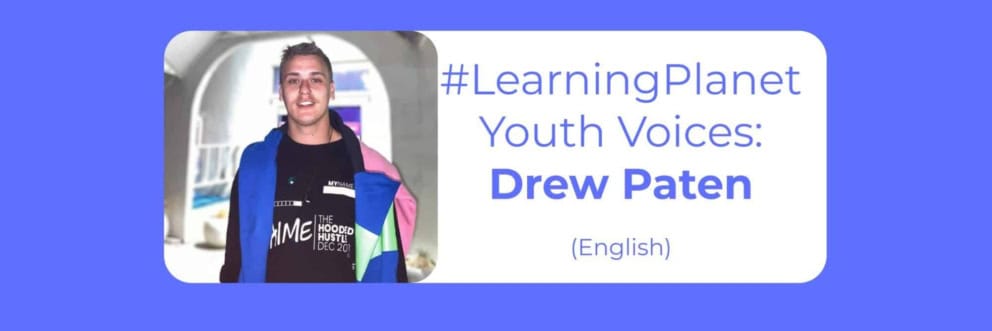
Meet Drew:
Drew Paten is a proud Gunai/Kurnai from Gippsland, Victoria, with links to Papakura and Aotearoa. Over the past five years, Drew Paten has held various roles in program delivery and mentoring, recruitment, global operations in the USA, and is currently Co-CEO of AIME Mentoring. His focus is on building bridges between marginalized youth and those in power, helping to alleviate educational inequalities. One of his core passions is amplifying young people's voices and representation in decision-making, on platforms and in venues that haven't yet done so.
Click here to find out more about AIME mentoring.
How can we ensure effective intergenerational collaboration between young people and decision-makers?
It is essential to give young people the opportunity to be heard and understood; it is necessary for young people to be considered as equals in all discussions. Albert Einstein said: “We cannot solve our problems by thinking the way we created them” We need to build bridges between young people and decision-makers. To tackle the complexity of inequity, we need to influence the ecosystem around our young people by enabling executives to give children a seat in the boardroom, engaging citizens to make a difference in their communities, and creating jobs and opportunities for our young people. That's why it's essential that youth participation doesn't stop at consultation, but extends to all projects, with mentoring and advice from decision-makers.
How can we create a meaningful and useful mentoring space between young people and adults? What would be the structure of such a space?
We can create and maintain a safe mentoring space between young people and adults by building bridges across societal divides and creating unlikely connections. In AIME's IMAGI-NATION{University}, we connect people so they can coexist in these spaces. A high school student sits side by side with a citizen, an executive, a teacher and a student. Within their tutorial group, {Uni} students exchange time, knowledge and understanding. Together, they rewrite the narrative and create system-wide change.
How do you think we can involve young people who want to have an impact but don't have easy access to participation (because of language, lack of networks, difficulties accessing and using technological tools)?
Solutions to many of these challenges already exist. The key is to build bridges between individuals, organizations and networks. Whether it's large technology companies, wealth holders or local university students willing to be mentors, everyone can play a part in providing opportunities for young leaders. When young people take to the stage at AIME, we see leadership, solutions, inspiration, and that's such a positive thing to share, especially in difficult times, as we saw with COVID-19.
What advice would you give to young people who want to make a positive impact? How should they start?
- Ask yourself what change you want to see, ask your friends, family and peers.
- Write it down, say it out loud, take responsibility.
- Ask questions, listen, research, study and read.
- Know yourself and your values
- Find people with common interests and find mentors.
- Above all, don't sit back and think you're too young to lead, or too young to contribute or make an impact. Your contribution and your voice count today more than ever.
What would you like to say to decision-makers?
Young people are not a problem to be solved, but a solution when they are given a voice.
Following the “Heart of Uluru Declaration” in 2019, a group of Aboriginal youth gathered in eastern Arnhem Land for the Garma. The youth forum was facilitated by AIME and culminated in a statement to the Prime Minister and education ministers across Australia - the Imagination Statement. The Imagination Statement.
Since 2019, we've seen many students stand up and take on the challenges they currently face, thanks to AIME programs in schools, on university campuses and within IMAGI-NATION{University}. It is essential, now more than ever, that decision-makers give young people the opportunity to create solutions, solve problems and imagine the future they want to see.
(Photo courtesy of Drew Paten; copyright: Drew Paten)