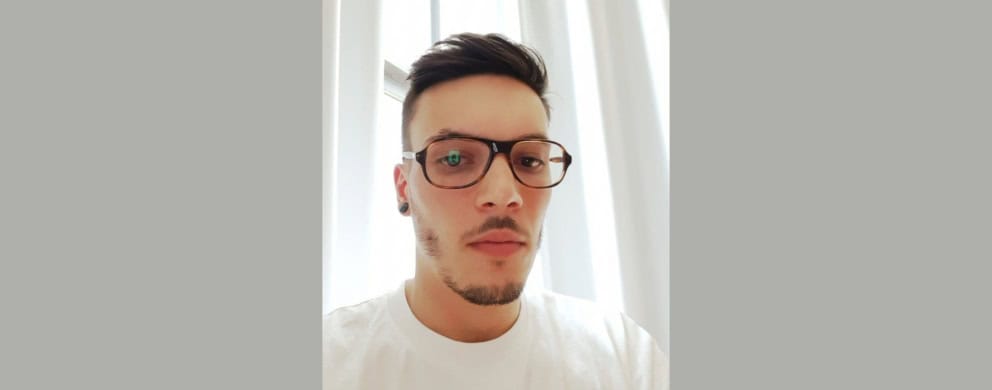
An SVT teacher in an REP+ middle school, curious about educational technologies, Matthieu Stein has been leading Savanturiers projects since 2016, creating links between different scientific disciplines. Here's a look back at his background and classroom practices.
HOW DID YOU BECOME A TEACHER? WHAT IS YOUR BACKGROUND?
I've been an SVT teacher in a REP+ secondary school for 5 years, having completed a Licence de Sciences de la Vie et Physiologie Sportive (Option Sciences de la Terre) at the Université de Savoie-Mont Blanc (Bourget du Lac). I then went on to do a Master MEEF SVTU at the University of Lyon 1, passing the CAPES in M1 and doing an M2 internship at the Lycée la Martinière-Monplaisir in Lyon. I also resumed my studies in 2018 to take a Master MEEF parcours 4 on Educational Technologies at the University of Cergy.
WHY DID YOU CHOOSE TEACHING? IS IT SOMETHING YOU'VE ALWAYS ENJOYED, OR DID YOU CHOOSE IT DURING YOUR TRAINING?
I chose teaching intuitively during my studies. Initially interested in sports and innovative technologies in sports practice, I started working in this field via my physiology skills, but having learned of the lack of places available for these professions, I pursued my Earth Sciences option and decided to practice a profession that combines the two sciences, so it was the teaching profession that presented itself to me.
HOW DID YOU FEEL ABOUT SCIENCE TEACHING IN SCHOOLS AT THE TIME?
At the time, I thought that science in the classroom would boil down to a study of the structuring and historical experiments in science, with an approach based on these experiments to support current knowledge. However, this approach based on the history of science isn't exploratory enough, and is sometimes too complex for students, with whom I think we need to turn to a personal, direct approach to get them interested in current events, and then discuss the different phases through which their knowledge has passed.
CAN YOU TELL US A LITTLE MORE ABOUT YOUR CLASSROOM PRACTICES?
I try to use topical or concrete examples for the students, developing elements of scientific research in stages. I encourage students to take the initiative and, above all, to take a stand on the issues raised in the session or sequence. Working on critical thinking is therefore what I try to incorporate into my classroom practices, by varying the supports and types of activities.
HOW DO YOU SEE SCIENCE IN YOUR CLASSROOM? HOW DO YOU SEE SCIENCE TEACHING IN SCHOOLS TODAY?
In my class and for my students, science must remain a discipline that asks questions and provides answers through a unique and universal methodology. In my class, therefore, science is a contribution to the students' methodology before being a contribution to knowledge. I see science at school as a parallel to laboratory science, a small-scale reproduction of collaboration between disciplines to develop and use new tools, and a means of testing and developing ideas around a subject or a socially relevant issue.
I try to take a practitioner's and analyst's look at science in schools by bringing social and topical scientific issues to life in class with my pupils, in order to respect the curriculum but also take advantage of scientific advances to interest pupils, give meaning to teaching and make links between the different scientific disciplines.
WHAT KIND OF PROJECTS DO YOU RUN WITH YOUR STUDENTS? DO YOU PARTICIPATE IN OTHER PROGRAMS? DO YOU CALL ON OUTSIDE CONTRIBUTORS?
Overall, I run Savanturiers projects with my students on the theme of the impact of Man on his environment. I don't participate in other programs or projects, but develop and adapt Savanturiers projects to other issues and disciplines (sharing knowledge and data between EPS and SVT, Physics-Chemistry and SVT, Geography and SVT, etc.). Outside contributors are those from Savanturiers when there are any, otherwise I don't call on contributors for projects. I prefer to work with colleagues from my own school or from another college.
WHY DID YOU GET INVOLVED IN THE SAVANTURIERS - ÉCOLE DE LA RECHERCHE SCHEME?
I embarked on this project to develop my skills in transmitting the scientific approach, which I'd struggled to bring to life in my first year. A colleague who knew about the scheme encouraged me to do a Savanturiers project to continue the project approach we had initiated with the students.
CAN YOU TELL US ABOUT THE E-FRAN AND SCHOOLS CHALLENGE PROJECTS?
The e-FRAN project is a project in which Savanturiers and the Créteil academy proposed that we work on a digital research notebook. Teachers like me who took part in the project try to indicate what teachers and students are researching and practicing around digital and science. The CNEC was born out of this project, thanks to the development of Tralalère and Savanturiers, and we were able to test it during the Savanturiers project and provide feedback on the software.
The Schools Challenge is an inspiring project focusing on the impact of mankind on the environment, with the challenge of developing a real prototype solution to climate change/global warming. The advantage of this project is that it involves students who are less “academic” and who are more interested in making things and DOING things, which is sometimes complicated in a Savanturiers project with 3rd graders, who may have ideas that are technically or legally impossible to implement in middle school.
HOW IS YOUR SAVANTURIERS PROJECT ORGANIZED DURING THE YEAR? DO YOU USE SAVANTURIERS TOOLS (NAVIGATION MAP, VADE MECUM, CNEC, ETC.)? IF SO, WHICH ONES AND HOW?
Over the course of the year, we decide with motivated colleagues how to integrate this into our programs. Generally speaking, we start with a common problem or questions from students or colleagues that come up around the general theme. To maintain coherence between several disciplines and the sometimes distant dates between project sessions, we used the CNEC last year and will continue to use it if possible to keep track of and manage the project between the different groups.
HOW DO YOU AND YOUR STUDENTS INTERACT WITH YOUR MENTOR?
Usually, the colleagues and I are the only ones who interact with the mentor. The two times we had one, we worked with the mentor to develop the idea and problem of the subject. Then, during the sessions, the mentor provided the students with documents to help us move forward in our research and discover documents from scientific research.
WHAT IS YOUR ROLE/POSITION AS A TEACHER IN THE PROJECT? WHAT IMPACT DOES THIS PROJECT HAVE ON YOUR TEACHING PROFESSION?
The teacher in a Savanturiers project is more of a methodological helper than a teacher providing essential knowledge or information. I already think of teaching in this way, and taking part in projects like Savanturiers reinforces my belief that it can be done, and above all, that it can be done efficiently if the upstream preparation is consistent with the level of the students. You also have to learn to let go of the reins of control that you often try to hold on to during projects. For in this type of project, the students must have the freedom to develop their ideas and prototypes, which we as teachers wouldn't necessarily have thought of.
-> Are you a teacher too? Embark on a research or engineering project with your class! From kindergarten to high school, explore fields of research: climate justice, agronomy, urban planning, sociology...