
Article written by François Taddei and Marie-Cécile Naves, first published in The Conversation.
The extraordinary synchronization of our experiences as a result of the pandemic is fostering a global awareness of the urgent need to reinvent ourselves and offers us the opportunity to transform the way we organize ourselves. This implies, both upstream and downstream of political decisions, sharing and exchanging ideas, and thus offering the conditions necessary for constructive citizen conversations.
«Authority is what makes others grow», according to Michel Serres. An authoritative debate is a debate that helps people grow.
And yet, with three months to go to the French presidential election, we are witnessing the persistent poverty of political debate. The renewed fascination with exclusionary, pessimistic and nostalgic ideas continues unabated. Attempts to divert attention from the major challenges of our time are multiplying. As if it were possible to ward off social demands and the major anthropological and ecological upheavals amplified by the pandemic.
In a democracy, authoritarian temptations to reduce the role of intermediary bodies and checks and balances, and to disqualify critical knowledge and science, are compounded by a tense defense of positions of power. With each passing day, the risk of a gradual disappearance of the possibilities of democratic debate takes shape, to the benefit of the trivialization of polemics, insults and lies.
Because democracy is a «form of life», as philosopher Sandra Laugier puts it, Since the confiscation of speech is deadly, it is essential to fight to preserve places for dialogue and defend formats that encourage mutual listening and the expression of narratives based on diverse registers of skills. Hearing what individuals and groups have to offer as a common agenda presupposes building a learning society in which everyone participates in co-constructing knowledge and recognition.
“We won't get out of this crisis only thanks to the frontrunners, but thanks to the frontrunners and to all those who put themselves at the service of others.” François Taddei, biologisthttps://t.co/x0sG3IvnUO
- France Culture (@franceculture) January 11, 2022
In recent decades, under the impetus of associative movements and scientific research, democracy has spread to the family and school as places of socialization. Private and intimate spheres have become political. The diversity of experiences, points of view, knowledge and know-how is a richness that political deliberation would be wrong to do without. Everyone, at every age, deserves to be seen as a genuine political subject. Like democracy, citizenship, from the local to the global, needs to be renewed.
Promoting fractal citizenship
Fractals were invented by the Franco-American mathematician Benoît Mandelbrot. They describe identical geometric shapes, whatever the scale at which they are observed. What might a fractal democracy look like? A democracy that functions in the same way at all scales. In part, it already is. By its history: it first developed within restricted perimeters before gradually expanding, applying its founding principles to ever larger scales and opening up to ever greater numbers of people.
Read also: Good sheets: «Feminist democracy, reinventing power»
This evolution has been closely linked to that of communications. The faster and further we were able to disseminate information (and laws), the greater the scope for democracy. But the possibility of direct debate remained dependent on the size of the forums, on the physical possibility of organizing contradictory debates. We debated in agoras, universities, courts, salons, academies, councils, clubs...
The Internet has shattered these limits, offering, for the first time in history, the possibility of organizing large-scale debates, including on an international scale.
By introducing «European citizenship», our continent has taken an important step forward. It grants all European citizens the rights set out in the Charter of Fundamental Rights of the European Union.
Calls to transform the’1TP5Education to meet today's challenges. How about turning schools into idea laboratories? Article by Sébastien Claeys (@UtopieNumerique), Head of the Editorial Consulting Master's program @LettresSorbonne https://t.co/SZuAk1ifmD pic.twitter.com/Kc9Jp7Iu5p
- Sorbonne University (@Sorbonne_Univ_) December 13, 2021
On the other hand, you can declare yourself a «citizen of the world» out of conviction, but no rights will be attached to this status. And no world organization is designated by direct suffrage. The United Nations, for example, has no «citizens» chamber". From the IMF to the WTO to the COPs, major economic, environmental and climate issues are not dealt with democratically. It's high time to enrich this system with other forms of expression and decision-making, at all levels.
Open consultations
The first option is to set up ad hoc assemblies on specific subjects. This is what France did with the Citizens« Climate Convention. 150 people, representative of French society, were chosen by lot and worked for several months to submit proposals to the government, some of which were included in the bill »to combat climate change and strengthen resilience to its effects".
According to a count by Le Monde, 78, i.e. 53 %, were «partially recovered», and 18 were fully recovered. As the political scientist Hélène Landemore, a specialist in deliberative democracy:
«The 150 citizens have put forward some ambitious proposals, and have also helped to raise the profile of climate issues in the media: 70 % of French people now say they are aware of these proposals.»
It would be interesting to observe the momentum generated by such an initiative in view of a more global movement: a future global citizens' assembly on climate, for example.
Read also: Collective intelligence at the heart of political and social issues
Second track: civic technologies («civic tech»). These are digital platforms for collecting data on all scales, including very large ones, organizing the exchange of ideas, evaluating proposals and, ultimately, helping to make decisions.
Transparent (open source), platforms such as All Our Ideas or pol.is are very easy to use, and are already used by millions of people. The first hosts tens of thousands of consultations and has, for example, generated over 42 million votes on questions submitted by the United Nations (on sustainable development), the OECD (on education), the City of Calgary (for its participatory budget), and the City of New York, which has used it as inspiration for several environmental projects.
Read also: In our digital world, how can we reinvent democratic debate?
The second was popularized by Audrey Tang, Taiwan's «citizen hacker», ex-leader of the «sunflower movement» in 2014, now a government minister. She has deployed a whole series of consultation and, above all, deliberation tools that are now an integral part of the country's democratic life. Thus, she explains, «people are free to express their ideas, to vote for or against the ideas of others».». But we discover that they «agree on most things, with most of their neighbors on most issues. And that's what we call the social mandate or the democratic mandate.
The time of «humble government»
A third approach has nothing to do with technique, but rather with methodology or state of mind: what the Finns call «humble government». It postulates that solving complex problems begins by questioning the structural and cultural issues at stake in political decision-making, in order to move away from vertical decision-making to a «network model».
Putting this humility into practice requires four conditions.
- The first is to seek a consensus, however minimal, on the objectives pursued and the shared values that underpin them.
- The second condition is to give autonomy to the various entities called upon to put the reform into practice.
- Third condition: feedback loops in which everything stakeholders learn from implementing the reform circulates.
- Fourth and last condition: the possibility of revising the reform on an ongoing basis, whenever a new situation or new knowledge calls into question what has been decided.
If technology is not the solution to the problem of the confiscation of the democratic voice, it is a tool which, properly used, helps to solve it. And while it remains logical and reasonable to give elected representatives time to implement their programs over several years, many subjects can and should be submitted to discussion and voting at a much more sustained pace.
The new Enlightenment must therefore update its formidable heritage in an egalitarian context and in light of two notions ignored in the 18th centurye century: acceleration (and the finitude of the planet) and the simultaneity of human experiences (globalization). And to help us move from a logic of having to a logic of being.
There's no shortage of proposals. Linking the myriad of initiatives and individual wills that exist with entities capable of acting on a large scale invites us to multiply middle grounds, massive open online debates (MOODs), where ideas are transformed into action, where people from different backgrounds co-construct possible futures.
To mark Unesco's International Education Day, the «What if learning was a party?» provides another opportunity. Growing abstention is not (only) a sign of citizen disengagement. There are many other ways of getting involved in community life, across all generations.. Those who aspire to political responsibility must no longer ignore them.
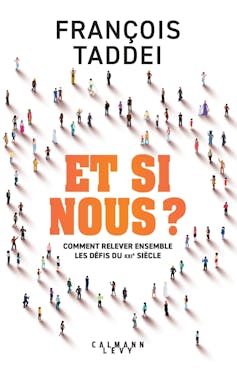
François Taddei's latest book, «What if we? How can we meet the challenges of the XXIᵉ century together?» was published by Calmann-Lévy in January 2022. For the same publisher, Marie-Cécile Naves is the author of «Feminist Democracy. Reinventing power».
François Taddei, Inserm Researcher, Director, Learning Planet Institute and Marie-Cécile Naves, Doctor in political science, associate researcher at the Learning Planet Institute)
This article is republished from The Conversation under Creative Commons license. Read the’original article.