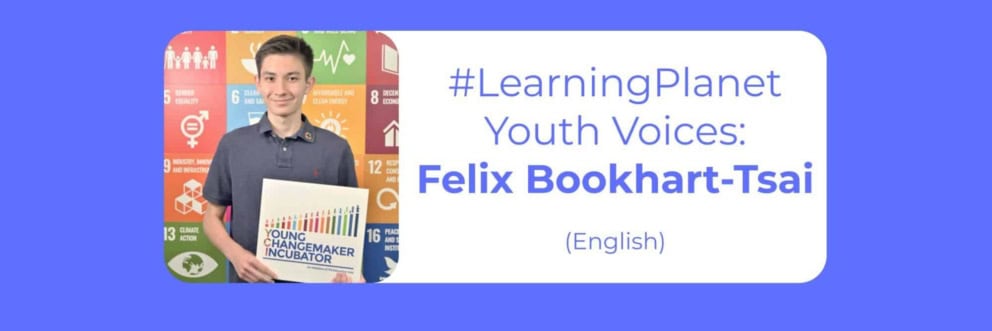
Meet Felix:
My name is Felix Bookhart-Tsai, I'm a student at the American International School and I live in Hong Kong. I was born in the United States. However, in 2013, my family moved to Hong Kong. From an early age, I've always been interested in wildlife. As I grew older, I began to realize the importance of animals to the environment and their vulnerability. I was deeply saddened to discover the extent to which habitats were being polluted and destroyed. That's why I started to think about the different ways I could contribute to minimizing this damage. My aim is to contribute to the preservation of wildlife and the natural environment, while offering help to those in need. My main SDGs are ODD 3: Good health and well-being, ODD 11: Sustainable cities and communities and ODD 14: Life under water.
Take a look at his initiative, SolarMask, here : www.solarmask.org
What don't adults understand about young people? What's the most common misconception they have about young people?
I have the impression that adults often neglect young people. One of these is the belief that teenagers are still maturing and have received less formal education than adults, and are therefore not in a position to be addressed on concrete issues, as they have nothing of value to offer. In reality, despite our potential knowledge gaps compared to adults, we are capable of having a significant impact on our communities. The minds of young people offer fresh perspectives and unique approaches to problem-solving, and as a member of the KIDsforSDGs community, we are witness to this through the group of 300+ young change-makers who lead both through intermediary and action. Ultimately, young people will be responsible for society's future progress and reforms, so it's of the utmost importance that we're included in the conversation when it comes to deciding how to move forward.
What was the first moment of enlightenment that encouraged you to take action for the society in which you live?
I vividly remember one day, in my first year at school, researching marine pollution and coming across an alarming statistic estimating that around 1.6 billion disposable masks would pollute the oceans by the end of 2020. In addition, I had just finished a school report on coral bleaching, which really opened my eyes to the importance of preserving marine life and ecosystems worldwide.
What projects are you currently working on? What challenges are you and your organization facing today?
I'm working on an initiative called SolarMask, which aims to reduce the pollution caused by disposable masks, while offering people in developing countries a safe, affordable and quick solution for reusing their masks. SolarMask promotes the use of a solar oven as a means of mask sterilization. The solar oven can be created using basic items found in most households. Once the oven reaches 60 degrees Celsius, the mask can be placed inside the oven for 10 minutes to kill bacteria. The main challenge I face is data collection. During my experiments, I encountered numerous obstacles that delayed the process. Although I have data to support the solar disinfection approach, I need to conduct further experiments to be absolutely certain that this method is totally safe.
How can we make intergenerational collaboration between young people and decision-makers a reality?
Capacity building for a social impact project like SolarMask requires user-friendliness and easy access to raw materials or prefabricated components. The first homemade solar oven can be refined through continuous experimentation to arrive at an ideal set of components. To maximize the chances of adoption, materials must be readily available at little or no cost - we need the support of corporate decision-makers. A full, up-to-date explanation of which materials work best, and what alternative materials can be used, would enable people to implement them whatever their local situation. These goals should enable more people to build the kiln in more places. As well as sharing within a community of like-minded people, contributions effectively broaden the research base and enable new ideas and/or local adaptations. This will help solve the problem of materials available in different locations and broaden potential collaboration between different stakeholders.
What would you like to say to decision-makers?
As the SolarMask progresses, we intend to set up a scientific advisory board to help us manage our research, development and commercialization strategy. We look forward to the commitment and support of the decision-makers who support our mission!
Copyright: Felix Bookhart-Tsai; photo courtesy of Felix Bookhart-Tsai