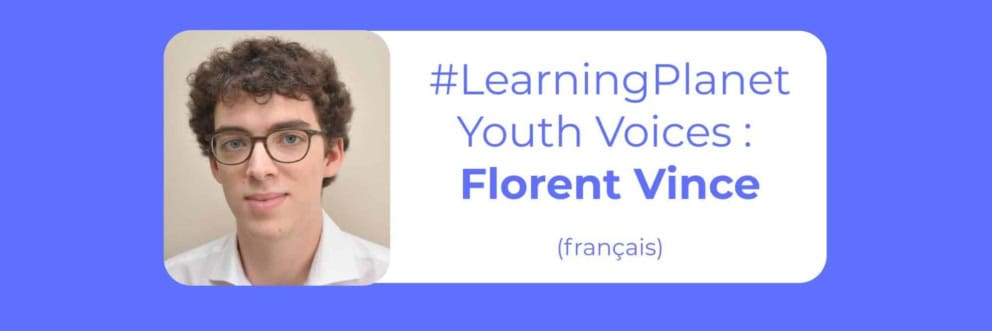
Meet Florent:
My name is Florent Vince, I'm 22 years old, and I'm studying to become an energy engineer at Grenoble INP - Ense3, UGA, as well as an Ecological Transitions course at Sciences Po Grenoble - UGA.
Concerned by socio-ecological issues and convinced of the power of commitment, I'm also president of the COP2 Student, an association that supports Higher Education and Research in the transition of their training courses and campuses.
What causes are important to you, and to young people today? Why or why not?
I won't speak for all young people, but the causes that come up most often are ecology and social justice. Our generation will suffer the ecological, economic and social consequences of climate change and the decline in biodiversity even more severely than they already do. And that's because of a system that doesn't care about the planet, and is a source of inequality. I believe that our generation rejects this system and the future it prepares, and is working to bring about a society that is more respectful of the planet and human beings. In any case, this is the raison d'être that guides many youth organizations today, including COP2 Étudiante.
What projects are you currently working on? What challenges are you facing today?
Today, I'm working to develop our association, COP2 Étudiante, to support as many higher education establishments as possible in the transition of their courses and campuses, and to impact as many students as possible. We're also in the process of setting up joint projects with other youth organizations!
In my opinion, the major challenge today is to scale up: to ensure that the actions carried out by the various organizations spread massively, to all strata of society.
How would you like adults to support you in this initiative?
I think the best thing adults can do to help young people today is, above all, to trust them. It's legitimate for young people to be concerned about socio-ecological issues, and therefore for them to take up these questions. Today, we have a vision of the world to propose, ideas to contribute, and the desire to co-construct. I think everyone, including adults, would do well to stop questioning our legitimacy, and start listening to us, and dialoguing with us horizontally, without regarding us as children. We don't want to take their place, we just want to deal with adults.
How can we ensure that young people's demands are genuinely listened to and taken into account?
By not confining them to an advisory role, but including them in decision-making processes, and considering them as adults. Young people certainly don't have as much experience as the not-so-young, and they can still learn, but today we're asking to be a force for proposals AND decisions about a future that concerns US. And the best way to ensure that our expectations and demands are genuinely taken into account is still to allow us to be proactive, and to participate in shaping the responses to our demands.
What advice would you give to young people who want to get involved? Where should they start?
United we stand, divided we fall! I think the first step is to find people around you who share the same desire to get involved. It helps to motivate each other in moments of doubt, so you don't feel alone. It also helps you to take on more ambitious projects, so you feel more effective.
Then, don't ask yourself too many questions, don't censor yourself (“we'll never manage that anyway, it's utopian...”): we're often surprised to see what we can achieve when we're motivated.
(Photo courtesy: Florent Vince, copyright: Florent Vince)