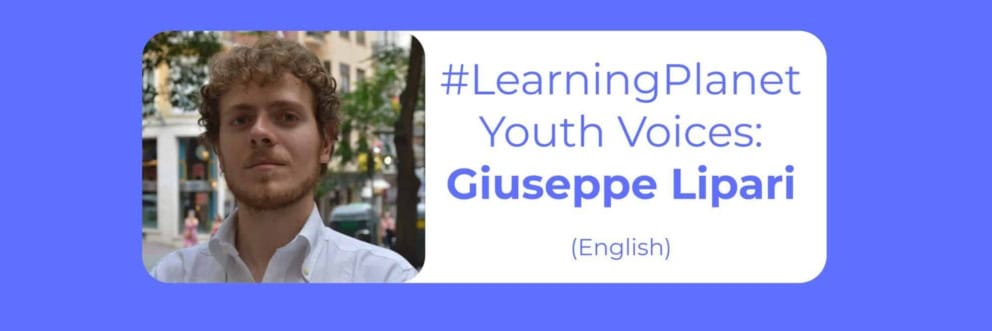
Meet Giuseppe:
Giuseppe Lipari is a member of the Steering Committee of the Global Student Forum, the worldwide umbrella organization of student organizations, with 199 members from 119 countries. Giuseppe began his activism in high school, joining Legambiente (the environmental league) and Arci (the Italian cultural association), focusing mainly on pro-environmental actions and anti-mafia campaigns. In high school, he helped refound the local branch of the RSM (Student Network) in Palermo, founded the school branch of his institute and was a member of the provincial and regional board of directors in Sicily. He began his international activism as RSM's international officer in 2016, guided the union's entry into OBESSU, the European regional platform of students' unions, and was a member of its board for the 2018-2020 term. He supported the creation of the first independent worldwide grouping of students' associations in recent history, the Global Student Forum, and is today one of the seven members of its steering committee.
Giuseppe holds a degree in Political Science from the University of Palermo and is currently studying International Relations at the University of Bologna.
Click here to find out more about the World Student Forum.
You can contact Giuseppe via giuseppe@globalstudentforum.org
What don't adults understand about young people? What's the most common misconception they have about young people?
A widespread idea, but fortunately not one held by all adults, is that young people must first and foremost learn and follow processes decided by others. In reality, young people, even in high schools, already have the tools to understand politics and formulate complex demands on the political system. What's needed is training, as for adults, and there are many organizations that provide this. What is often lacking - and this is the main difference between the generations - is space for genuine active participation. Young people should be included fairly in decision-making processes, respecting the pluralism of the youth constituency, avoiding tokenism and understanding that age is not enough to be a youth representative, nor to represent all young people. A school student representative will not say the same thing as a university student representative, a young trade unionist or a party youth leader.
What was the first moment of enlightenment that encouraged you to take action for the society in which you live?
I grew up in a family that was very involved in politics, albeit from a working-class background. They taught me how injustice can affect the lives of disadvantaged people and, on the contrary, how good social protection can guarantee a better life for all, without discrimination. I started working against pollution because of the living conditions in my city, Palermo, which suffers greatly from its effects. Similarly, it seemed natural to me to get involved in anti-mafia activism, because of the suffering imposed on the Sicilian people by organized crime, which affects our living conditions, our democracy and our effective rights. In high school, I started out as a class delegate to facilitate cooperation with teachers, but then I realized that the values I'd acquired in my previous experiences could have enriched my fight for students' rights, so I joined the RSM union.
What projects are you currently working on? What challenges are you and your organization facing today?
Since 2018, my work has focused on the international level, because there was a need in my union to get better connections at the European level, then after serving in OBESSU, we saw a similar need at the global level. But in reality, having the privilege of working internationally, I can say that student unionists and activists have everything they need to understand each other. What's harder to do in reality is to meet financial and organizational needs while remaining committed to totally independent student activism, but ESU (university students) and OBESSU (school students) in Europe have proved that it's possible, and the World Student Forum is on the verge of becoming financially viable.
How do you think we can involve young people who want to make an impact but don't have easy access to opportunities to get involved (because of language, lack of networks, difficulties accessing and using technological tools...)?
When I worked at local level, I was confronted with some of these challenges, particularly in trying to include learners from less privileged schools, lacking the most basic services, and students from immigrant backgrounds. I believe that the effects can only be felt if organizations and movements decide to invest structurally in these communities. The first thing to eliminate is the stigma, sometimes present among well-educated and wealthy activists, because it should be clear that everyone deserves opportunities and that it's also civil society's job to provide them to all potentially interested individuals and groups. Participation in mixed contexts may become slower, but its results are certainly richer and provide a better understanding of society as it really is.
What advice would you give to young people who want to make a positive impact? How should they start?
My advice would be very simple: unite because you'll be stronger than if you stayed alone. It's not the easiest thing to do, and we're all different when approaching new people and groups, but there's no doubt that being part of a bigger team with people who share your conditions, concerns and hopes will enable you to better defend your rights, and also to meet some extraordinary people. Organizations and collectives aren't always perfect, so don't expect to like every aspect of those present in your school, campus or region, but becoming active can also allow your voice to have an impact on things to change, by making these structures more representative. And if the existing structures don't meet your aspirations and ideas, why not consider creating new spaces? I did both, I joined the student union in my town and, with a great team, I created a new space in my school, different from the ones that already existed, which still works today, and it was incredible.
(Photo courtesy of Giuseppe Lipari; copyright: Giuseppe Lipari)