In November 2021, the iGEM Paris Bettencourt team presented its Mini.Ink project for the annual international iGEM competition. A project combining sustainability, bio-safety and social considerations in the field of enzyme production. Interview with 2 team members.
For several years now, a handful of students from the Université de Paris - Learning Planet Institute, and from other backgrounds, have been taking part in the global challenge proposed by the International Genetically Engineered Machine foundation: the iGEM Competition. The competition encourages students to form interdisciplinary teams to push back the boundaries of synthetic biology and meet the challenges of today and tomorrow. Every year, some 6,000 participants from all over the world propose their projects, which they carry out both inside and outside the laboratory: scientific communication, fund-raising, protocol proposals and team management.
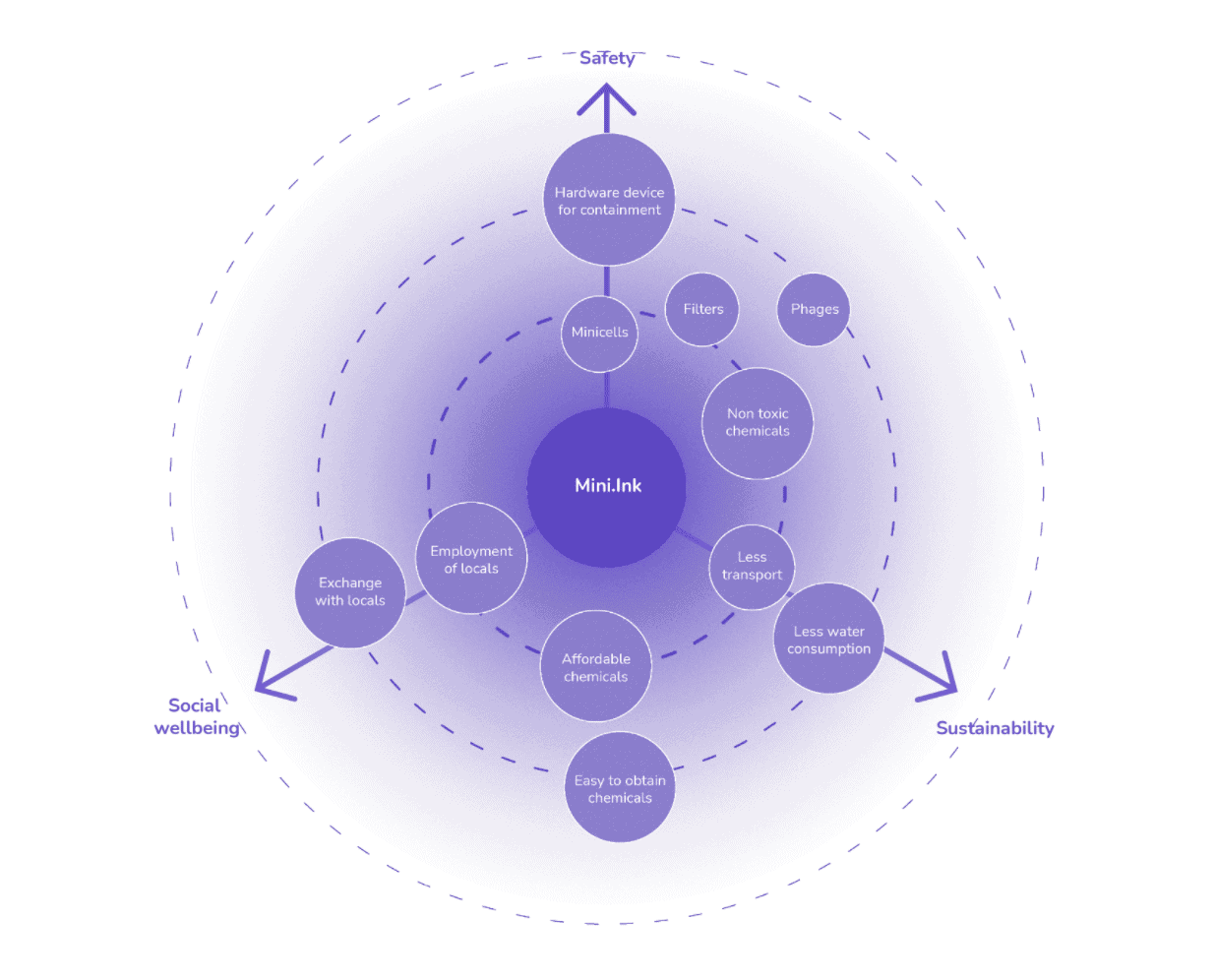
In 2021, the iGEM Paris Bettencourt team, Mini.Ink, has developed a method for producing a new type of indigo pigment for safe textile dyeing, without the need for purification or the addition of chemicals, using bacterial mini-cells. The nano-sized cells are chromosome-free, a technique specifically designed to guarantee biosafety in synthetic biology applications. This work, partly carried out at the Learning Planet Institute, included the functional prototype of a machine for producing mini-cells, the hardware. These remarkable results have earned the iGEM Paris Bettencourt team the following awards a gold medal (watch the video announcement here), along with a price for Best Manufacturing project. It was also nominated for awards in three other categories: Best Wiki, Best Human Practices and Best Hardware.
Interview with Juliette Bellengier and Clément Galan, members of the iGEM Paris Bettencourt team.
Juliette and Clément are both following the route Master AIRE Life Sciences. Before embarking on his Master's degree in life sciences, Clément's undergraduate career was focused on mathematics. Juliette, for her part, was already a regular at the CRI, now Learning Planet Institute, having graduated from the Licence Frontières du Vivant ; an already highly interdisciplinary background combining mathematics, physics, chemistry, computer science and biology.
Can you tell us more about the iGEM Competition?
[Clément] It's an international bio-synthetics competition that brings together, depending on the category, masters, bachelors and high school students from all over the world, to work on projects for a year. At the end, there's a huge gathering [the Jamboree] where everyone presents their project, and where you can make lots of contacts through this great community.
[Juliette] There are also lots of different categories, both for projects and award categories; there are lots of possibilities for synthetic biology.
Juliette and Clément put a lot of themselves into the project. It's a very full commitment, with a wide range of missions: laboratory work, modeling, but also team communication and coordination, creation of the project presentation website, partnerships with other teams and organization of the Jamboree [a weekend gathering of teams to announce the results of the iGEM competition].
How did you put together your team?
[Clément] It's a project that requires a lot of motivation and investment. In the first phase of the project, there were more than fifteen of us, and as time went on, a core group of ten or so stayed together. And then, depending on what we were doing, we needed different kinds of expertise, so we went to different people. If there's ONE thing I hadn't understood before starting the project, it was just how complicated it can be to get organized as a team! And then... (...) We spent hours reorganizing our notes.
[Juliette] We also had so much research and so many different parts to our project that we almost each had our own part of the project. The challenge was to coordinate and bring all this information together to form a coherent whole, accessible to everyone. And that's how the website came about. It took a lot of work, but the result is worth it!
Throughout the project, student team members are left to their own devices. Project management, choice and adaptation of laboratory protocols, definition of equipment and deadlines, etc. The team does, however, benefit from the support of mentors.
What was the role of your mentors Alexis Casas, Aya Gomaa, Edwin Wintermute and Ariel Lindner [co-founder and director of research at the Learning Planet Institute]?
[Clément] They gave us a framework and helped us to stay within our limits.
[Juliette] They also have this experience of the competition and iGEM which allows them to give us ideas. For example, when we started out, we had lots and lots of ideas. At that point, they were more present to assess with us the feasibility of the projects we had in mind. The iGEM project had to be developed in 9 months, including 4 months in the lab, which is a very short time. They also helped us contact scientists (authors of protocols we wanted to adapt).
[Clément] But at no point did they make a decision.
[Juliette] They accompanied us, but always let us do our own thing. (...) We developed a level of autonomy, for example in the lab and in research, that we'd never had before, especially in terms of intensity and duration. It trained us in all kinds of aspects: lab work, modeling, website code, etc.
[Clément]... communication...
[Juliette] ... and collaboration between teams! This is one of iGEM's key criteria: getting teams to collaborate with each other.
Where did the idea of working with mini-cells come from? How did this project come about?
[Juliette] During the brainstorming process, we had a wide range of ideas, from biosensors to biofilms. Then someone told us about these organisms. We started reading scientific publications on these mini-cells. They are used in delivery systems, for example, to deliver drugs to certain parts of the body. Mini-cells are used a lot in this field because they have the particularity of being very small and able to get into places inaccessible to bacteria. And most of the articles on mini-cells dealt with this subject. As we delved deeper into the subject, we realized that we could also use these cells for other purposes.
[Clément] We took this idea, which was a bit out of the blue, and applied it to our values - working locally, respecting the environment - and to a visual project that we could show people and that they would quickly understand. That's why we also turned to pigments.
[Juliette] Behind it, there was also the desire to show the other applications of these mini-cells to enzymes, not just pigments (which serve our project to make it understood), and to fit in with the consequences and achievements of covid's time, notably the need to relocalize [production].
[Clément] Another use of our project is to apply it to an enzyme called taq polymerase which is the enzyme used in PCR tests. We could produce this enzyme more locally and more simply, and continue to use it in PCR tests.
[Juliette] And above all, with the hardware we've created, we can ensure that the whole system is secure. And that's a strength. It avoids everything from human error, possible contamination, or possible biological or chemical risks.
[Clément] We were also careful to limit all the purification stages, which use a lot of chemicals and handling time. With this small machine, the hardware, everything is automated and simplified, to achieve a result which is certainly not pure, but which does what it is asked to do.
But what are mini-cells after all?
[Juliette] Mini-cells are organisms that were discovered several decades ago, but haven't been characterized very much. We don't have a lot of information about their size, life span and so on.
[Clément] “Characterize”[in research], it's really “define”In the scientific sense. Try to describe as much as possible what you're working on.
[Juliette] There was also an interesting part about these mini-cells that wasn't covered in the papers, and which we may be able to address [later on]: the ethical aspect. Mini-cells are not considered living beings because they don't grow.
[Clément] And according to the current definition of a living organism, it has to be able to grow and replicate. This is not the case for mini-cells. BUT they are capable of producing proteins and are metabolically active in the same way as all the cells we have in our bodies. A mini-cell does everything a bacterium is capable of doing. We thought it was so simple, and so little studied, and so full of potential!
[Juliette] The fact that they don't divide or grow was a good point for the safety aspect, from a biological point of view. We also explored how we could ethically use these organisms and how we could qualify them. And that's really something new, because we hadn't found these aspects in the literature.
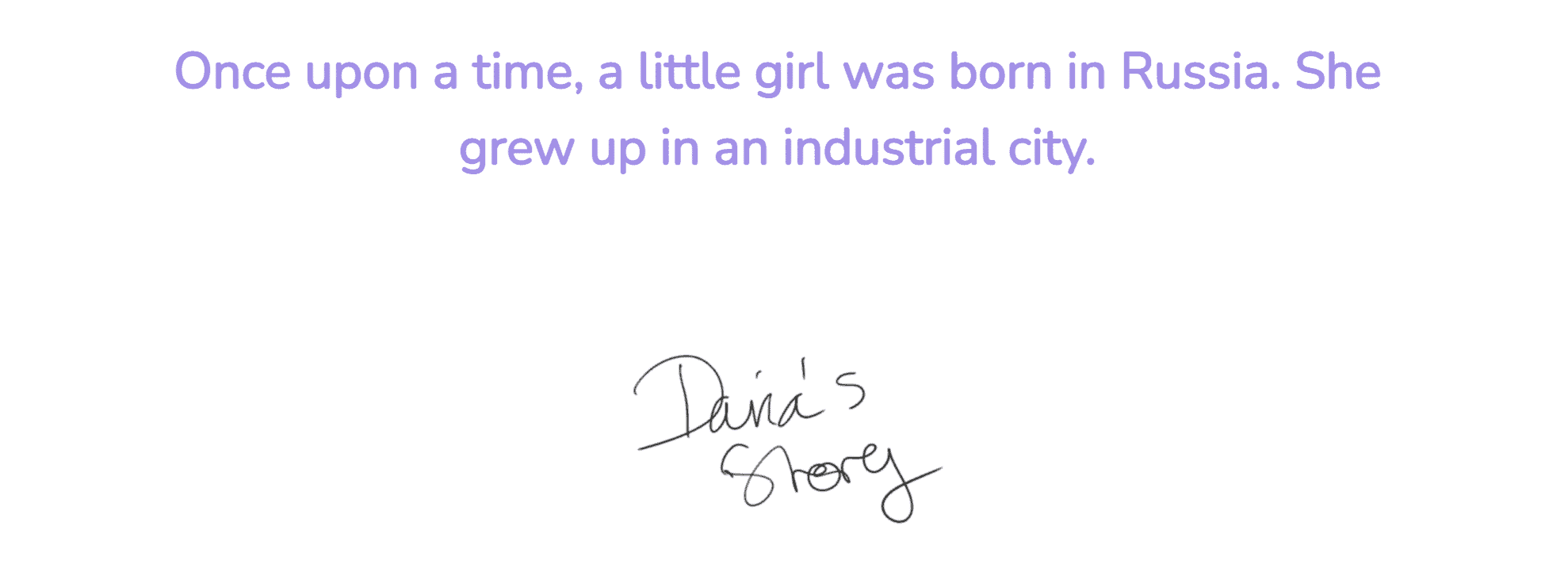
The story of the project as described on your website is particularly telling. Is it a true story?
[Clément] It's a bit romanticized... but the heart of the story is true, yes! We wanted our project to be understandable, to be able to communicate it and show it off. That was one of our main objectives.
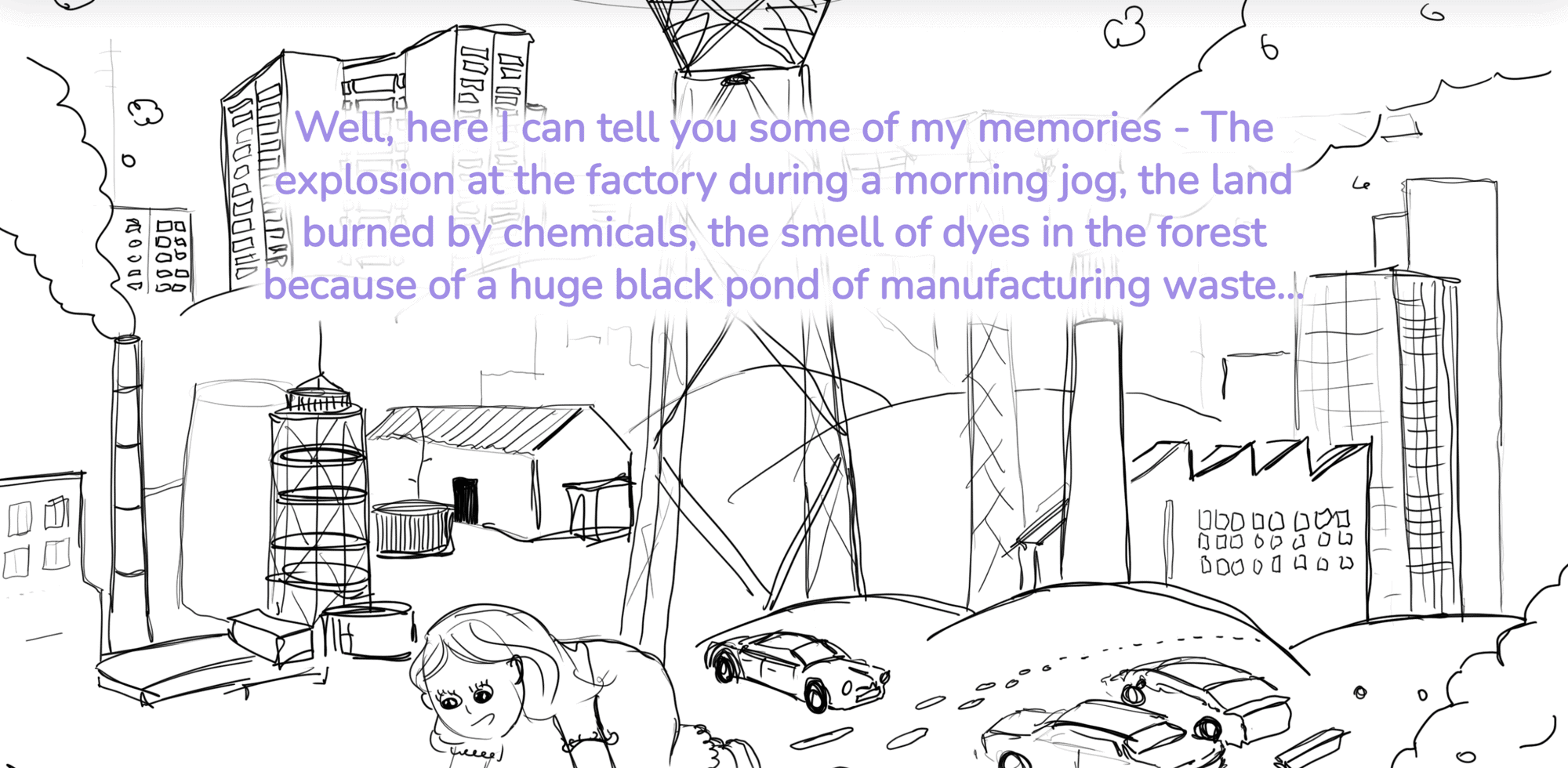
[Juliette] We wanted everyone to see the project's potential. Industrial production methods have very real consequences on the direct environment of these factories, places of production. And this story, based on Daria's experience, was a great way of communicating the subject. Starting from Daria's experience with the pigment industry, which is very polluting, at least on this scale, we also wanted to extrapolate, to show that this is an example, but that any large-scale production has a non-negligible impact on the environment.
[Clément] The need to communicate about biotechnologies also stems from the fact that most people are reticent about the subject, they're a bit afraid of it. And we really wanted to take a more positive view of biotechnologies: you can do a lot with them, you can't be afraid of them.
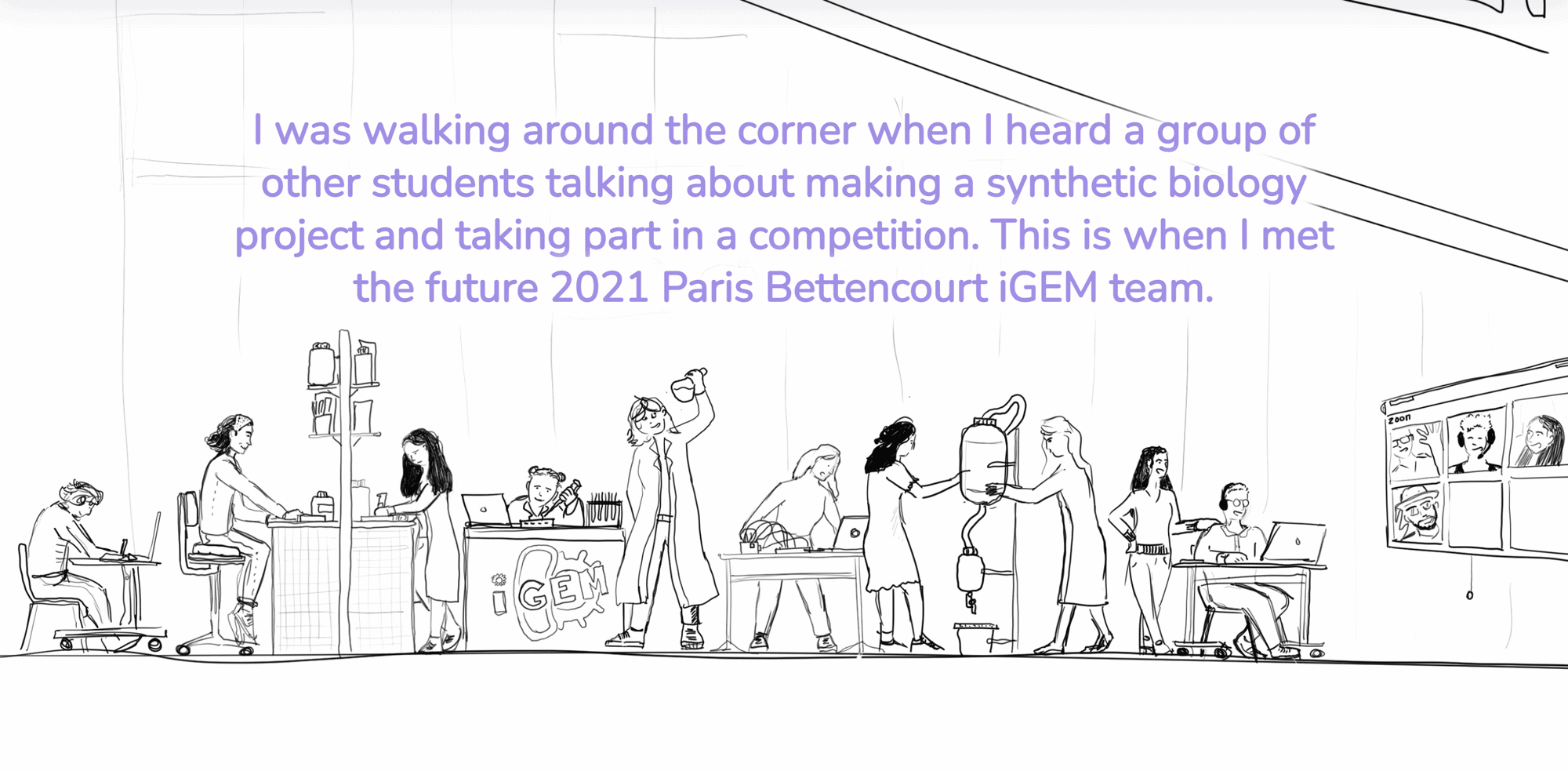
Thanks to the hard work put in by each team member, in research, IT development and collaboration, the iGEM Paris Bettencourt team distinguished itself in several areas of the competition.
At the end of this scientific competition, you were nominated for 4 prizes, one of which you won.
[in unison] YES!
[Clément] At the end of the project, we applied for several award categories. First, the iGEM Competition made an announcement of the preliminary results, which communicated the nominations for these awards. We were lucky enough to be nominated for FOUR categories! Even at this stage, we were thrilled!
[Juliette] And then it's time for the awards ceremony.
[Clément] First prize announced: “Best Manufacturing Project”...
[Juliette] ... one of the categories we were nominated for...
[Clément] ... and then we see our name! Everyone started shouting!
[Juliette] We also had 3 other nominations. Best Wiki (the website), which was already a great nomination because in terms of execution, structure and content, it was something that impressed the judges. There was also Best Integrated Human Practices: this is a central theme in iGEM: how our project will influence and how the world has influenced and will influence our project...
[Clément] ... means integrating a project into the community through communication and interaction with the various players.
[Juliette] And the last prize was the hardware.
[Clément] Our hardware, This is our machine. This is the bioreactor our team built. The judges were impressed by its simplicity, and by what we were able to achieve in such a short time.
[Juliette] I think the jury also liked its adaptability. Like the whole project, this hardware can be applied in other fields. And we've proved that it works, that it's functional; that's a big step forward in hardware production. Our hardware has several functions: cultivating our bacteria, producing the enzymes of interest. It was our container with which we could both control the parameters we were interested in (temperature, for example) and leave it on its own.
You also won a gold medal. What does it represent?
[Juliette] There were also medals to which each team was entitled: bronze, silver and gold. These medals are awarded to teams when they have met the criteria set by iGEM for a particular medal level. The criteria for the gold medal include collaboration, success in bioengineering, modeling and human practices - it's all very interdisciplinary!
[Clément] And we won the gold medal! The more the project progressed and took shape, the more we thought we could go for that gold medal.
Traditionally, the presentation of awards and medals is the subject of a special event: the Jamboree. Our interview takes place a few days later.
Can you tell us more about this “Jamboree”?
[Juliette] This year, our team, the iGEM Paris Bettencourt team, offered to host a number of students from different iGEM teams - mainly European teams, although there was also a team from Egypt! So we brought together 120 students at the CRI [now the Learning Planet Institute] for a weekend, during which we had lectures by researchers from the CRI collaboratory [now the Learning Planet Institute], and were able to discover the projects of the other teams present. It was a great way for us to end the competition on a high note!
[Juliette] When it came to organizing the event, we knew we'd be supported, and the premises lend themselves well to this kind of event... so we figured if we were going to be involved in the competition, we'd be involved right to the end! And it worked out pretty well logistically, being both in person and connected to the rest of the teams around the world.
[Clément] We got many, many thanks! The joy of the people who took part... it was really worth it.
What will you take away from this experience?
[Juliette] It was a very rewarding 9 months in many ways. The iGEM competition is very interdisciplinary. The teamwork, building it [the team], putting the project together, getting the funding, communicating the project, right through to the final achievement... It was a long process and we really won at every stage. And the final concretization with the gathering of several European teams at the CRI [now the Learning Planet Institute], is really where we realized all that had been accomplished up to that point for everyone.
[Clément] I see two fundamental aspects: communication and collaboration within the team and with the people who gravitated around our project, and skills and scientific work.
The next iGEM Paris Bettencourt team is currently being formed, for a new competition, a new project, new achievements - contact them igem2022@cri-paris.org ! Juliette and Clément are determined to pass on their experience.
What is your first piece of advice for the next competitors in the iGEM 2022 competition?
[Clément] Know where you're going and take your time. It's really a project that requires a lot of investment. At the end of the project, you realize that it was worth it, but during the project, it's a bit of a rollercoaster. You really have to take your time, talk to each other, and work hard on the team atmosphere that enables you to go further. Otherwise, it just doesn't work.
[Juliette] Collaboration and communication within the team. These are the first points at the start of the project, and are fundamental to finding other people, holding the first meetings and making the first reports.
Thanks to Juliette and Clément for sharing their experience!