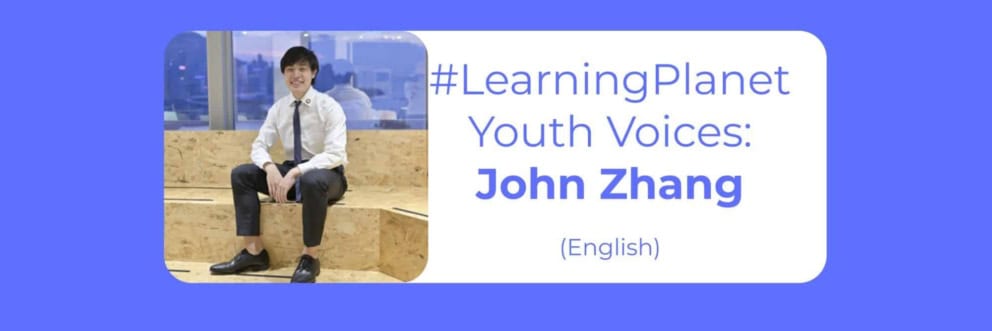
Meet John :
Mr. John Zhang, aged 18, heads a Hong Kong-based, youth-led refugee empowerment organization - Second Strings. The organization's services focus on community and soft skills development through education and the staging of the arts as a means of advocacy, to fill current unmet gaps in support for local refugees.
Find John on Instagram (@zhangjohn117) and LinkedIn.
Would you like to work with KIDsforSDGs on the next Planet Learning Festival - January 2022? If so, what would be your ideal contribution?
Yes - a potential showcase for Second Strings and its impact on local communities. Using the arts as a medium, we can show the work our direct education has done on students, while highlighting key advocacy projects such as our documentary and art show.
What was the first moment of enlightenment that encouraged you to take action for the society in which you live?
When I took over Second Strings at the beginning of my first year, I remember being motivated solely by improving my organization's image, rather than by understanding the needs of those who benefited from our services. As a result of focusing my efforts on expansion rather than on the quality of our social impact, the organization almost closed its doors: one of the biggest failures I've ever experienced.
Come to think of it, reading a book about the situation of refugees in Hong Kong completely changed my perception of this community. I discovered the “limbo” refugees face due to Hong Kong's own screening system, the inadequate living conditions created by the ban on work and the payment of minimal subsidies.
When I learned that refugees were not allowed to receive the COVID vaccine, it triggered my first advocacy initiative by petitioning the government. Just as universities such as Stanford encourage direct collaboration with ASEAN leaders as part of their annual summer institute on international humanitarian law and human rights, I believe it will be possible to establish a similar form of communication with the Hong Kong government.
What projects are you currently working on? What challenges are you and your organization facing today?
Over the past year, Second Strings has prepared a documentary aimed at humanizing the refugee community through the lives of two refugees, as well as an art exhibition and concert involving both students and refugees. In all, over 100 students from three schools are performing or involved in the organizing process. As part of our mission to help refugees integrate, we believe we must start by rectifying perceptions that refugees are all criminals, here for economic reasons, and cannot contribute to society. In fact, in a 2019 collaboration between UNHCR, hotels in Hong Kong and Shanghai, and The Repulse Bay, two refugees were hired to assist the respective companies and competently completed their work periods.
Since this is a service that stems from school requirements, one of the main challenges was to get around the regulations on schools and “services” in the initiatives we wanted to set up. Since then, however, I've taken most of our Second Strings initiatives out of the school framework and become involved in regional youth initiatives such as UNITAR's Young Ambassadors program for Asia and the Pacific.
How can we make intergenerational collaboration between young people and decision-makers a reality?
Young people often don't realize the unique benefits that only they can bring. For example, in a recent initiative where I responded to a local refugee NGO's call for dentists on the South China Morning Post, I never imagined that, because Second Strings, as a group of students, was so in touch with other organizations in Hong Kong, we were able to establish a formal referral program between NGOs to ensure that refugees in need received proper dental treatment. As refugees cannot legally work, they cannot afford more serious dental care than that provided by public facilities; I was particularly motivated by the story of Annie, a refugee who had to endure seven years of severe toothache before receiving any treatment.
Overall, it taught me not to minimize the impact we think our ideas can have in shaping our social cause; by taking the initiative to communicate your ideas with change-makers, we can fill in the “gaps” that may be present in their work.
How do you think we can involve young people who want to make an impact but don't have easy access to opportunities to get involved (because of language, lack of networks, difficulties accessing and using technological tools...)?
I would say that everyone faces circumstances and limitations to some extent - initiative comes from adapting what you have to offer to positive social change. When organizing our volleyball program for refugee children, the lack of sports facilities was a major obstacle: the public courts were always full, and we needed a venue that also lent itself to transportation. To solve this problem, my co-manager Timothy Chan and I bought a makeshift volleyball net and organized classes in a public park. Playing on an open court, with enough space and in good weather, was an experience in itself: more importantly, it showed that it's always possible to find solutions by adapting creatively to the situation we're given.
Conclusion
Ultimately, the Hong Kong refugee problem that Second Strings is trying to solve is far from being just a local one. Across the Asia-Pacific region, many countries, including Thailand, Indonesia and South Korea, have yet to sign the 1951 Geneva Convention protecting the rights of refugees. Refugee acceptance rates are low even in countries that have ratified the convention, such as Japan (1%) and South Korea (1.5%). Young people across the region need to collaborate and take the lead in tackling this stigma. I encourage everyone to do this by focusing on their interests - the arts, STEM or the humanities can all be effective vehicles for change. As our organization continues to grow, supported by community groups such as KIDsforSDGs, Second Strings aims to become a platform to amplify the voices of these initiatives.