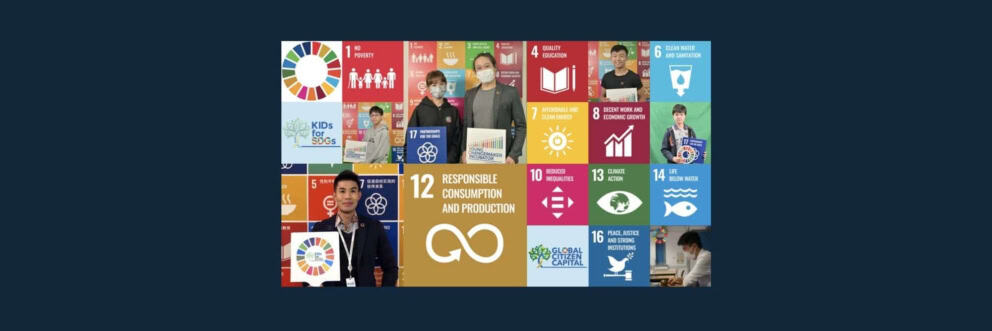
Hear directly from the participant, Mr. Kenneth Kwok, whose mission is to “strengthen the reputation and representation of youth-led innovation in the rest of the world.”
Read more :
Young people should play a crucial role in solving current and future global problems. They need to acquire the skills to contribute meaningfully to recovery efforts following the COVID-19 disaster, support each other through this difficult period, and accelerate the role of technology in driving and scaling up recovery efforts. To do this, institutions must enable young people to co-construct successful futures.
Today, over 40 % of the world's population is under the age of 25. The future of the planet and humanity, and their sustainability, are in their hands. Investing in the equity, health and education of young people is essential to achieving an inclusive, innovative and impactful world for current and future generations. Young people must be involved in all decisions concerning their education and their future, and this starts by giving all their voices the chance to be heard, respected and included.
Thanks to our BRIDGE principle, KIDsforSDGs advances the intersection of innovation, inclusion and impact to support youth action for the SDGs:
- Ownership. Providing a safe, welcoming space and giving people the power to express themselves and a sense of belonging.
- Respect. Respectful behavior in our quest for excellence and learning.
- Innovation. Strengthen and increase our impact through innovative practices.
- Diversity. Honoring and modeling diversity, equity and inclusion.
- Generosity. Encourage a culture of generosity of spirit.
- Empathy. Inspiring a culture of passion and understanding worldwide.
KIDsforSDGs and its young ambassadors across Asia are delighted to support the launch of the Youth Empowerment Circle by #LearningPlanet. Here are some of our collective thoughts on how to support it!
What is your vision of youth empowerment? Why is it important to create a youth empowerment circle today?
Justin Cheng, a student at Diocesan Boys’ School and co-founder of VIVA Forum Initiative Hong Kong, explains it best. According to Justin, “youth empowerment should incorporate not only gaining first-hand experience of local issues, but also lively discussions with other change-makers to drive change and take on board the SDGs” He adds that collective action is needed to recover from COVID-19 more strongly and effectively: “especially in difficult times, it's more important to diversify to integrate perspectives and tackle issues in tandem.”
Arthur Cheung, a student at Hong Kong's KGV school and advocate of the Millennium Development Goals, agrees: “Youth empowerment is a more important aspect of society than ever because of the countless and growing global problems that cast a shadow over the prospect of pleasant and sustainable living conditions for us as a global community. Young people are therefore the backbone of our planet's future, as they have the potential to establish a framework for becoming responsible, action-oriented global citizens, capable of working for a better future and mitigating the global environmental crises we face today.
Indeed, COVID-19 showed us all that we need to systematically establish and deepen dialogue on young people's rights, education, physical health and mental well-being, and all the other factors that influence their potential to flourish. As adults, we need to think outside the box and apply a bottom-up approach to youth programs and initiatives.
What do you think the priorities of this circle should be?
It's young people who are best placed to address the priorities of the youth empowerment circle. However, if I had my say, it would be to break the glass ceiling, eliminate barriers to entry and destigmatize the stereotypes that surround young people.
Jason Qiu, student at the Island School and founder of Carbon Neutral in Hong Kong, believes that “innovative practices should be applied to a sustainable future, especially to the protection of environmental ecosystems. This circle should prioritize strengthening the mindset and values of individuals so that they can take matters into their own hands and lead the next generation towards a more equitable and regenerative future.”
We need to collectively identify innovative practices to amplify the voice of young people on a large scale and involve them at all levels.
What are the ideal circle results?
According to Aden Wong, a student at the International Christian School Hong Kong, who is currently designing his “Exercise for the Elderly” program as part of his SDO work, “my vision is that young people, regardless of race or gender, are given the resources and opportunities to develop themselves, not only to improve their lives, but also to help solve the problems that will affect our future. With as much confidence as a middle-schooler can muster, he adds: “We are the leaders of tomorrow. If we are not empowered today, we will be ill-prepared to deal with the many global issues we will face. So, the ideal outcomes of this circle should be to invest in youth with resources, tools and life skills that would be affordable, available and accessible for the fast-changing world we live in.”
I couldn't agree more with Aden. As a society, we need to put the spotlight on young people, their authentic talents and value, and redirect their incredible energy towards decision-making and system change.
In short, to increase impact in a sustainable way, we need to connect like-minded communities with common causes. Following the notion of the intermediary institution, we do this by forging strong links with leading institutions, networks of social entrepreneurs, foundations, government organizations, universities, impact investors and more. KIDsforSDGs, Young Changemaker Incubator and our other youth initiatives will support the Youth Empowerment Circle and help youth-focused organizations meet, share resources and advance meaningful collaborations for youth engagement and action, both locally and globally.
About the author
As founder and CEO of Global Citizen Capital and KIDsforSDGs, Mr Kenneth Kwok has a key mission: to strengthen the reputation and representation of youth-led innovation in the rest of the world. He is the first member from Hong Kong and China to be elected to the UpLink Community of Innovators - the World Economic Forum's platform focused on the SDGs - and was also named the first Engagement Champion for UpLink. He is participating in the Davos Agenda 2021 on the theme “Accelerating Grassroots Innovation”. He is also a member of the Global Innovators community. Kenneth is a young advocate for the SDGs who focuses on the intersectionality of #impact, #innovation and #inclusion.
Through a hybrid for-profit/non-profit circular model, he aims to advance multi-stakeholder ownership towards financial and social justice, equality and well-being. Kenneth is particularly passionate about advancing SDG 4: quality education. Through KIDsforSDGs, he has created a community of young change-makers in Asia by engaging with the Forum itself, the World Humanitarian Forum (where he sits on the Youth Council), InterPride (where he sits on the Council as Vice President of Accessibility, Diversity and Inclusion), the Asian Development Bank, the Tsinghua Institute in Geneva, the iGEM community, UNLEASH, UNITE 2030, YOUNGA, SDG Labs and many others. A strong advocate of intergenerational learning, Kenneth's goal is to enable Hong Kong to become Asia's hub for education for sustainable development.