COP26 is over. Described as“last, best hope” for saving the planetby its chief organizer [1], COP26 merely highlighted - once again - the lack of ambition on the part of governments to take real, urgent action on climate change. A few days later, the hazy memory of governments' hollow commitments on climate change is fading fast. What we need to remember is the broad and loud international sound of young people raising their voices and holding their governments to account for their rights and for climate justice.
The impacts of climate change are hitting societies and individuals unevenly. Rich and poor, women and men, older and younger generations do not - and will not - bear the same effects of rising sea levels, global warming, increased pollution and health consequences. Recognizing the unequal responsibilities and consequences of the climate crisis is one of the first steps towards climate justice. Another step is to work on solutions that go beyond environmental challenges and tackle social and political ones too. Climate justice [2] is about understanding that sustainable goals are intertwined.
Proactive action is needed to achieve the SDGs (United Nations Sustainable Development Goals [3]). At CRI, we believe that education and awareness-raising are key to solving the challenges of our time and times to come. We are convinced that interdisciplinary and intergenerational collaboration is essential to tackling the SDGs in general, and climate action in particular.
We want to raise as much awareness as possible and convince as many players as possible - and as diverse as possible. At CRI, as an institution focused on research and education, as a member of an international network and as a host for different communities, we act to find solutions and to ensure that the next generations are heard and will find more creative solutions in the future.
From raising awareness to empowering new generations
From a very early age, CRI develops and promotes programs aimed at raising awareness of major social and environmental challenges among young people and young researchers. Changing habits isn't enough; we also need to tackle sustainable development goals through education. These programs and activities don't just sound the alarm, they are also designed to empower people by giving them the methods and tools they need to collectively identify and nurture solutions to these challenges.
Education to understand and identify climate-related problems
It would be wrong to assume that children are unaware of climate change and its consequences. More often than not, they hear and understand far more than we realize. Despite this, they continue to learn every day - just as we do - and often need to broaden their point of view, learn a method, experiment. Aware of this, and of the shortcomings of school curricula, les Savanturiers - Research School have developed a environmental justice toolkit to help teachers and educators address climate issues and environmental rights, and act accordingly with their classes. From elementary school to high school, teaching professionals also have access to turnkey activities and projects at the crossroads of disciplines. With the “Sustainable Classroom Hackathon”, students are challenged to use scientific knowledge and skills, as well as economic expertise, to tackle social issues concerning urban planning, consumption, civic life and territorial policies.
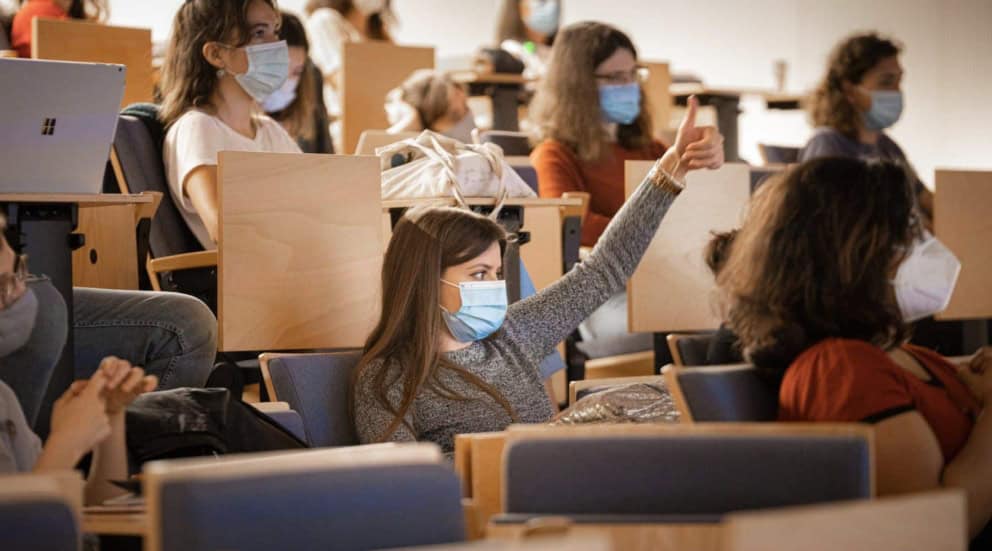
At CRI, students in license, master and PhD the’University of Paris are challenged to build their own projects and take their impact into account. To raise awareness, the teaching teams have integrated the notion of sustainability, particularly ecological sustainability, into their curricula wherever possible. The undergraduate curriculum includes an entire semester devoted to the SDGs, in the form of a project: “Life Sciences for SDGs” (life sciences for the SDGs). For a semester, students become apprentice researchers, developing and creating sustainable and ecological solutions to socio-economic problems. In the Master's program, students learn how to use algorithms that consume less energy and resources, for example. Students study while making an impact, perceiving the interdependence of the 17 DGOs and “the systemic, integrated and interdisciplinary solutions they require” [4].
The doctoral school [5] also offers a course entitled “Responsibility in research and entrepreneurship”. Led by Mélanie Marcel (CEO of SoScience), this course proposes a new vision of research and entrepreneurship in which scientists can engage as citizens through research, and in which “the power of science and technology generates positive impacts for people and the planet”.” [6].
A project-based method to start building the future
As already mentioned, we believe in project-based learning and learning through research. At CRI, we are convinced that experimenting, failing, correcting and ultimately succeeding is the best way to learn sustainably and to keep learning. As such, CRI supports and encourages innovative, interdisciplinary projects targeting issues related to the SDGs. In the CITIES project, students contribute to the SDGs. An example would be the major student project “Clean energy with N. CRASSA” (clean energy with N. CRASSA). The students have identified two problems: the problem of recycling cellulosic waste (paper, cotton, brewer's grains, etc.) and the need for a new energy source. Through research, project members aim to “implement an effective literature-based protocol using N.Crassa (a fungus) to produce bioethanol by degrading some of our daily cellulosic wastes“.
We're proud to see that students are also getting involved outside the classroom. The Upcycling Club [7] was foundedfor“discover different upcycling solutions to give new life to anything considered waste”We're also able to share our discoveries on a wider scale outside the CRI.
Empowering students and encouraging them to take action through teaching teams, dedicated researchers and tailored curricula is one thing. But it's not enough: we also need to rely on the enthusiastic commitment of young people. The best proof of this is the formidable initiative led by students at the Université de Grenoble Alpes: the COP2 Student. The association aims to raise awareness of environmental challenges among French higher education establishments, and is committed to ensuring that these establishments take action within their own communities, curricula and campus management. At CRI, 4 students from the University of Paris (Fanny Gouel, Nour Bocquet, Louise Jouveshomme, Nina Sibertin-Blanc) led working groups of students, staff and faculty to rethink our methods, taking into account all aspects of the environmental and social challenges they might raise. In France, 70 higher education establishments took part in similar processes, representing some 300,000 students in all.
As a higher education establishment working with the University of Paris, CRI has also taken its responsibilities seriously and, with the active help of Living Campus, has changed and continues to improve its habits by reducing its energy consumption and waste, buying local products where possible, etc.
Living Campus: a cross-functional initiative at CRI
Officially launched in 2020, Living Campus Rather, it has grown out of various existing initiatives. Its considerations and actions cut across all CRI departments, communities and activities. Living Campus leads, supports and promotes the development of sustainable activities and habits. It is based on three principles: working towards a sober campus, a learning campus and an “engaging” campus. By analyzing energy, water and resource consumption on campus, and constantly seeking more sustainable solutions, Living Campus influences all institutional and community practices. Recently, Living Campus established a consumption report for our various activities, and then balanced certain aspects of our consumption, notably by implementing a new heating/cooling process. Their team also created an evaluation grid to help determine whether our suppliers respect our values (short cycle, sustainable practices, etc.). Living Campus also facilitates exchanges, discussions and collaborations between the different communities represented at CRI (staff, researchers, students, teachers, project leaders, etc.).
And to raise awareness and take action in a fun way, Living Campus has brought together 2 CRI teams (with staff and student participants) to take part in the “My Little Planet” [8]. For 3 weeks, colleagues - or friends and family - teamed up and competed against teams based all over the world on ecological challenges proposed on the platform. At CRI, the competition mobilized 17 participants who successfully completed 244 environmental challenges!
Working with institutional partners: mutual enrichment in a committed network
Solutions must be cross-functional and built collectively
The SDGs are interdependent. Working for one of them means working for many others. This is great, but it also shows how many disciplines and actors need to be involved in solutions for the SDGs. To create a toolbox for climate justice, Savanturiers - École de la recherche has teamed up with Everyone's business, an association deeply rooted in the fight for climate justice.
We are also very proud to be part of the’Climate Academy. The Climate Academy, based in Paris and managed by the City of Paris, is a place dedicated to young people, a privileged venue for informing, raising awareness and engaging young people in sociological and environmental issues. It is also a project on which many partners committed to climate action interact. These include Together 4 Earth, COP2 Student, E-grain, Young Ambassadors for Climate JAC, Thinking beyond, Paris Climate Agency.
We also welcome the’SDO Summer University, a joint project of CRI and’University of Geneva, “a four-week challenge-based university that gives you access to a platform where you can voice an opinion, take action and make an impact alongside 15 young leaders from around the world“
Going beyond the local to the global
We also want to extend our reach in SDO education globally, bringing together organizations and communities acting with a common purpose. The international alliance #LearningPlanet takes a keen interest in sustainability issues. Together with the Club of Rome, it co-created the “Learning circle for sustainability”who“explores how learning processes and all types of education need to evolve by asking what learners need to be, understand, know and do“. Bringing together leading players (institutions, practitioners, scientists, artists, activists and young people), this circle considerably facilitates the emergence of innovative and proactive projects for more sustainable practices. Other partners involved in this circle include: Ashoka fellows, members of Catalyst 2030, AFD Campus, Climate Action Project, Youth for Sustainability Initiative, etc.
CRI is also one of the 6 partners in the transdisciplinary consortium Crowd4SDG, which promotes “the development of citizen science projects to address the SDGs, with a focus on climate action”. This is a research and innovation action Horizon 2020 supported by the European Commission's Science with and for Society (SwafS) program. At the time of writing, the teams involved in the program are preparing some big ideas on how to tackle both climate and gender.
On November 20, every year since 1959, we celebrate Universal Children's Day [9]. This day celebrates children's rights. But how can we reaffirm these rights at a time when climate change and its effects are casting a shadow over the future of generations to come? How can we ensure that these rights evolve in line with the challenges and responsibilities we impose on them? At CRI, we're calling for a reassessment of children's rights, an update that will promote young people's citizenship. By including more and more committed young people in democratic processes, by involving them in science, by helping them to think openly and collectively, we want to help them understand their rights and how to use them. We want them to realize that they have the right to have rights.
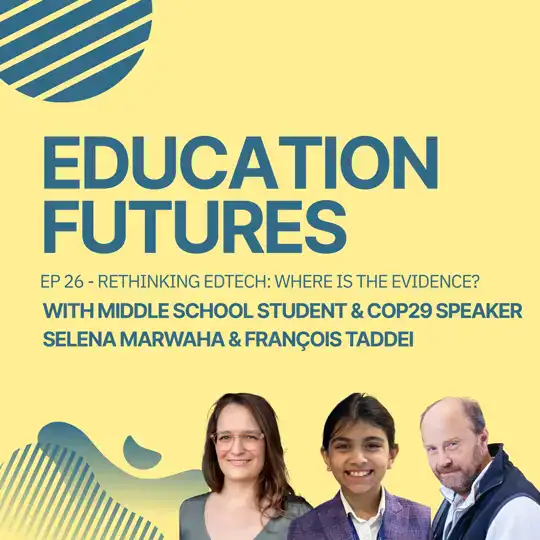
In line with these values, and drawing on its expertise in education, Savanturiers - École de la Recherche is currently presenting a Mooc on education in the Anthropocene era.(Education in the Anthropocene [10]). The 6 sessions of this Mooc, and the associated round tables, are dedicated to education professionals, scientists and anyone interested in initiating discussion and educating the younger generation about the new challenges we face in the Anthropocene.(Join us at the CRI on Friday November 19 at 6pm for a wide-ranging discussion on the Anthropocene across disciplines. here). On another level, #LearningPlanet has worked closely with Ashoka France, CAP-2030 and Catalyst 2030 to launch the Youth Empowerment Circle, in which “institutions, practitioners, scientists, artists, activists and young people interested in amplifying the voice of young people in the fields of rights, health and education and working on the designated topic can get involved” [11]. On November 20 and with the City of Paris, the Cercle francophone pour l'autonomisation des jeunes (French-speaking circle for youth empowerment) will meet at the CRI for a new session(join us online on November 20 at 5 p.m.) here). And it's no coincidence that the biggest event organized by #LearningPlanet happens to be International Education Day, on January 24. We hope to see you - individuals, educators, institutions, associations, young people, etc. - at the #LearningPlanet Festival to further our commitment to young people!
Read more :
#LearningPlanet - and become a young #LearningPlanet scholarship holder
And for the more French-speaking among you, we suggest you listen to and watch :
- The episode “When will there be a children's republic?” - a podcast from Combattants Pacifiques
- The 6 sessions of the Mooc “Education in the Anthropocene”from Savanturiers - École de la Recherche
- The opening round table the MOOC “Education in the Anthropocene” from Savanturiers - École de la Recherche, with Ange Ansour, Director of Savanturiers - École de la Recherche, François Taddei, co-founder of CRI, Antoine Maldonado and Frédérick Heissat, co-founders of the Profs en transition network, and Monique Dupuis, Inspectrice générale de l'éducation nationale, du sport et de la recherche, referent for Education for Sustainable Development.
- Thinking beyond - The Webinar series “Thinking Beyond” Covid-19, presented and produced by Stacy Algrain.
------------------
[1] 6 takeaways from the U.N. climate conference, The New York Times (Nov. 13, 2021) https://www.nytimes.com/2021/11/13/climate/cop26-climate-summit-takeaways.html
[2] Climate justice, Legal and environmental assistance platform https://leap.unep.org/knowledge/glossary/climate-justice
[3] The 17 objectives, United Nations https://sdgs.un.org/goals
[4] Understanding sustainable development objectives through education, Ariane Baumard (March 8, 2021) https://news.cri-paris.org/news/ZZ8l2Zbi
[5] The “Frontiers of Innovation in Research and Education” (FIRE) doctoral school is an international, interdisciplinary doctoral program, hosted by the University of Paris (UdP) and co-hosted by the Université Paris Sciences et Lettres (PSL), that promotes original and ambitious research projects involving interactions between a wide range of academic disciplines in the pursuit of understanding living systems, and/or exploring new ways of teaching, learning, and doing research.
[6] Extract from the FIRE 2021-2022 doctoral course syllabus
[7] The club's activities are aimed at MDGs 11, 12 and 15.
[8] Next “My Little Planet” challenge on January 31, 2022 https://mapetiteplanete.org/
[9] On November 20, 1959, the United Nations General Assembly adopted the Declaration of the Rights of the Child, https://www.un.org/en/observances/world-childrens-day
[10] Mooc “Education in the Anthropocene“Savanturiers - École de la Recherche, with the help of Fun Mooc and Université de Paris.
[11] Youth empowerment circle - https://projects.learning-planet.org/projects/uJJO9GBt/des
Photo credits - © Quentin Chevrier