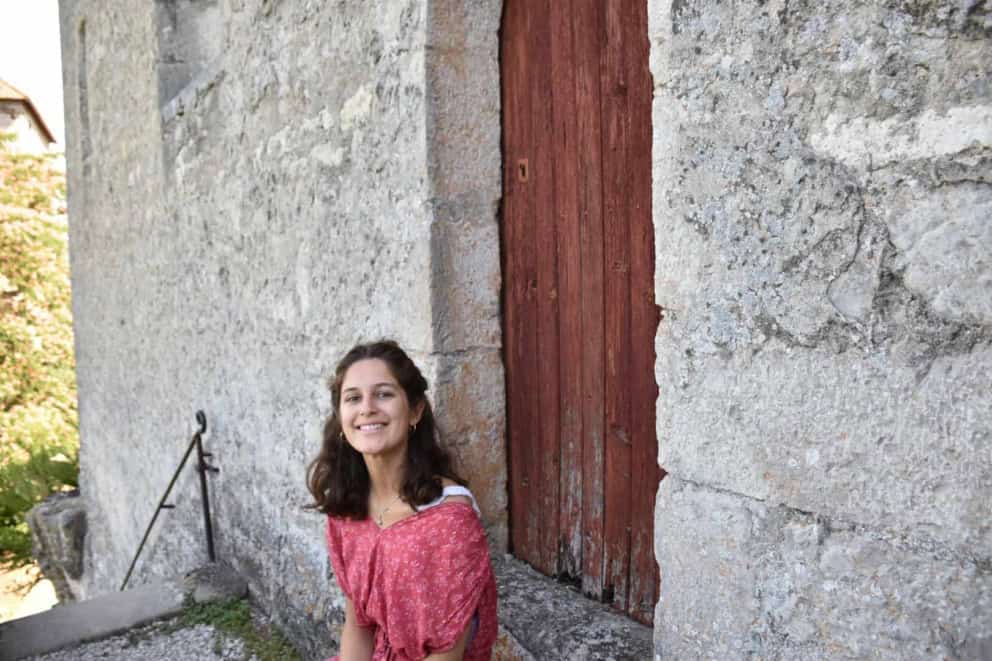
A (very) gray February morning in Paris would have discouraged many, yet that doesn't stop Manon Sala from introducing herself to the Learning Planet Institute with a big smile and a slight Southern accent that brings a little sunshine into the room - « I've never had it too much, but every now and then it shows up. »
Manon Sala is in the first year of her thesis at the’FIRE doctoral school - Frontiers of Innovation in Research and Education (Université Paris Cité / PSL University / Learning Planet Institute). A passionate researcher, she also makes podcasts and clearly enjoys meeting people around her favorite subjects: educational sciences and the relationship with life. On the occasion of the opening of applications for the FIRE doctoral program, she agrees to tell us about the path that led her to the Institute.
Weaving the link between education and the living world
Manon took a few twists and turns between the end of her Master's studies and the start of her research project. After a master's degree in sociology and political science at Sciences Po Strasbourg, then a specialization in the 2nd year of a master's degree in the sociology of health and the environment, in partnership with the Strasbourg Medical School, When she returned her memoir, she found herself unsure of the path she wished to follow.
« I had no idea what I wanted to do. I wanted to do research, but my teachers had talked me out of it. They told me it was very hard, that there weren't many jobs. They scared me. »
During his internship at the Democracy Division of the Council of Europe, Education Sub-Division, European Youth Centre: CEJ de Strasbourg - Youth, as a research intern, she evaluates and designs educational policies in conjunction with sustainable development objectives (SDGs). This work will provide food for thought for her future research project.
« The policies we conceived included all the member states of the Council of Europe, i.e. an international scale comprising EU and non-EU states. We launched the first Youth Advisory Committee on Climate Change in February 2021: Advisory Committee: «The climate crisis, young people and democracy» - Youth »
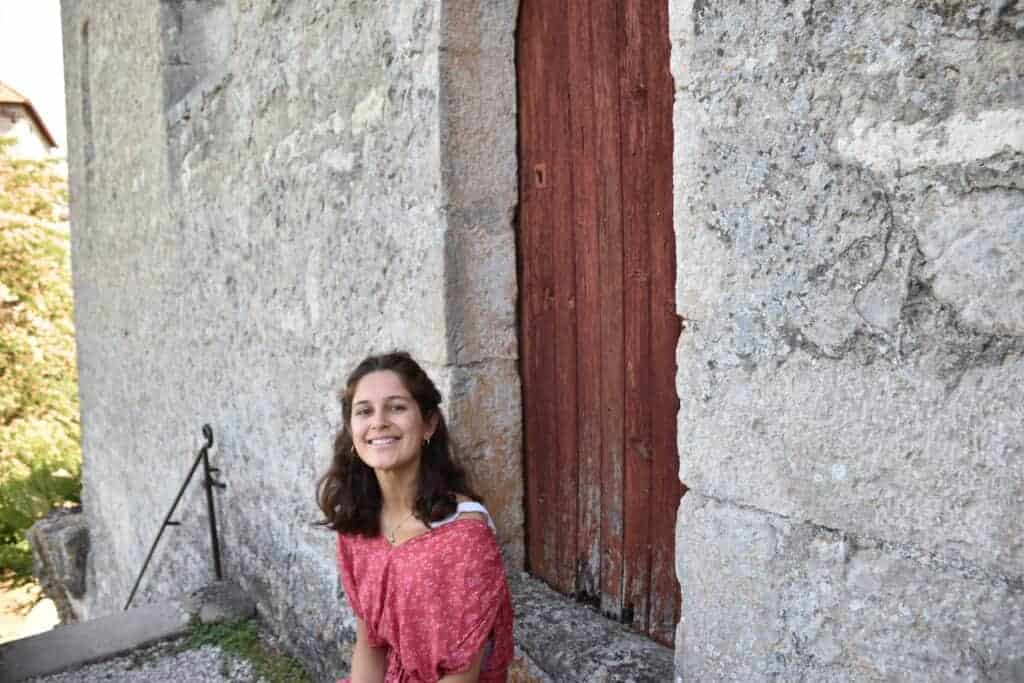
At the end of her studies, putting aside her interest in research, she headed back south to Toulouse, where she took on a civic service role with La Découverte school, an elementary school with alternative teaching methods - or techniques. This small 2-level structure (nursery and primary) welcomes around thirty children and is self-managed by the school's parents. Three to four teachers run the classes, supported by two civic services. Two different pedagogies are used to support the children's schoolwork:
- the Freinet pedagogy : « a pedagogy based on children's free expression »(Wikipedia)
- the Montessori pedagogy : « a pedagogy“scientific”which is based on an experimental and observational approach, with the aim of helping children to blossom. »(Wikipedia)
At school, Manon assists teachers during class hours and designs workshops to reconnect with nature and the living world.
« For me, it was really new. That's what I talk about in my thesis in a slightly more elaborate way: it was my first experimentation with new pedagogies, or what I call “new" pedagogies.“transition”. My role was really to work on children's relationship with the living world. »
Life at the heart of Manon Sala's intellectual journey
Manon has the soul of an explorer of the living world. Although she is committed to her studies in sociology, politics, health and the environment, she remains hungry for more.
« I wasn't at all satisfied with the way I'd heard about living things. I found it very limited, very materialistic and rational. There was a sensitive scope that I missed. »
As she finishes her Master's degree, she finds herself with a bit of free time, which she hastens to use for a more personal project. In 2021, she launches her own podcast, “New Consciousness”.
« I said to myself: I'm going to create a space for reflection on global ecology, with this more systemic scope [that I was missing]. »
She recalls her modest beginnings. She first interviews two of her close friends - an architect in the responsible construction field and a psychologist working on the emotional approach to trauma. « From a practical point of view, it also allowed me to see what it's like to create an interview for the purpose of being recorded and listened to. »
At a rate of one episode every two weeks, then every month - « now I've had to cut back to one episode a month »With one guest per program, she meets a wide variety of people thanks to her microphone.
She invites people who have inspired her personally, on subjects she had not been able to develop in her academic life. She talks to shamans such as Ghislaine Duboc, holistic psychotherapists, and writers such as Frédéric Lenoir, philosophers like Dominique Bourg « that dares to speak of the living and the sensitive »or committed artists such as Jade Verda from Collectif Minuit 12 (that we also receive on the occasion of the LearningPlanet 2024 Festival). She also invites people we know well: François Taddei - President of the Learning Planet Institute - in a recent episode, and Cloé Brami - oncologist, researcher, professor and alumna of the FIRE doctoral school. She recalls this interview from the first year of her podcast:
« His systemic approach to medicine and health inspired me a great deal.. She talks a lot about WHO's vision in which “health“is a state of complete physical, mental and social well-being and not merely the absence of disease or infirmity”[...] Cloé Brami is an oncologist who practises traditional oncology and at the same time uses complementary medicine to treat her patients. Complementary“ medicines are those that complement conventional medical knowledge in France, such as those inspired by Chinese medicine, hypnosis and reflexology. »
Cloé Brami completed her thesis - as part of the FIRE doctoral program - in psychology and the science of thought. She is also responsible for teaching “Mindfulness and Medicine” at Université Paris Cité and founder of the School of Medicine and Integrative Health. Mû Medicine. In 2021, she and Margot Smirdec the MOOC Meditation and medicine in 2021: praise for care? - broadcast in 2022, produced by the Learning Planet Institute.

I'd been studying for 5 years without being able to express that part of myself. I said to myself: this podcast is mine, I don't have to answer to anyone. I wanted to build bridges between more traditional Western knowledge and a decolonial approach, by questioning other approaches to the world. I wanted to create a dialogue between cultures, knowledge and energies.
The call of research
The idea of going into research has never completely left Manon. The podcast and her teaching work at the school near Toulouse enable her to explore new avenues of innovation in education and fuel her thinking. These projects also give her new confidence in the field of research.
In 2022, she accepted a position as a political attaché for elected officials in the Toulouse metropolitan area. Among other things, this enabled her to work with schools and develop new pedagogical approaches to children's well-being and their relationship with living things. The work she embarked upon at the time is still ongoing.
In parallel with her new position, she matured and reworked her research project, determined this time to take the plunge. In February 2023, she found a co-supervisor for her dissertation and applied for a doctorate. in extremis - she submits her application to the FIRE doctoral school within the last 2 days of the application period. Following the selection process, her thesis is accepted and she joins the FIRE program alongside some thirty other French and international students.
Manon Sala is co-directed by :
- Angela Biancofiore - university professor and researcher (Université Paul Valéry Montpellier 3), artist and essayist,
- Cécile Renouard - philosophy teacher at Sèvres Center, a teacher at Mines Paris - PSL, at the’Essec and Sciences Po Paris, scientific director of the “Codev - Entreprises et développement” research program at the’Institut Irené - Essec, founder of Transition Campus
« Cécile replied in extremis, just before the interview phase for the FIRE doctoral school. From the moment I submitted my application to the end, the timing was perfect! »
A research project on self-deployment
Manon's research project combines subjects close to her heart: the deployment of oneself as an individual in one's environment. How do learning networks enable social engagement through the realization of our interdependence as human beings? How can transition pedagogies, via eco-psychosocial skills, transmit an «ecological self"? »itself at the service of transitions?
« In my thesis, I talk about the psychosocial and psycho-emotional approach. The eco-psychosocial approach is a concept we're in the process of developing with one of my co-directors. So I'm not talking about health in the sense of “treating illness” - I'm neither a doctor, nor a psychologist - but what interests me is how the individual can unfold, be fully himself, in connection with the community - the social context in which he lives - but also in connection with the earth, the living.
How does the individual situate himself in society, in his ecosystem? How do they express their personalities and objectives, while at the same time integrating into a social context - necessary for economic and emotional survival? What interests me is this deployment of the self. »
Furthermore, the concept of« ecological self »is a concept theorized by the Norwegian philosopher Arne Næss (1912-2009).
« Arne Næss was unique in that he wore the triple hat of philosopher, activist and mountaineer. He was at once in the world of thought, embodied thought and action, and at the same time, he had this carnal link to the mountains, the rivers, his living environment. I've never been to Norway yet, but I'm trying to immerse myself in his writings, in what he felt in order to theorize this “ecological self".”. »
According to Næss, the individual is linked to the surrounding environment and, more globally, to living species. In this context, the ecological self is intended to give rise to a feeling of interdependence with all living species. It's a matter of repositioning the human being in ecosystems, with a vision of species as equals. (Wikipedia)
There's a fine line between this and a form of holistic thinking that erases the differences between species, a point emphasized and criticized by Baptiste Morizot (philosopher and teacher-researcher at Aix-Marseille University) and many philosophers in the United States.
« For me, Næss' thinking doesn't say that: we retain our particularity as humans, or as plants, or as animals, but our rights will derive from our positioning, and ethics is adapted to the link that connects the two living species. For me, it's about giving just rights to living entities. It's a movement that can be seen in particular among the defenders of the rights of nature and this tends to destabilize and even frighten Western countries. »
Manon's research project focuses in particular on the politicization of this ecological self, i.e. how the ecological self can be concretized at different political levels. She thus distinguishes three scales of the political:
- the micro-political: a person's experience, life and feelings
- the intermediary political or community level: how the ecological self translates into the group, the community, the ecosystem to which the individual belongs
- the macro-political level: how political institutions can embody this ecological self
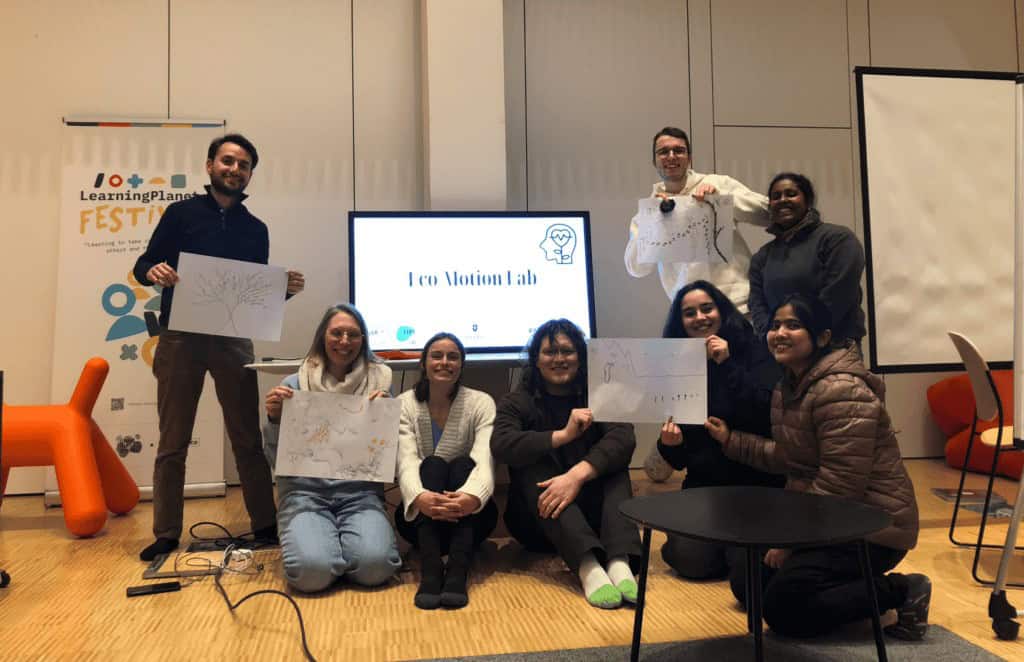
In February 2024, as part of her thesis, she created the ’ Ecomotion Lab »A group of about ten people. Anyone interested is welcome, and the group brings together students, teachers, researchers and others. The Ecomotion Lab meets once a month and serves as Manon's research field, experimenting with transitional pedagogies linked to the ecological self.
To find out more about the ecomotion lab, contact Manon Sala directly at this link or on its social networks.
The Institute, an environment conducive to exchange and creativity
Manon has energy to spare and a lot to share.
What I love about the Institute is that students are really given a lot of freedom. The projects I've been able to develop have come about naturally.
And with good reason: after only a few months at the Learning Planet Institute, she is also a lecturer for AIRE Master's students in the «EU" course.« Exploring sustainability ». She was also given carte blanche to give a masterclass in which she integrated a philosophical debate - « It was so much fun! Well, I had a blast, and I hope the students did too. »Projects born «by ricochets ».
« I first met Emmanuelle Donnard and Léo Houdebine from the Institut des Défis, who suggested I teach master students. Alice Robineau then suggested I do a masterclass. Then I spoke to Yaneth Ramos, who told me about student clubs. You'll always find people who can help you put your idea into practice, even if it's a bit innovative. There are always people with open hearts who listen without judgment. I even got to meet François Taddei, who took part in the Nouvelle Conscience podcast; it was a wonderful moment. »
As a doctoral student, she appreciates the quality of the support and the high standards of the FIRE program:
« We have a lot of class hours, We have to validate 300 hours of training over 3 years, whereas traditional doctoral schools require 100 hours. It forces us to take courses, to train continuously., Whether it's learning about scientific communication, public speaking or even - and this one made a particular impression on me - about well-being and mental health as a doctoral student. »
She also emphasizes the close ties with other doctoral students - they meet every fortnight for interdisciplinary seminars. These exchanges open up new perspectives: the thesis topics selected at FIRE range from neuroscience to microbiology, via sociology and education sciences.
« FIRE has a real openness to the international scene, to interdisciplinarity and also to originality and creativity. A key point for me is that it's a doctoral school whose dissertation topics are committed to and focused on ecological and social issues. (...) I finally feel like I belong. »
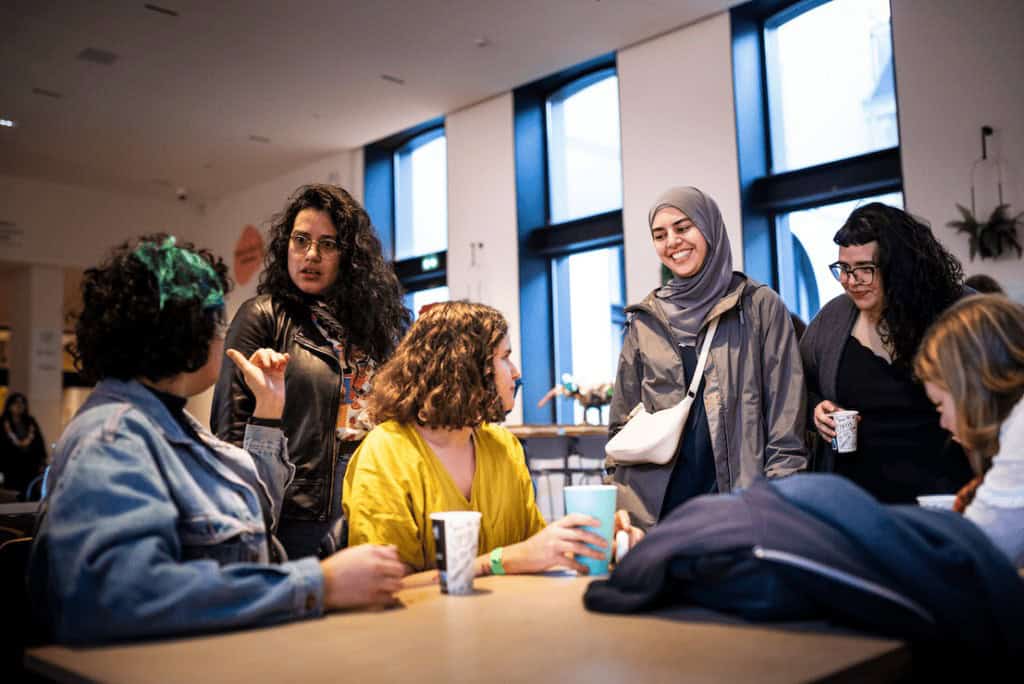
Our interview is drawing to a close, but we'd like to draw the attention of all FIRE doctoral school applicants to the following:
Even if your subject doesn't fit into all the boxes, even if the dossier to be submitted can be frightening, you have to try. The selection process is intense, but they [the FIRE teaching team] are very open and willing to listen.
As we say goodbye, we look forward to seeing you on the next stage of her adventures. Manon Sala's new project is a big one: she's publishing a book about her podcast. See you at the start of the 2024 literary season!
Find out more about :
FIRE is an international, interdisciplinary doctoral program accredited by Université Paris Cité (UPC), co-accredited by the’Université Paris Sciences et Lettres (PSL) and housed on the Learning Planet Institute campus.
It welcomes PhD students wishing to contribute to the implementation of the Sustainable Development Goals, by exploring new disciplinary interfaces and using innovative methodologies.
The FIRE doctoral school welcomes research projects that cannot be accommodated in the laboratories' usual doctoral school because of their unconventional nature.
- The Nouvelle Conscience podcast by Manon Sala
In her search for a systemic understanding of ecology, Manon Sala interviews researchers, authors, therapists and shamans who propose a vision of the world in connection with Living Things and Nature, both human and environmental.
Nouvelle Conscience Podcast is available on all listening platforms.
- the MOOC “Meditation and medicine in 2021: praise for care?” by Cloé Brami and Margot Smirdec, produced by the Learning Planet Institute
A 5-part exploration of mindfulness meditation in medicine, questioning the culture of care, the meaning of caring for oneself and others.
In April 2020, in the midst of the 1st COVID wave, and immersed in research work and the roll-out of the Health&Care Lab, Cloé Brami met Margot Smirdec. Together they co-created this 5-episode documentary a few months later to share about the care that sustained them and connected them to the world during their studies, and which continues to animate their relationship to life, finitude and caring for others.
Because taking care of oneself has become an essential part of cultivating a sense of care - because the pandemic has highlighted the vulnerability, and even more the suffering, of medical students and caregivers, which had been preexisting for a long time - it now provides an opportunity to question learning, the meaning of care and the function of a caregiver.
A project supported by Université Paris Cité, the Jean Perrin Center, and Tep Care. With Cécile Badoual, Grégory Baptista, Angela Biancofiore, Jean-Michel Constantin, Xavier Desplas, Claire Kéfalas, Margot Ladroue, Antoine Lutz, Katell Ménard, Soizic Michelot, Grégory Ninot, Emilie Olié, Frédérique Penault-Llorca, Marie-Aude Piot, Arnaud Poublan, Véronique Roux, Jordan Sibeoni, François Taddéi, Patrick Visseq, David Viala, Jessie Abichara, Perrine Bastos, Solène Blanchin, Haddi-Emile Chebbaki, Victor Di Martino, Maël Esnault, Guillaume Genin, Léna Glasberg, Raji Venou