
A new study by CRI Research Associate Bastian Greshake Tzovaras and his colleagues in Mainz, Frankfurt and Leiden has been published in the journal Genome Biology & Evolution! This article lays the foundations for new genomic studies on lichens.
Lichens are symbiotic organisms composed of one or more species of fungi living in close symbiosis with green algae or photosynthetic bacteria. This symbiosis is so successful that it is not only evolutionarily ancient - the first lichen symbioses appeared at least 300 million years ago - but has also occurred independently at many different times. This makes lichens interesting models for studying how the genomes of individual symbionts evolve in response to joining a symbiosis.
This potential has yet to be fully exploited, as the sequencing of lichen genomes is complicated by a number of factors: lichen growth is notoriously slow, making it difficult to obtain sufficient quantities of biomaterials. Moreover, in many cases, it has so far been impossible to cultivate individual symbionts outside their symbiosis. Due to these factors, lichens are often sequenced as a whole, leading to highly diverse and complex sequencing datasets, which generally make it impossible to create high-quality reconstructions. In this new study, the authors demonstrate a workflow that enables high-quality reconstructions of whole lichen genomes, making previously understudied lichens available for further work on genome evolution. In the future, we hope this work will unlock the full potential of lichens as model organisms.
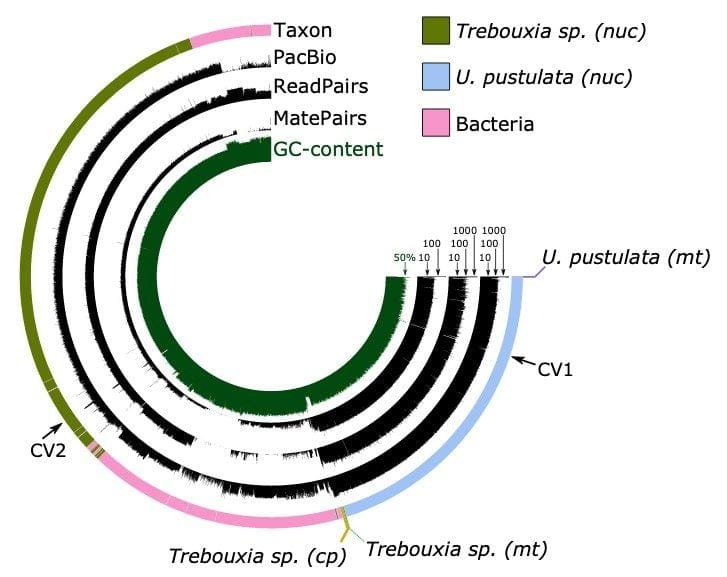
The graphs presented here show the individual genomes of lichen symbionts. Umbilicaria pustulata and the varying proportions in which they contribute to lichen symbiosis.
The full text of the study is available here.