
A new article by Stefani Crabtree, Short-term Fellow at CRI Research, and her collaborators has just been published in the Springer Encyclopedia of Global Archaeology. It deals with the use of network science by archaeologists. You can find the full text here here.
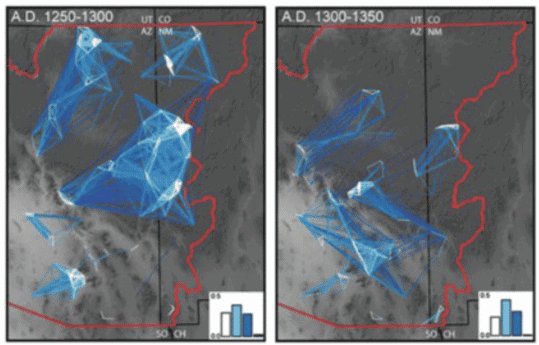
Archaeologists reconstruct the activities and interactions of individuals using the material culture accumulated in the past, but detecting these interactions can prove difficult using traditional archaeological analysis tools. The development of a methodological framework derived from graph theory, coupled with increased computing power and a growing multidisciplinary theoretical framework to interpret these analyses, has alleviated the difficulties associated with discovering, analyzing and interpreting networks in the past. From examining the physical locations of sites and their interaction, to trade routes and migration paths, to the exchange of ideas across time and space, network approaches have infiltrated archaeology and grown exponentially in published studies. With increasing computing power and the use of large datasets of uneven structure or resolution, network studies will undoubtedly shed further light on the archaeological past. These approaches may well herald new interdisciplinary collaborations and enable archaeologists to use these social network models of the past to understand our present and future.