
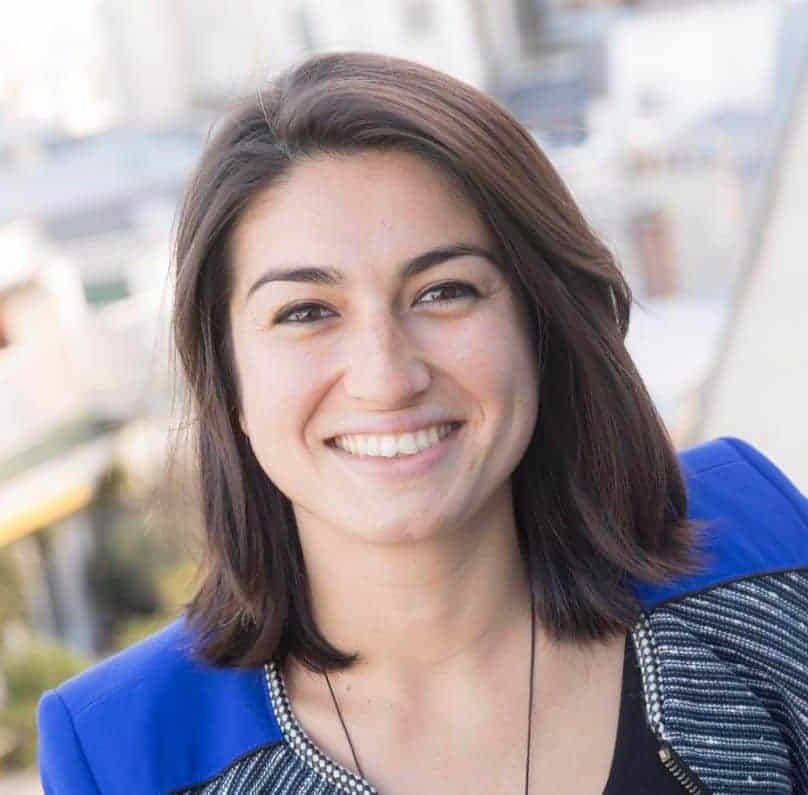
Flora Vincent is doing a post-doctorate in marine microbiology in Israel. Curious by nature, she joined CRI* following her engineering studies at AgroParisTech. A true deformat to better emancipate herself, in her own way and without restricting herself. The CRI enabled Flora to feed her great curiosity, to co-found the association WAX Science for the place of women in science, and to do her thesis in marine microbiology, a subject she is passionate about. Meet this alumna.
[Editor's note: Flora Vincent now heads a research team (the European Molecular Biology Laboratory), after completing his post-doctorate in marine microbiology at the Weizmann Institute of Sciences].
Flora was born in Marseille. As a child, she asked a lot of questions in class, which was not particularly encouraged... Flora spent her vacations by the sea, and dreamed of becoming a diving instructor. Very curious, she finally enrolled in a biology preparatory class before entering the AgroParisTech engineering school. At the end of her studies, Xavier Duportet, an alumnus of her school, told her about CRI. Flora was interested and came to CRI in the second year of her Master's program. «We've created a breeding ground for Agro at CRI »she explains. The transition from engineering school to the CRI Master's program involves the integration week at Sèvres - a defining moment for Flora, for a variety of reasons. « This is where it all comes together. You come out of an engineering school and find yourself sitting amongst other people doing strange things, like transcribing genetic code into musical notes. We called it the «Symphony of Life».» »explains Flora with a smile. The accessibility of the teachers, the creative, even «zany» workshops and the fact that the students are taken seriously are essential ingredients in this transition. «We're told: we want you to go peanut, but do it right.
« CRI breaks down the barriers so that we can dare. There's an audacity, a latent madness in us, and it comes out!. For Flora, it was a real wake-up call. « It's a big RESET of the machine. They're trying to deform us so that we can build ourselves in our own way. »
Few institutions allow the creation of this space of curiosity, Flora acknowledges: « I sold the CRI like you can't sell it! ». It's a real place for debate, where the little girl who asked too many questions becomes a student whose curiosity is encouraged: «It's a real game-changer. All of a sudden, you're told «the goal is to be curious»! You say more stupid things, of course, but the priority is given to thinking». . Autonomy and independence are also essential, and students are given a great deal of freedom without anyone taking them by the hand. This is how Flora was able to explore her thesis topic right from the Master's level, by doing internships in laboratories: « I realized that it was the research internships that really amused me! »
At the same time, with Aude Bernheim, who had become a close friend, she created the WAX Science association to promote science and women in science. They embarked on this adventure after producing a video on the subject that creates emulation (this video was made as part of the «Draw me Why» club with, among others, Stéphane Debove). For four years, Flora and Aude managed WAX Science, organizing weekly meetings with forty people, running stands at Solidays, raising awareness among the general public... Flora says she learned a lot: project management, team management, public speaking and so on. « The CRI encourages student initiatives and the teachers have been exceptionally supportive.». Today, WAX Science still exists, but Aude and Flora have passed the torch. That hasn't stopped them from pursuing projects together: they co-wrote the book Artificial Intelligence, not without them, a book in which they explore the gendered biases of algorithms. « The general idea behind our approach since WAX Science is that to produce good science, teams need to be diverse. Mixed teams are more likely to take gender into account in their research. That's my Trojan horse, the best way to put things right by using science.» explains Flora, for whom «what can't be measured, doesn't exist». For Flora has a scientific mind, which she developed at CRI and during the construction of her thesis in marine microbiology with the ENS. «If I'd been a diving teacher, I'd have been intellectually bored. When I did my thesis in 2013, the TARA boat had just finished its expedition! ». With this scientific expedition whose aim was to take stock of the biodiversity of marine microorganisms, that Flora is doing her thesis.
« It was an international consortium. It was all about science, and raising public awareness. This was totally in line with my values, and those of CRI in the end.. »
Flora is very enthusiastic when she talks about her research, explaining that she has discovered thousands of things at the heart of this monumental project: « I used to study the interdependencies between certain members of phytoplankton. Now, when a species dies, I see the whole network of interactions dying out with it.»Flora left with new questions, and a new pair of binoculars to explore. Totally stimulated intellectually, and in her element.
«The CRI opens up the field of possibilities, and I'm one of the people who got the most out of it.», she concludes.
-
An article by Marie OLLIVIER
* CRI is now called the Learning Planet Institute.