Faced with the challenges of the 21st century and the necessary transitions: how can we learn differently?
The Learning Planet Institute is delighted the renewal of the UNESCO «Learning Sciences" Chair »jointly supported by the Institute and Université Paris Cité. M. François TADDEI, founder and president of the Learning Planet Institute, holds this international teaching and research chair, which combines research, pedagogy and technology to promote a learning society for a sustainable world. To mark this renewal, the Learning Planet Institute is launching a cycle of four conferences on four distinct themes.
Zoom in on this Chair and the inaugural conference held on October 19, 2023.
The UNESCO Chair in Learning Sciences: an initiative to build a learning society
In a recent report by Reses, 69 % of students would like their studies to provide better training in transition issues. At a time when crises and changes are accelerating, it is urgent to reflect on and adapt to the new skills and knowledge needed for transitions.
Against this backdrop, the “Sciences of Learning” Chair was launched in 2014 with the aim of combining research, pedagogy and technology to support teachers, researchers, teams and stakeholder collectives in building a learning society for a more sustainable world. It is based on the conviction that youth, learning at all ages of life and collective intelligence are the levers for the necessary transformation of our societies. The four-year “Sciences de l'apprendre” program has been renewed for 2018 and 2022.
The “Sciences of Learning” Chair supports UNESCO's four priority objectives
- “Ensuring equitable and inclusive quality education and lifelong learning opportunities for all (...)”
- “Work to build sustainable societies and protect the environment (...)”.”
- “Building inclusive, just and peaceful societies by promoting freedom of expression, cultural diversity and global citizenship education (...)”
- “Promote a technological environment that serves people through the development and dissemination of knowledge and skills (...)”.”
For the period 2022-2026, the Chair has chosen to focus its work on the activities of the following clusters R&D, Education and International Alliance of the Learning Planet Institute.
As part of the Chair, a series of conferences on the theme of transitions
How can we learn in an uncertain context, and how can learning ecosystems help us move from adversity to prosperity?
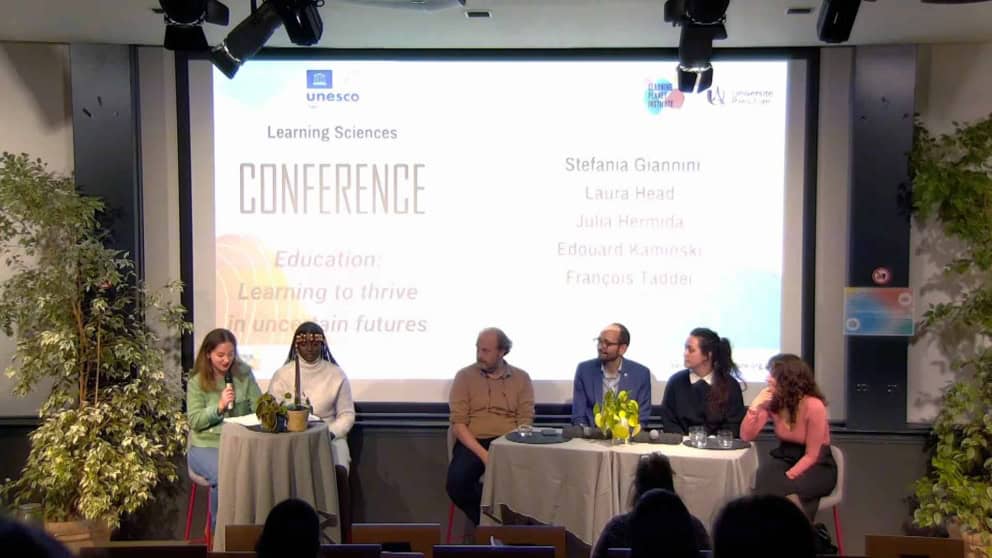
This was the subject of the inaugural conference organized on October 19, 2023 at the Learning Planet Institute in support of UNESCO's first goal: “Ensuring equitable and inclusive quality education and lifelong learning opportunities for all, in order, inter alia, to reduce inequalities and promote learning and creative societies, especially in the digital age”.
A number of personalities - including Édouard Kaminski, President of Université Paris Cité, François Taddei, Founder-President of the Learning Planet Institute, and Julia Hermida, IBRO-IBE/UNESCO Fellow for the sciences of learning in 2022 - discussed the following topics
- TheUNESCO The “Sciences of Learning” Chair: its priorities and context
- The role to be played by education systems, especially universities, and learning systems in an uncertain context
- Concepts and techniques for combating educational, health and social disparities
A variety of opinions and information were thus shared, including the students' point of view on the issue, via the testimony of Laura Head from Master of AIRE (Interdisciplinary Approaches to Research and Teaching) of Université Paris Cité, housed at the Learning Planet Institute.
Université Paris Cité works with nine interdisciplinary institutes, including the Learning Planet Institute, to build bridges between research, learning and disciplines: “We are first and foremost an experimental university. We can do things differently, without always following the rules.” says Kaminski.
Based on the “Exploring Local Learning Ecosystems in the Global South: Pathways to thriving for every child”produced by the Learning Planet Institute in collaboration with Dream a Dream and The Global Education Leaders program (GELP), its international partners, François Taddei brought the debate to a close, stressing the importance of supporting the «GELPs".« Learning Planetizens »The aim is to teach them to take care of themselves, others and the planet. “We must mobilize international cooperation, in the North and South”he warns. “Learning Planetizens, whatever their age, must learn to work together to overcome individual, national and international challenges (including 17 United Nations Sustainable Development Goals)”
We need to rethink the university on a global scale
A “Planetizen University” would solve certain problems and “.“is currently being prototyped at the Learning Planet Institute.”underlines Mr. Taddei. “Education must be part of the solution to the major challenges, emergencies and crises facing us (...) UNESCO can really become, in the coming months and in close collaboration with the Institute, a platform, putting together all the pieces of the puzzle within this Planetizen University”.” completes Stefania Giannini, Assistant Director-General for Education at UNESCO.
Three other themes will be deciphered and addressed at other conferences to be held in 2024, which will also address issues linked to UNESCO's priorities:
January: Greening education (UNESCO Objective 2)
March: Learning and teaching in the age of Artificial Intelligence (UNESCO Objectives 1 and 4)
July: “Planetizenship” and youth empowerment (UNESCO Objective 3)
Press contacts ECONOVIA - Emma RIDAOUI - emma.ridaoui@econovia.fr - 06 58 04 46 51