
[September 22 - New research published in eLife “BiteOscope, an open platform to study mosquito biting behavior - by Felix JH Hol et al.”]
Scientists have developed a tool to study the biting behavior of mosquitoes carrying common pathogens, according to a new study published today in eLife.
This tool, which uses an artificial blood meal and a surface imitating human skin, will enable detailed understanding of blood feeding without using human subjects as bait. It can also be slipped into a backpack, enabling mosquitoes to be studied both in the laboratory and in natural environments.
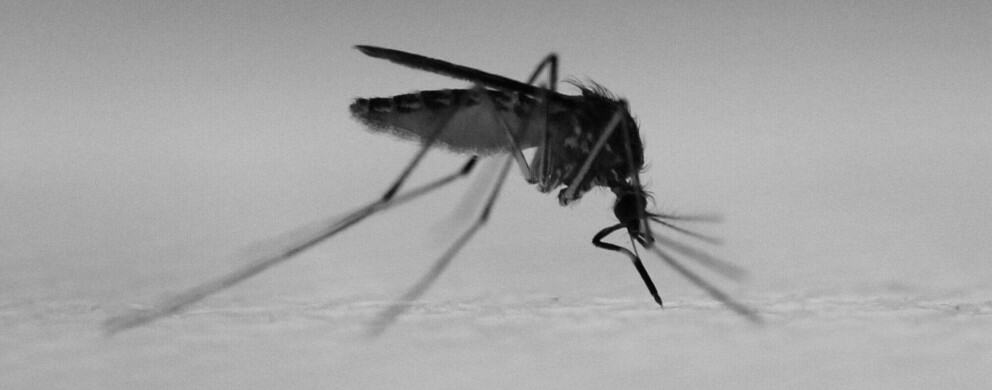
The biteOscope is used to record a mosquito feeding on imitation human skin. Photo credit: Felix Hol (CC BY 4.0)
Blood sampling is essential for mosquito reproduction, but it is during blood sampling on human hosts that they transmit pathogens such as malaria.
“While the initial stage of obtaining a blood meal - flying to a host - is relatively well characterized, the steps that take place after a mosquito lands on a host are less well understood,” explains first author Felix Hol, a researcher at the Institut Pasteur and the Centre for Research and Interdisciplinarity, in Paris, France. “There is a lack of tools to measure mosquito biting behavior, and those that do exist rely on the use of human hosts, which limits the number and type of experiments we can carry out - we can't study pathogen-carrying mosquitoes in this way
This is important because it is thought that factors such as infection can affect a mosquito's feeding behavior, including the number of feeding attempts it makes and the size of the meal it takes. In turn, these aspects can alter the transmission dynamics of pathogens. To address this issue, Hol and colleagues from Stanford University (California, USA), Institut Pasteur and CRI (Université de Paris/INSERM) (Paris, France) have developed the biteOscope, a tool that enables high-resolution study of how mosquitoes explore and probe their host's skin surfaces before taking a meal.
It consists of a bite “substrate” - a transparent, temperature-controlled surface that mimics body temperature to attract mosquitoes. An artificial meal is applied to this surface and covered with a commonly used membrane that mosquitoes can pierce. The meal resembles blood, allowing the mosquitoes to gorge themselves and multiply their weight by two or three. This bite substrate is then placed in a transparent cage, and an external camera records the mosquitoes' behavior.
“Open Annotations. The team tested biteOscope with four medically important mosquito species and built a computer model to analyze behaviors from captured images of the mosquitoes as they landed on the “skin”. “We found that the time a mosquito spends exploring the skin without successfully feeding is rarely longer than the duration of a successful meal,” explains author Louis Lambrechts, research director at the Institut Pasteur's virology department. “This suggests that if blood is not found within a certain period of time, the mosquitoes give up and move on.”
The researchers then demonstrated how the tool can track body parts to understand how mosquitoes “feel” the surface they are exploring. When they coated the imitation skin with the insect repellent DEET, they found that mosquitoes tended to land and take off immediately, coming into contact only with their legs, suggesting that repulsion is mediated by contact with the legs.
“We have used the biteOscope to describe the behavioral patterns of four key mosquito species, providing a useful knowledge base for future studies of blood-feeding behavior,” concludes author Manu Prakash, Assistant Professor of Bioengineering at Stanford University. “More generally, we hope that the tools presented here will offer a new perspective on mosquito behaviors relevant to pathogen transmission, and enable researchers to gain a detailed understanding of blood feeding without having to sacrifice their own skin.”
[Photo credit: Felix Hol (CC BY 4.0)]
Press contacts
Emily Packer
eLife
e.packer@elifesciences.org
+441223855373
About eLife
eLife is a not-for-profit organization created by funders and led by researchers. Our mission is to accelerate discovery by leveraging a research communication platform that encourages and recognizes the most responsible behaviors. We work in three main areas: publishing, technology and research culture. We aim to publish work of the highest quality and significance in all areas of biology and medicine, including the’ecology and neuroscience, while exploring new and creative ways to improve the way research is evaluated and published. We are also investing in open-source technological innovation to modernize the infrastructure of scientific publishing, and to improve online tools for sharing, using and interacting with new results. eLife benefits from the financial support and strategic direction of the Howard Hughes Medical Institute, the Knut and Alice Wallenberg Foundation, the Max Planck Society and Wellcome. To find out more, visit https://elifesciences.org/about.