

Pedro Ramaciotti Morales and his team work at the interface of sociology, machine learning and engineering to produce realistic characterizations of individuals' political mental structures.
Pedro Ramaciotti Morales works at the interface of mathematics, computer science, sociology and political science. He began by studying physics and mathematics, driven by his scientific curiosity, but over the years the focus of his studies shifted from pure mathematical models to sociology and politics. After a doctorate in applied mathematics(Ecole Polytechnique) and a postdoctoral fellowship at Computer Science Department, Sorbonne University, he worked as a researcher at Sciences Po, for the Centre d'Etudes Européennes et de Politique Comparée (CEE) and later for the médialab.
His research interests are varied, including social media, algorithmic bias, misinformation, computer science and AI, but also the polarization or populism in political science. One of his recent projects, entitled “AI-Political Machines”, proposes to test whether algorithms learn and exploit users' political opinions, and how they affect the dynamics of information in public debate.
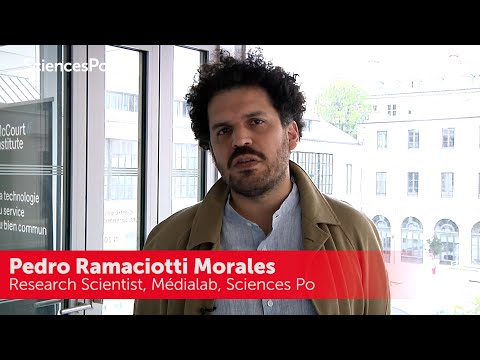
Another project, Social Media for Democracy (Some4Dem), focuses on the impact of social media on society with regard to political debates. In the past, Pedro Ramaciotti Morales has also studied online and offline polarization in the Gilets jaunes movement in France, or how different relationships between Youtube channels can affect the diversity of content watched by users.
The researcher arrived at the Institut Planète Apprentissage in 2022: “What interested me about the Institut Planète Apprentissage was the diversity of the stakeholders surrounding the scientists. There's a diversity of players, from industry to associations, or foundations, as well as a large international community.”
Following on from his previous studies, his project focuses on social media and politics. As he explains: “There's a long list of things that can go wrong online. People think of polarization, echo chambers or misinformation, for example. When doing scientific research on these topics, you first need to understand people's opinions, and these concerns can be described as research questions.”
Traditionally, when analyzing socio-political dynamics, many studies only consider polarization along left-right ideological dimensions. For Pedro Ramaciotti Morales, these left-right analyses need to be enriched with additional dimensions. These include, digital relational behavioral traces (what users like, comment on or recommend) can be used to extract opinions. The researcher works with data from Twitter, Facebook, Youtube and Linked in, for example. Using these social network data, he sets out to inscribe individuals in opinion spaces where dimensions act as indicators of users' ideological traits.
In a recent article on the geometry of misinformation, he produced the first “attitudinal embedding of social network users“. Using Twitter data, he and his colleagues show that the combination of extreme left-right polarization and anti-elite sentiment is most predictive of the propensity to share fake news.
In his own words “Much of my research is aimed at trying to produce realistic characterizations of people's political mental structures”.
The ‘Learning Planet Institute, called Formal Computational Socio-Politics, comprises three PhD students (Tim Faverjon, Benjamin Gilbert, Duncan Cassells) and one post-doc (Zografoula Vagena). “They come from sociology, machine learning or engineering. They have a fantastic mix of diverse skills that converge towards the team's mission”, explains Pedro Ramaciotti Morales.
“Our core mission, which sets us apart from other people doing examples of computational social science, is that we believe in the idea of applying mathematics to formalize problems that are deeply theoretical in the social sciences.”.
Article written by Sophie Vo