
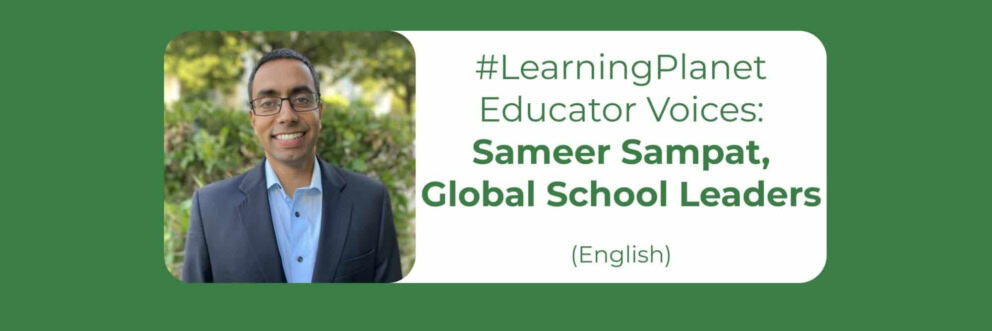
Meet Sameer :
sameer is co-founder of Global School Leaders. Global School Leaders (GSL) works with donors, governments and NGOs to specifically strengthen schools in marginalized communities. GSL is a not-for-profit organization dedicated to mobilizing key stakeholders in low- and middle-income countries (LMICs) to invest in and participate in school leadership training in their countries. GSL provides a combination of tools, resources and in-depth consultation specifically designed to address the issues faced by school leaders in LMICs, helping them to improve their school's effectiveness and performance, and achieve better learning outcomes. GSL has worked with over 3,500 headteachers, impacting around 920,000 students. Its main countries of intervention are India, Indonesia, Malaysia, Kenya and Brazil. During COVID, it extended its activities to the Philippines, Uganda, Nigeria and Peru.
Previously, Sameer was the first Executive Director of the India School Leadership Institute (ISLI) and worked as a project manager and research analyst at Harvard University's Education Innovation Laboratory, where he designed, implemented and evaluated interventions to close the racial achievement gap in the United States. He has also worked with Teach For America, Akanksha and Adharshila Shikshan Kendra.
Sameer holds a bachelor's degree in electrical engineering from UCLA and a master's degree in economics and education from Columbia University.
Why is it important to have networks of teachers, principals and schools?
The role of Global School Leaders is to enhance and support the improvement of school leaders' ability to improve outcomes for children. We believe that one of the most important ways of doing this is by creating networks of school leaders.
Capacity building for headteachers is most effective when it follows the three Cs approach:
- Coaching: headteachers benefit from ongoing individual support to help them meet the challenges they face,
- Content: headteachers have access to content designed to help them improve their teaching and become better headteachers.
- Community: Leadership can often be a lonely role; we don't often have the opportunity to share ideas with other principals, for example. Bringing headteachers together has the power to generate new ideas and provides a platform for sharing best practice.
What's more, effective headteachers will do the same for teachers on their side; they'll find ways to get teachers to interact with each other and share ideas.
Finally, bringing people together from different communities adds another layer of richness, which we do through international networks of school heads.
How have your teachers, schools and principals performed in these times of crisis?
Firstly, school leaders have been led to focus on aspects other than the child's academic needs (for example, basic needs: food, housing...), which were already challenges before COVID, but which were exacerbated during the crisis. For example, in Malaysia, a school manager took the initiative of organizing regular meals for 80 needy families at the school.
Secondly, the crisis has highlighted inequalities in access to schools and education. Prior to COVID, most of the countries in which GSL worked ensured that children attended school. However, COVID turned this situation on its head - and school heads had to do a lot to ensure that children had access to school. In India, for example, we worked with a network of schools to identify the specific difficulties teenage girls might face, so as to get them back into school. One of the school principals had spotted that one of the girls in his school was getting married at an early age. Together with the principal's network, they identified over 200 students who were going to undergo early marriages and worked together on accommodations and ways to ensure they could return to school.
If you could bring to life an ideal future for teachers, schools and headteachers, what would it look like?
Even before COVID, we were pushing for leaders to really focus on students' academic, social and emotional learning as the school's number one priority. An ideal school leader remains focused on this question: how can we best support the children in our school? It's very important to keep addressing these needs, and to see the school as partly responsible for them.
In addition, I think the link between schools and parents has strengthened. Our recent survey of 11,000 educators (including 4,000 headteachers) to understand the response to COVID showed that the most popular initiative to support COVID in schools was parents' meetings. This link between school and home has grown stronger, and it's essential that we continue to strengthen it to best meet the needs of every child.
What we're asking of school leaders and teachers is no easy task - and we need to consider an ideal support system to develop and strengthen their skills and recognize the incredible work our educators do.