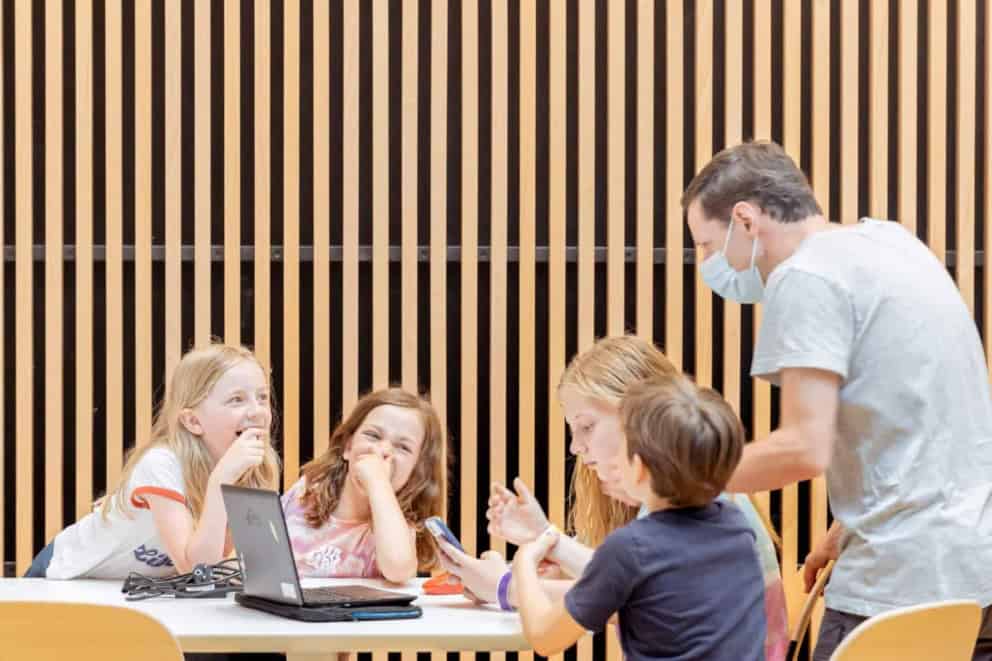
To mark its 90th anniversary, the Lego Foundation has launched its “Build a world of play” challenge, which places the well-being of children at the heart of its concerns. Together with our partners, we decided to join this initiative because it resonates with our commitment to learning. At the Institut Planète Enfants, we believe that compassion, empathy and social and emotional skills are essential for taking care of oneself and others, at any age. To back up this assertion, we asked experts about social and emotional skills, why they are so important and how they can be acquired from an early age.
Since the 1960s, Social and Emotional Learning (SEL) has slowly developed through research, and has become an increasingly important part of conversations about education and child development. More and more teachers, parents, schools and preschools are taking an interest in the concept. What is social and emotional awareness, and how does it influence early childhood development? Why is social and emotional awareness essential to meeting today's challenges?
To find out more about this topical issue, we consulted the following LETS experts and researchers, who are members of #LearningPlanet:
- Macarena-Paz (Mathilde) Celume, researcher and lecturer at the Learning Planet Institute
- Kim Normand Dobrin, co-founder and CEO of Free the Mind Co
- Suchetha Bhat and Tania, Dream a Dream
- Dominic Regester, program director at Salzburg Global Seminar
What is social and emotional learning?
According to the Collaborative for Academic, Social and Emotional Learning (CASEL), social and emotional learning is “the process by which all young people and adults acquire and apply the knowledge, skills and attitudes needed to develop healthy identities, manage their emotions and achieve their personal and collective goals, feel and show empathy for others, establish and maintain supportive relationships, and make responsible and caring decisions”(CASEL, Fundamentals of SEL).
Macarena-Paz (Mathilde) Celume, researcher and lecturer at the Learning Planet Institute, fits this broad definition:
“The most widespread definition of social-emotional learning refers to the process of combining thought, feeling and action, in order to develop self-awareness and interpersonal awareness, to make moral judgments and to control one's own conduct and that of others.

In research, several researchers - such as Gardner, or Mayer & Salovey - approach SEL from different angles: personal skills, personality traits, emotional intelligence and so on. However, as Macarena-Paz points out, all these approaches seem to designate skill sets that do not fall into the family of academic skills.
Why is SEL so timely and important?
“L‘Anxiety has increased fourfold in the last two years. And one child in five suffers from an anxiety disorder.“
Kim Normand Dobrin, co-founder and managing director of Free the Mind Co. Recent years have indeed been marked by mental health challenges, and young people are confronted with anxiety problems. Their mental health is now a serious and urgent issue: in France, for example, more and more young people feel depressed, lack motivation and are often anxious in their daily lives.(Santé Publique France, 2022). This is why, now more than ever, social and emotional learning is essential. Children and young people in general have a strong need for interaction with adults and peers to develop their social and emotional skills and feel secure.

Suchetha and Tania are part of Dream a Dream, a non-profit organization that empowers children from vulnerable backgrounds to overcome adversity and thrive in a changing world. In a recent interview, They underline the importance of SEL for the future well-being of children:

“We've seen young people show significant improvement in the way they interact with others, overcome difficulties, take initiative and manage conflict - some of the most important SEL or life skills. In 2019-20, we observed 5332 participants (2638 males and 2694 females) aged 8-17 in Dream a Dream's after-school life skills program, who showed a positive change of 91 % in life skills (Impact Report 2019-2020 Dream a Dream).”
We need to empower the next generations so that they learn how to learn, and develop the skills and abilities to care for themselves, others and the planet. Compassion, empathy and creativity are essential to meet the challenges of our time.

Why should SEL start at an early age, before school starts?
People need strong social and emotional skills to better understand themselves, manage relationships and interactions with others, and figure out what they want to do with their lives. And the sooner the better, according to Dominic Regester, Program Director at Salzburg Global Seminar:
“L‘he idea that social-emotional skills are as fundamental as literacy and numeracy skills is starting to gain ground. (...) All the time spent investing in the development of literacy and numeracy, if we could do something similar for social and emotional skills, I think it would allow future generations to have a far more positive set of opportunities than previous generations necessarily had!

Read more :
- Video series on socio-emotional learning with François Taddei, Kim Dobrin (July 2022)
- Why is socio-emotional learning important and timely? An interview with Suchetha and Tania from Dream a Dream, #LearningPlanet (July 2022)
- Press release - The Planet Learning Institute joins the LEGO Foundation's “Build a World of Play” initiative (June, 2022)
- Challenge“Building a game world“Lego Foundation
As an organization committed to learning and empowering the next generation, we believe in the power of social and emotional skills to develop social and emotional intelligence, to be able to learn, to care for ourselves, others and the planet.
We also believe that storytelling in general is an essential tool in preschool education and beyond.
That's why the Educational Planet Institute has teamed up with Harper Collins (USA), Bookr Kids (Hungary) and Copublica (Denmark) to join the Lego Foundation's “Building a World of Play” initiative to enable children to achieve higher levels of self-awareness, interpersonal skills, self-management, social awareness and empathy. Together, we hope to offer a playful, at-home storytelling solution for socio-emotional learning. This easy-to-use storytelling application would enable families to empower children to achieve higher levels of self-awareness, interpersonal skills, self-management, social awareness and empathy.