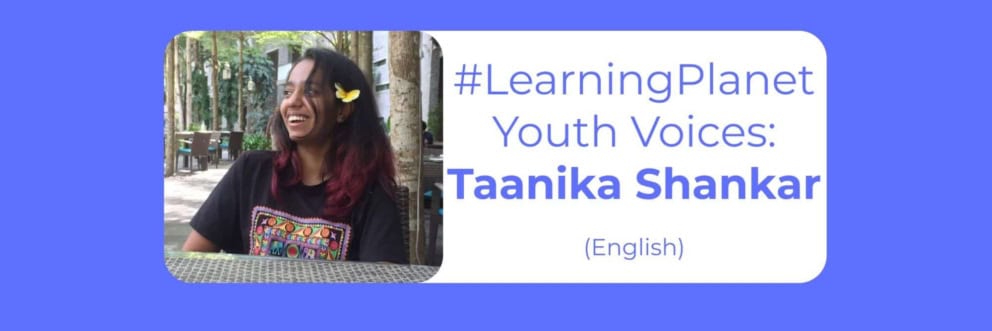
Meet Taanika:
Taanika Shankar is a third-year Economics and Sustainability undergraduate from Bangalore. She has a keen interest in social and environmental justice and strongly believes in the power of a more inclusive and holistic education. Taanika is the co-founder of the Yugmā Network, a youth network working for environmental justice. She has worked in the past with organizations such as Reap Benefit, Kids Education Revolution, YLAC and Project Sitara. She also loves trees and music 🙂
What causes are important to you and to young people today, and why?
I think there's no limit to the causes that matter to young people today. In a world with no shortage of problems, inequalities and injustices, fortunately there's no shortage of causes people care about.
I'd say the most popular causes are the climate crisis, feminism and gender equality, LGBTQ+ rights, casteism (in India), anti-fascism, body positivity, rethought and inclusive education. As for why, I think it's because of world circumstances and dissatisfaction with the attention important issues receive.
What don't adults understand about young people? What's the most common misconception they have about young people?
In my opinion, the most common and frustrating misconception is that young people don't know what they're doing most of the time, and are incapable of clear, critical thinking. They think we do most things whimsically, in a moment of fleeting passion (which can sometimes be true), but that we are capable of understanding, reflecting and consciously using our rational autonomy to make decisions and act for causes we care about. They also believe that we cannot reconcile studies (which are not the end in themselves) with activism and other activities.
(A little anecdote: an adult once told me that he thought Greta Thunberg was a puppet for certain big companies or other NGOs! It seems so hard to accept that a young person could be conscious and working on something).
What was the first moment of enlightenment that encouraged you to take action for the society in which you live?
When I was in Grade 8, some students at my school organized a clean-up campaign around our school and I signed up to take part. I'd never done anything like it before and I really enjoyed it! I even received a small informal certificate at the end of the operation for being one of the most active and committed volunteers!
For as long as I can remember, I've wanted to grow up and help protect the environment, but I always thought I'd do it when I grew up. Taking part in this little clean-up operation and realizing that it was something I loved and was good at was my moment of enlightenment. It was also the first time I was brave and independent enough to do something like this on my own.
Afterwards, I signed up to work with Reap Benefit (a wonderful organization that works on local civic and environmental issues by involving young people) as part of their program at my school, started volunteering for tree plantings, visits to retirement homes, clean-up campaigns and began tutoring girls at a home for the disadvantaged).
How do you think we can involve young people who want to make an impact but don't have easy access to opportunities to get involved (because of language, lack of networks, difficulties accessing and using technological tools...)?
I think the simplest way to address a specific problem is to find out why certain groups of young people don't have access to these opportunities. If language is the issue, I think we need to make opportunities more linguistically inclusive; if access to and use of technology is the issue, I think we need to make these tools more accessible. There's always a way, depending on the nature of the problem. In a world as diverse as ours (especially in my Indian context), inclusion and equity are two of the biggest underlying challenges. We should seek to address them in any attempt to create impact, otherwise no approach is truly effective.
What I'm trying to say is that if the movement isn't inclusive and opportunities aren't equitable, I think this is an inherent flaw in the movement itself, not just a lateral problem that needs to be addressed.
What advice do you have for young people who want to make a positive impact? How should they start?
I think there are two main reasons why young people who want to make a positive impact find it hard to get started: the first is that they don't know where to start! There are so many things you could do that it's hard to know what to do, how to do it and when to do it. It can be really overwhelming. In my experience, I think it's very useful to start by volunteering with an existing organization. This allows you to gain experience, find out what you like and don't like doing and, most importantly, have someone or a few people to ask questions of and learn from while you're experimenting and doing, rather than just talking to them.
Secondly, I think a lot of young people are a bit afraid to step out of their comfort zone and do something for a cause they feel strongly about. I couldn't agree more. It's easy to think that positive impact is something you can do once you're an adult, have a job and everything else. As cliché as it sounds, I think the only way to break out of this pattern is to stop thinking and take a chance. Find something that's close to your heart, maybe find someone you can act with (like an existing NGO or a friend who's equally enthusiastic) and go for it. And maybe give a little less thought to yourself - it's not the end of the world if you fail at what you're trying!
What would you like to say to decision-makers?
I'd like to say two things to decision-makers:
Firstly, we need to consider young people as active players in the present and future, and not simply as beneficiaries of the impact of policies. We are the future, so in a certain sense, we are one of the most important stakeholders!
Second, believe that we can think, do and contribute to decision-making processes. Please also recognize that we have the right to express our opinions and participate in democratic processes. Don't take this right and power away from us! In addition, they must create spaces where we can exercise our right and power!
(Photo courtesy of Taanika Shankar; copyright: Taanika Shankar)