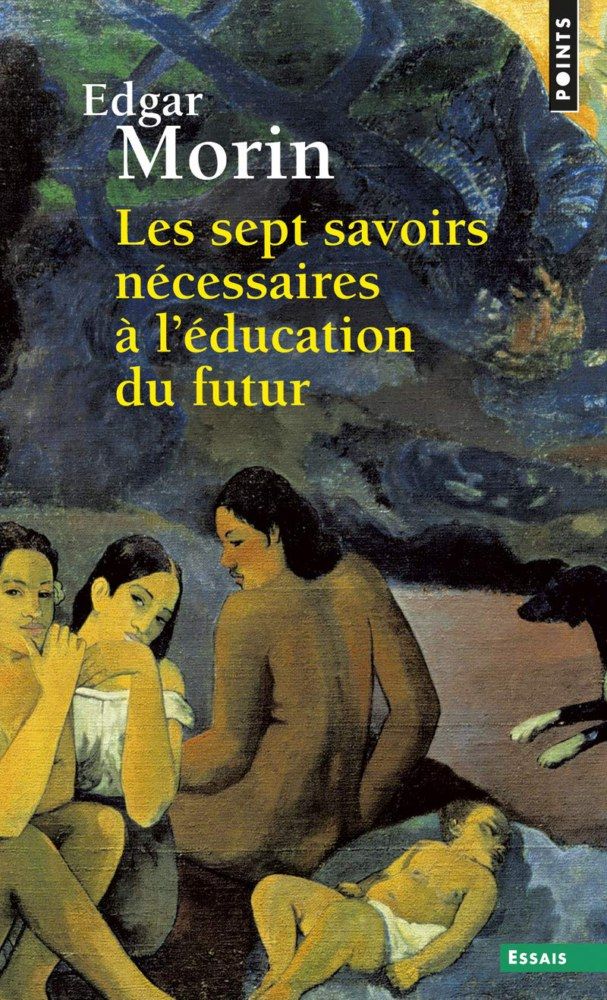
Edgar Morin proposes a transdisciplinary approach that is essential if we are to help students grasp contemporary problems in all their globality and complexity. Current education, like modernity, tends to fragment and compartmentalize knowledge, and to make techniques independent of existential and human concerns. Edgar Morin, on the other hand, advocates linking up the dispersed knowledge in each discipline (his concept of reliance) to «teach the human condition and earthly identity», which would also have the advantage of developing students« faculties for understanding others. Rather than reducing education to the transmission of established knowledge, in an often deterministic conception of the evolution of societies7 , he considers it preferable to explain what he calls »the ecology of action«, »the mode of production of knowledge«, or »the knowledge of knowledge".
Based on a cosmic vision of the human adventure, in which creation and chance play an essential role, he proposes a complex philosophy of the «human condition» that should serve as the foundation of humanity's identity on Earth. This identity integrates ecological and humanist concerns.
In this opus, signed by Edgar Morin after being submitted to and amended by leading academics and international civil servants, he envisages a project for the philosophical and pedagogical foundation of education on a global scale. This book does not deal with all the subjects that are, or should be, taught, but it sets out the seven fundamental knowledges, all the more necessary to teach as they remain totally ignored or forgotten.
Extracted from: Wikipedia