As a player committed to achieving sustainable development objectives, CRI is responsible for measuring and improving the environmental, social and economic impacts of its activity in collaboration with all its stakeholders. In 2019, a dedicated team will be created: Living Campus*.
Interview with Léo Houdebine, a member of a team and a program in continuous development, which are putting collective and individual modes of consumption and commitment at CRI back into perspective.
Identify, improve and systematize
When it was set up, the team's initial ambition was to quantify the environmental, social and economic impact of CRI's activities, identify areas for improvement and propose a roadmap.
“One of the first projects was to draw up an assessment of greenhouse gas (GHG) emissions attributable to CRI's activities.”begins Léo Houdebine. To ensure that as many externalities as possible are covered, the Living Campus team takes into account a broad scope (scopes) of study. This approach enabled them to identify the main areas in which they could work to reduce the institution's GHG emissions. Three areas quickly emerged: transport, heating and electricity consumption. “Thanks to the internal audit on the operation of the thermal control system, we have ensured that it is working as intended, and we have modified the parameters that were not compliant. In a few months' time, our team will be able to assess the effects of these changes on campus consumption.”
Relying on a network and sharing practices
Participation in the symposium EcoCampus 4 in Poitiers in 2019 is a key event for the project team. Léo Houdebine explains: “We met and exchanged ideas with a large network of managers. Sustainable Development & Social Responsibility (DD&RS) in higher education.”Following these discussions, best practice ideas from other establishments were adapted and added to the roadmap, enabling the development of a series of relevant actions to achieve the objectives set by the team (creation of an eco-responsible event guide, promotion of student commitment, DD&RS label...).
Student commitment at the heart of the Living Campus approach
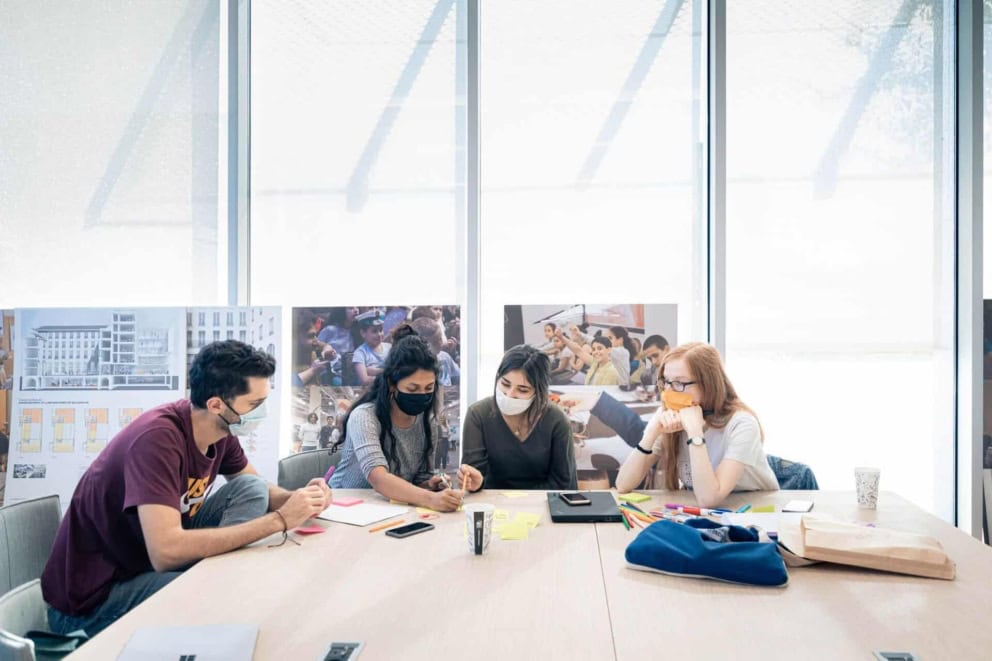
From the outset, the CRI has been built with students. “Our team was enriched by the arrival of two students who dedicated their Masters internship to implementing part of the roadmap.”Through the organization of community workshops, “they provide a dimension of awareness and creativity”. These initiatives gave people the opportunity to take part in discussions on the phenomenon of ecoanxiety, to take part in a painting workshop to express their emotions, to record a series of podcasts on a variety of subjects, or to develop systemic thinking on the implementation of a sustainable campus.
At the beginning of 2021, a student will also complete his end-of-study internship with the team, helping to develop the dimension of raising awareness of sustainability issues. Léo Houdebine looks back on Nicolas Steinik's assignments: “Her experience of student associative involvement and her sensitivity to the challenges of transition in higher education have provided us with a wide range of activities in which CRI students, staff and researchers have already been able to participate: games, round tables, partner visits, cooperative ventures, and so on.”A committed internship that has resulted in the opening of a position within the Institut des défis to continue this work and prototype actions that can be proposed to Université de Paris to support its transformation towards a more sustainable model.
Raising awareness and mobilizing communities through student involvement
The beginning of 2021 was strongly marked by a low presence of students and staff on campus, due to the Covid19 crisis and sanitary measures. This made it difficult to mobilize the CRI community en masse for awareness-raising activities. However, Léo Houdebine praises the motivation of a few die-hards: “However, a core group of students has helped to revitalize these initiatives, and a number of them have committed themselves to these subjects, proposing other activities..”
Initiatives such as the manifesto Pour Un Réveil Écologique or the student COP2 (now known as “Agreement for the Transition of Higher Education Institutions”), demonstrate to the entire higher education ecosystem in France that students want to be involved in the future of their institutions. “This CRIticism of youth is not insignificant, and it's what Living Campus strives to bring to life through its activities.”Léo Houdebine.
At the initiative of 4 CRI students, the Living Campus team has set up a working group for student COP2. “Their involvement in particular, and that of many people from the University of Paris, fuelled a rich exchange of ideas on how to integrate sustainability issues into teaching and consumption on campus.”
Following these discussions, CRI became a signatory to the Grenoble Accord, committing itself to integrating sustainability issues into its various activities.
From achievements to challenges and from challenges to achievements
The official DD&RS roadmap will guide CRI's future actions to reduce the negative externalities of its activities on the environment and society, and to develop activities with a positive impact. Léo Houdebine looks back on the drafting process: “A first version of this cross-functional strategy was first presented to the ComEx in July 2021, to validate the approach and present it to the various teams, and a phase of co-writing the final version with the various CRI stakeholders is currently underway”. In line with the approach adopted by Living Campus since its creation, this roadmap takes stock of the actions undertaken in various areas (training, research, HR policy, buildings, etc.) and goes on to define quantified objectives and performance indicators.
A committed and engaging sustainable campus
The activities of Living Campus resonate with the missions of community animation and support for student projects carried out by other teams. “The strong involvement of students in issues relating to the building and its community, and the need to support them in their mobilization, led us to the idea of grouping all these activities under the name “Living Campus”.” ”A space, a setting and a community committed to the development of a meaningful, learning campus.
*The Living Campus initiative cuts across all CRI activities, and leads, supports and promotes actions to raise awareness and develop sustainable activities. These actions are embodied by three concepts:
- A learning campus
A place where students and staff can meet, exchange ideas and work together (courses, projects, clubs), the campus is dedicated to learning about the challenges facing our society. - An engaging campus
The campus is a place for listening, sharing and inclusion, with moments dedicated to discussion and the participation of CRI players in joint projects. - A sober campus
Finding ways to limit the consumption of energy, water and material resources associated with CRI's activities is a major focus of the team's work.
Find out more about Living Campus, a sustainable campus
Photo: © Quentin Chevrier