Schoolchildren from Joliot Curie, Stains and Iqbal Masih, Seine-Saint-Denis! The third graders, part of The Schools Challenge program, were welcomed to the MakerLab from Learning Planet Institute to bring their projects to life.
The educational mentoring program The Schools Challenge, led by Savanturiers - École de la Recherche and J.P. Morgan, Its mission is to develop the interest of Seine-Saint-Denis secondary school students in science and sustainable development, and to encourage them to take ownership of urban and local issues through project management.
For 6 months, with the help of their Savanturiers and J.P. Morgan mentors, the schoolchildren have been imagining, designing and proposing very concrete solutions for better living in their city and region. At the end of January, with designer Roxane Philippon, the schoolchildren discovered all the tools of the trade. fablab (3D printers, laser cutters) to bring their ideas to life.
On Tuesday, March 15, the students presented their project to a panel of judges:
- Olivier SIMON, Managing Director, J.P.Morgan
- Vanessa ENGEL, Head of Philanthropy, J.P.Morgan
- Ange ANSOUR, Director of Savanturiers - École de la Recherche, Learning Planet Institute
- Marie-Elise GAUDICHE, Ile de France Program Manager, JobIRL
- Chloé BONNEFOND, Project Manager - Education for sustainable development, Department of Seine-Saint-Denis
- Dusan Misevic, Director of Scientific Affairs, Learning Planet Institute
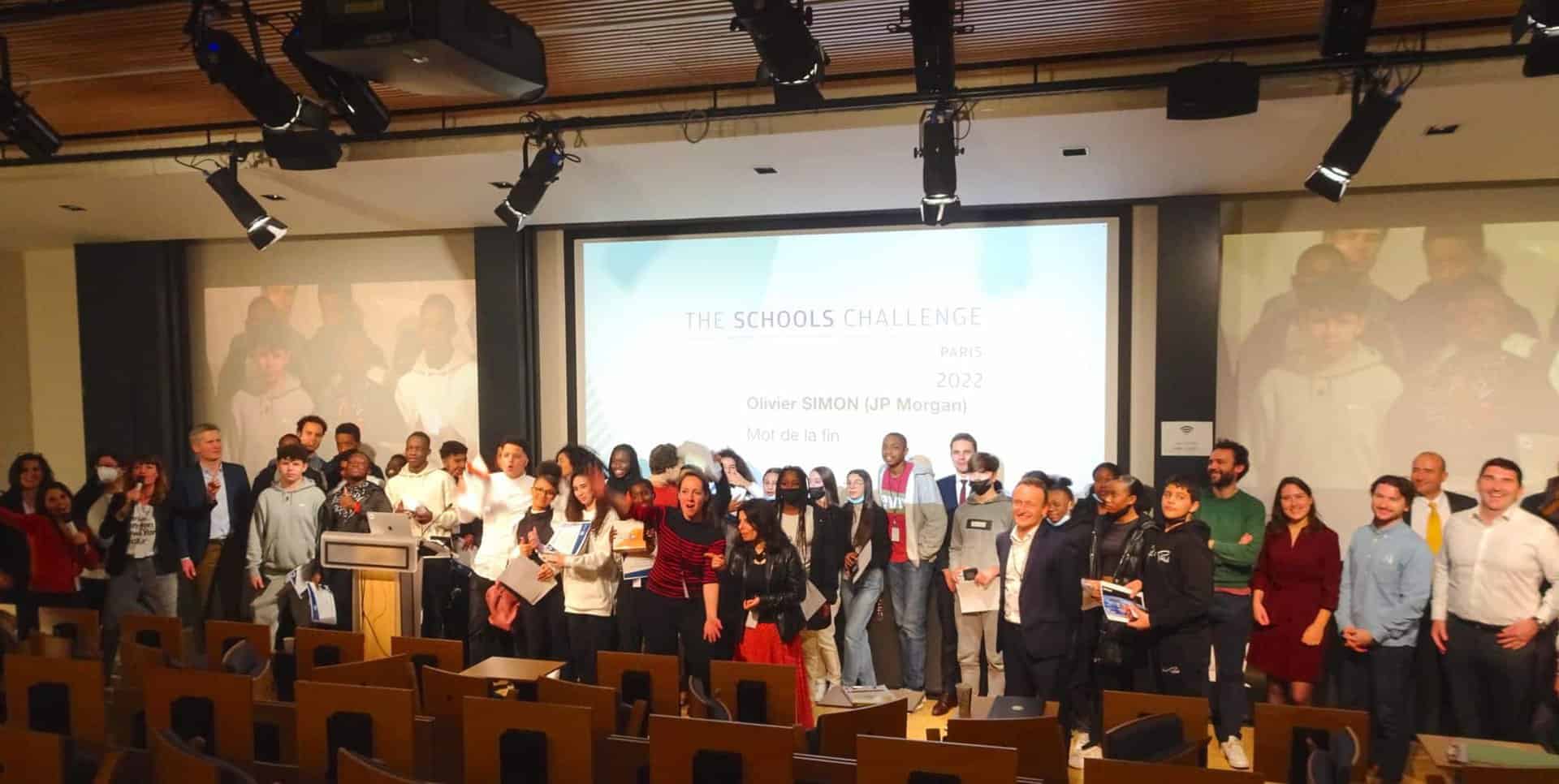
THIRD-GRADERS BUILD THEIR CITY
The “Les Audacieux” team” creates a hydrogen bus model focusing on the engine to illustrate hydrogen production by wastewater electrolysis.
Price : “Eloquence”, for the best oral presentation.
The Jaguars“ prototyping a blind sound insulation for windows to reduce noise pollution in cities.
Price : «The »Student-Researcher" award goes to the group that best adopts the student-researcher posture.
For the “Seven Silences” to reduce noise pollution from cars. They have come up with a box to reduce motor noise. To do this, they tested all kinds of materials to find those with the best insulating properties.
Price : “The ”Collaboration" award goes to the group that best adopts the collaborative posture.
Road safety for the “Joliot Curie Innovation” team” ! By installing motion sensors on street lamps, In this case, light signals are projected onto the ground to warn motorists of the presence of a pedestrian!
Price : «The »Orientation" award goes to the group that best identifies the players and sectors involved in their innovation.
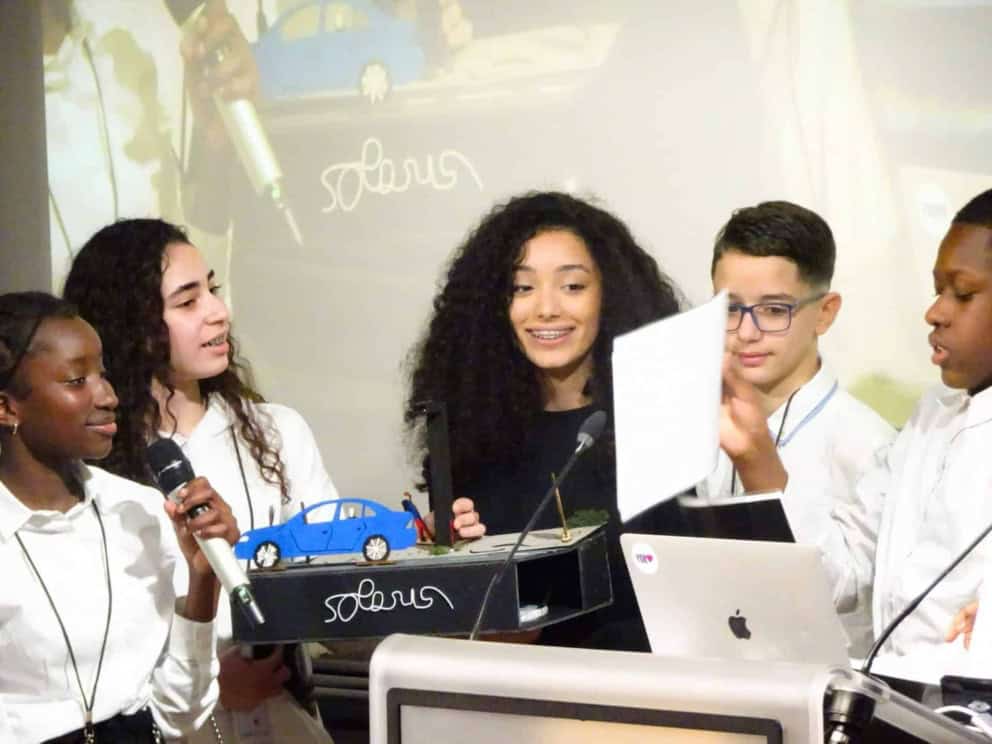
For the “Baguettes” project, the schoolchildren recreate a street scene to test their idea of a intelligent street lamps. Presence sensors enable them to adapt their brightness. This reduces energy consumption and visual pollution.
Price : “Idea” goes to “Wands” for Solaris!
They will represent France in the international final of “The Schools Challenge”!
The ”Maladesh” team” will create two bus prototypes! The first will be equipped with’a bus ventilation system which the driver can activate when CO2 levels are high. For their second bus, the schoolchildren rethink its ergonomics to smooth the flow of incoming and outgoing traffic.
Price : «Planning» for better project management (feasibility, business plan, etc.)
INTERVIEW - A PLACE WHERE EVERYONE CAN CREATE AND EXPERIMENT
Philippa-Jane Blein, responsible for school projects and Paul Monsallier, The Schools Challenge project manager, explain the essential role of this stage of the program at Makerlab.
Why is it important for schoolchildren to make models of their projects?
Paul Monsallier: Creation brings together the abstract and the concrete. These models are the fruit of both their reflection and their ability to materialize their ideas. This approach is all the more effective for its playfulness.
Philippa-Jane Blein: All of us - students, mentors and support staff alike - were looking forward to the Makerlab, where we could put into practice all the ideas that had been developed and matured over the last 5 sessions.
Pedagogically, it's a key moment in the project when students reinvest all the notions they've seen previously with their mentors, and make them their own as they build their prototypes.
It's also a moment when students begin to change their posture, because they know they'll be asked to present and promote their project.... It's at this precise moment that we introduce another, more professional dimension, where students become aware that they have to put themselves in the shoes of the audience who will discover their project, and ask themselves questions about it. Work sessions will be dedicated to this before the grand finale, with the collaboration of our partner Yolo Conseil et Coaching and mentors J.P. Morgan.
Why is MakerLab the ideal place for this project?
PM : The Makerlab offers students the chance to witness and experience an unusual space. With its high-tech machines, such as a laser cutter and 3D printer, the Makerlab is the stage for different approaches to creativity, between self-expression and peer learning. The students were both guided and involved in the creation of their models. The Makerlab is intended to be a space where knowledge is passed on to others, to create a certain horizontality between people who want to learn and do. This requires humility in the face of the creative process. This is what this space promotes: solidarity in access to creation. The students were able to see how they, their mentors and the technical supervisor were involved in the creative process. This shows that the idea of collaboration and sharing exists in the creative process.
Did you get any feedback from the students on these two days?
PM : The students were won over by the technical prowess of the machines, particularly the laser cutter. Their ideas quickly went from sketch to object. The format of the workshop allowed them to put their imagination and manual skills to the test. As the machines weren't the only ones involved in shaping the models, the students were able to participate by using the glue gun to assemble their various elements.
This workshop gave them the opportunity to consider the translation of an idea into an object in a more concrete and accessible way.
PJB: It was one of the best days they've ever had. The schoolchildren get away from their everyday lives, discovering and handling machines that most of them have never had the chance to see before. It also introduces them to new professions, which we'll be coming back to later in two workshops with our partner. JobIRL.
The Savanturiers are proud of the projects they have developed today! But also of having contributed to raising awareness of science, and of having offered a space for creativity and construction.
Useful links
Article originally posted on Savanturiers - École de la Recherche
Find out more + on The Schools Challenge? (in English)
Discover the last year's projects
Discover the documentary on The Schools Challenge