Well-being and health during the doctorate: the FIRE doctoral school offers a new series of events
For the first time last year, the FIRE doctoral school organized a workshop dedicated to “well-being and health during the PhD”, covering two essential aspects of a young researcher's life that are often not sufficiently discussed within the academic world [1]. Here's an overview of what happened and the main developments in this year's program.
The initial two-day workshop was built around several presentations, attended by the same group of a dozen PhD students at different stages of their thesis. To enable a greater number of participants to attend and target what is most relevant to them, our various interventions can now be followed independently of each other.
Free discussion, sympathetic listening and mutual benevolence between participants remain the keys to fruitful interaction.
From impostor syndrome to communication, a wide range of topics covered
Among the most memorable moments, Colin Lemée will succeed Jeanne Boisselier on behalf of the association. Doctopus, to take an in-depth look at impostor syndrome with participants. This self-perception, of being less competent than others think of you, of feeling like an impostor despite objective proof of success, is widespread among doctoral students. Becoming aware of it, for oneself and for others, is therefore the essential first step to overcoming it.
The thesis is a stimulating period that can be accompanied by a wide variety of activities outside research, including teaching, student supervision, peer review of articles, and so on. To avoid feeling overwhelmed, it is sometimes necessary to turn down a few extra requests. To avoid feeling overwhelmed, it is sometimes necessary to turn down a few extra requests. More detailed emphasis will be placed on identifying individual needs and limits, including role-playing to practice saying “no” to opportunities that exceed limits.
As one former participant put it, seeing “how people I admire have faced the same challenges as me was very encouraging”. Wendy Ingram, from the international NGO DragonFly Mental Health, has clearly demonstrated this with a video in which accomplished scientists express the doubts and even mental health problems they have had to contend with. Breaking the stigma was one of the most important messages to remember, and we continue to emphasize this point. Wendy's speech also focuses on the’active listening as an introduction to difficult discussions.

This part of communication, which is crucial to maintaining quality interpersonal relations (with a thesis supervisor, collaborator, laboratory colleague...) was also addressed by Pascale Haag this autumn. Pascal holds a doctorate in psychology; her thesis focused precisely on the study of the doctoral career, from the angle of stress, health and supervisory relationships. She gave concrete examples of assertive communication, A way of expressing one's point of view or idea in an understandable and straightforward way, while respecting the interlocutor.
During her three-and-a-half-day workshop, she also addressed the field of positive psychology, presenting both theoretical frameworks and practical tools and techniques for building resilience and socio-emotional skills.
Topics that go beyond the concerns of doctoral students
During these workshops, we also discuss aspects of life as a researcher that are relevant not only to PhD students, but to people working in academia in general. Although our doctoral training is already open to a wider audience, we are also taking this opportunity to create new workshops that are aimed directly at a broader public. Such is the case with “Abuse of power in academia - what can we do?”, offered again by DragonFly Mental Health this spring. Together with the students who launched the Learning Planet Institute's Wellness Club, we are currently working on setting up this intervention and discussion for the Institute's community: all students and researchers are welcome.
Doctoral work, and by extension research work, is an exciting, stimulating and enriching scientific and human experience, which can also sometimes be emotionally challenging. We are convinced that it is part of our role to support doctoral students as best we can, so that they have a positive experience throughout their thesis. In doing so, we aim to improve the quality of working life within the academic world as well as for the wider communities.
Article : Camille Gaulon, Scientific and educational coordinator of the FIRE doctoral program
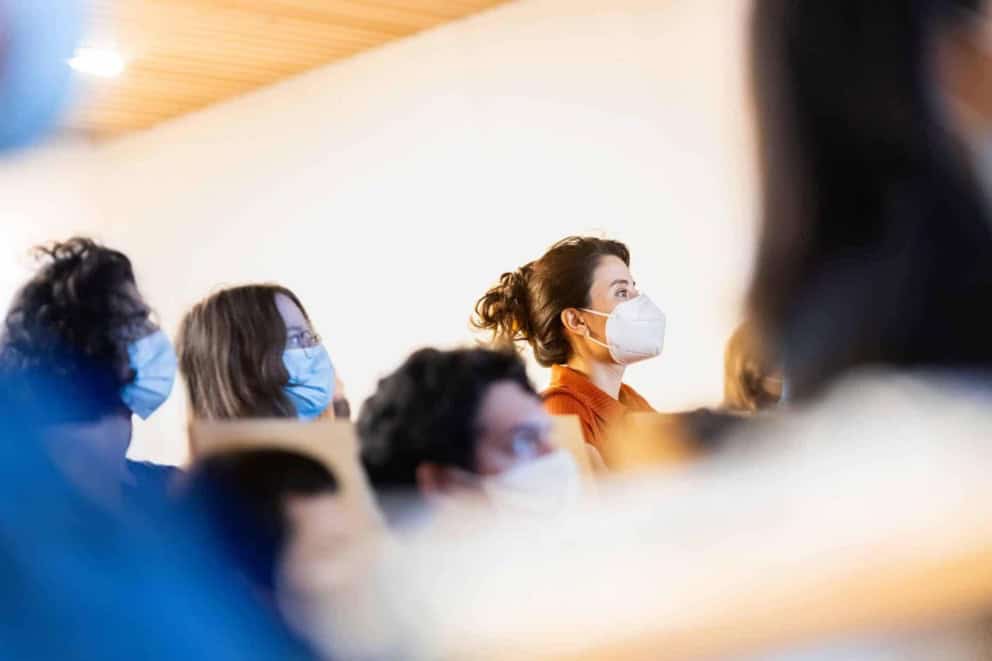
Photo credits: Learning Planet Institute_DiscoveryDays2021_©QuentinChevrier
the FIRE PhD program has not been implemented [1] despite very worrying figures: around a third of PhD students show symptoms associated with anxiety and depression. Source : Nature 575, 403-406 Nature 575, 403-406 (2019)
Find out more about the FIRE doctoral school on our website