Community-driven education to thrive in the face of adversity
Despite constant and significant efforts, millions of children in Africa, Asia and Latin America still have no access to quality education. These children face many difficulties: inequality, conflict, poverty and displacement. Traditional education systems, often designed far from their realities, do not always meet their learning needs.
We firmly believe that education should enable every child to flourish, whatever his or her circumstances.
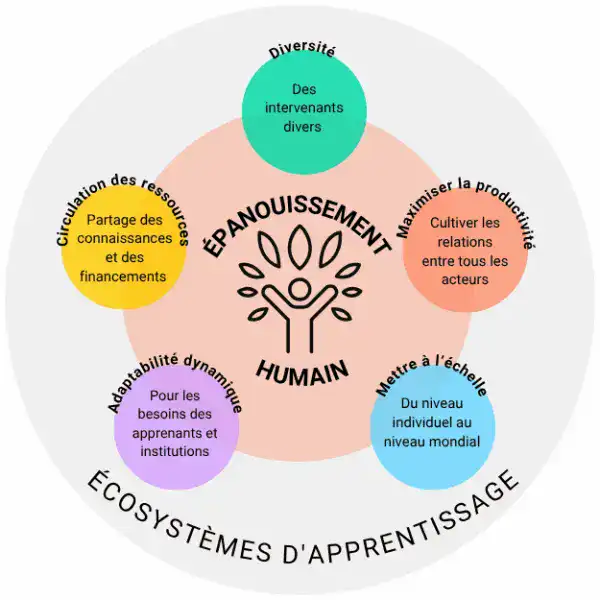
Faced with this challenge, a new approach is emerging: learning ecosystems. These community-driven educational models are based on local knowledge, equity and resilience. Teachers, young people, associations, public officials and the private sector work together to design learning paths adapted to local challenges. By bringing together a wide range of players, these ecosystems are transforming the way children learn, even in the most difficult situations.
A growing movement of educational innovators reinventing the way young people thrive
Our ecosystem is a network of organizations - in Africa, Asia and Latin America - which mobilizes local knowledge and partnerships to transform learning, while responding holistically to barriers to education such as poverty, violence and conflict.
Differences reinforce this approach, through peer-to-peer learning, South-South collaboration and shared governance.
From research to action
The Exploring local learning ecosystems in the Global South: Pathways to thriving for every child« report (2023) began with a global mapping of 100 pioneering learning ecosystems across the global South. We then selected 11 that were particularly unique in their fields. These ecosystems place human fulfillment, equity and learner autonomy at the heart of their approach. at the heart of their actions.
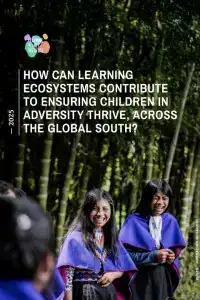
Moving from exploration to action, two years after the first published in 2023, How can learning ecosystems contribute to ensuring children in adversity thrive, across the Global South?« present a strategic roadmap for expanding learning ecosystems in the global South. Co-constructed with ten exemplary models, it shows how these community initiatives can become the basis for integrated formal and non-formal learning.
The document also addresses policy and funding challenges, offering a concrete blueprint for «education for human flourishing» (OECD), where local innovations transform national systems for the benefit of all children.
Taking the time to build trust is at the heart of the process — rather than delivering pre-designed programmes
Franco Mosso Cobián
Enseña Perú (Peru)
Our learning ecosystems do not focus solely on education — they also address peace, inclusion, mental health and our relationship with nature
Catalina Cock Duque
Fundación mi Sangre (Colombia)
Our organisation reaches more than 4 million people. But I focus on individuals. Jonathan, 11 years old and a victim of domestic violence, did not speak and had dropped out of school. Today, he is a successful photographer and teaches photography to others in his community. Miguel was a social leader who wanted to go into politics, with little real interest in his community. Today, he is a community leader preventing children from being drawn into illegal mining exploitation. Violent mothers have become caring teachers. Some people have become social entrepreneurs. I try to learn the name and story of each and every one
Gaby Arenas de Meneses
Fundacion TAAP (Colombia)
We are building a movement of practitioners who share their knowledge to integrate life skills into curricula and teaching practices
Stella Akongo
Luigi Giussani Foundation (Uganda)
Shared values are essential — universities must connect teaching, research and community service with the development priorities of their region
Dessy Aliandrina
Sociopreneur Indonesia (Indonesia)
Ndivho Mulaudzi, one of our former mentees (2019–2021), believed that the main reason for the low academic performance of students in her region was poor reading skills. Through our ambassadors programme, she was able to create a reading club for younger children, an initiative that was greatly appreciated by her community. The club focused on reading and building self-confidence through speeches, discussions and debates. Today, Ndivho is pursuing a diploma in Agricultural Sciences at Madzivhandila Agricultural College
Vhutali Nelwamondo
University of Venda and AIME Mentoring (South Africa)
Core tam
Olivier BRECHARD
Director of International Relations - Learning Planet Institute
Katherine BROWN
Project Manager - Learning Planet Institute
Rosie CLAYTON
Director of Digital Leadership & Research Fellow - Transforming Learning Group WISE
Gaby Arenas DE MENESES
Expert in social innovation & co-founder - TAAP Foundation
Valerie HANNON
Co-founder - Innovation Unit
Olga KOKSHAGINA
Associate Researcher, Learning Transitions Lab - Learning Planet Institute
Maria Angelica MEZA
Intern - Learning Planet Institute
Franco MOSSO
Co-founder - Enseña Perú
Marc SANTOLINI
Associate Researcher, Learning Transitions Lab - Learning Planet Institute
Radi SHAFIQ
General Manager - Friendship Bangladesh
Michael STEVENSON
Senior Strategy Adviser & Consultant, High Performing Systems of Tomorrow - OECD Education & Skills Directorate