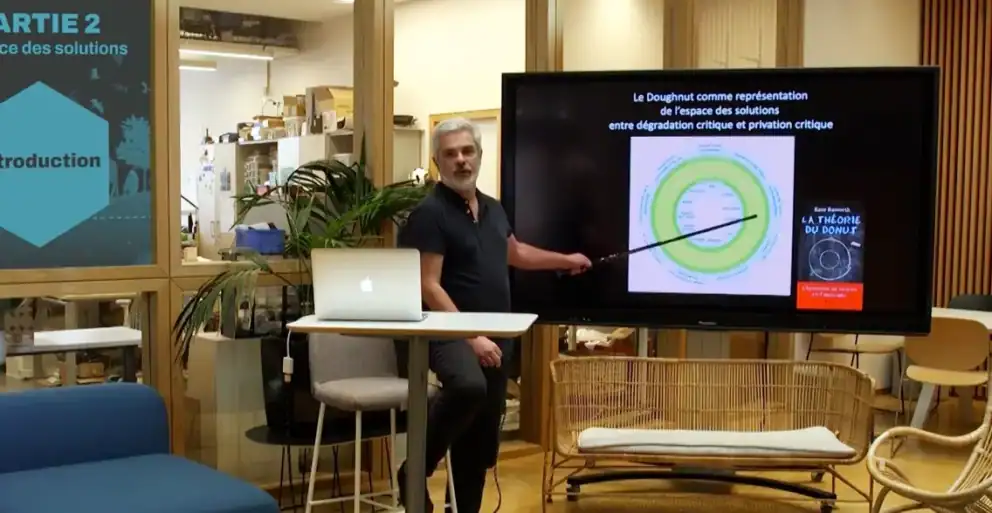
The course "What Paths for a Sustainable World?" offers an introduction to the key sustainability challenges we face and the range of existing — and yet-to-be-developed — solutions to address them. It provides a synthesis of the latest available scientific knowledge on these issues.
This course has been designed as part of a Bachelor's-level university module, and is aimed at anyone wishing to learn more about these issues. Most of the content is presented in layman's terms to make it as accessible as possible, with no pre-requisites.
The course is divided into two main parts:
I. The space of problems
II. The space of solutions
To fully grasp the key concepts, the sequence matters. We recommend watching the episodes in order — particularly in Part I — to follow the progression of the argument. Each episode is briefly presented below, along with references for further exploration.
Types of resources available
- To go further: Suggested resources accessible without specific prerequisites
- Expert mode: Reports and academic articles for those familiar with scientific literature
- Additional sources: Links to the original sources of images, videos and graphics used in the course
Note: This course is also available in Spanish (Parte I / Parte II) and English (Part I / Part II)
Part I: The space of problems
The first part explores the nature, complexity, scale and interconnections of the main environmental challenges we face.
Understanding planetary boundaries and natural constraints helps define the space within which human economic and social activities can develop without compromising Earth’s habitability.
Part I consists of four 30-minute episodes, covering eight chapters.
Episode 1
This episode introduces the concept of the Anthropocene. It outlines the demographic, economic, social and environmental characteristics of human development, highlights the central role of energy in these transformations, and explains the fundamental principles governing the biosphere.
Chapter 1: Introducing the Anthropocene
Chapter 2. The central role of energy
Chapter 3. Core principles of the biosphere
Episode 2
This episode presents the scientific theory of planetary boundaries and its components. It begins exploring the scale of humanity’s “metabolism”, starting with energy.
Chapter 4. Planetary boundaries
Chapter 5: The metabolism of humankind: orders of magnitude and limits of physical resources
- 5.1 Energy
Episode 3
Building on Episode 2, this episode examines other physical resources and constraints: mineral resources, greenhouse gases, climate change and pollution.
- 5.2 Metals and mineral resources
- 5.3 Pollution
- 5.4 Greenhouse gases
- 5.5 Other forms of pollution
Episode 4
The final episode explores impacts on the biosphere and the limits of exploiting living resources. It looks ahead at future human development needs and reviews theoretical models and institutional frameworks that help define potential solution pathways, detailed in Part II.
Chapter 6. Human metabolism: orders of magnitude and limits of living resources
- 6.1 Biosphere
- 6.2 Marine environments
- 6.3 Land environments
Chapter 7. Future development needs
Chapter 8. Framing the space of solutions
Resources
A downloadable PDF provides key academic references and sources for the illustrations used throughout the course.
Part II: The space of solutions
The second part explores different ways of addressing the challenges presented in Part I.
Each episode covers complementary themes and introduces broad approaches illustrated by real-world examples and expert insights.
This series includes nine episodes, approximately 60 minutes each.
Episode 1 - Introduction
This introductory episode revisits key elements from Part I and explains the methodology used to build the subsequent episodes.
Episode 2 - Measuring what matters
This episode examines research on the components of “quality of life” and different ways of assessing human prosperity. It concludes with examples of alternative indicators to GDP for measuring human wellbeing.
Episode 3 - Stabilising the climate
This episode presents complementary action pathways across sectors to reduce greenhouse gas emissions to net zero, a key milestone in halting climate change.
Episode 4 - Changing the energy system
Building on climate stabilisation, this episode explores the major levers for decarbonising energy systems and reducing their environmental impacts.
Episode 5 - Transforming humanity's metabolism
This episode examines how humanity extracts and uses resources. Through concrete examples, it outlines principles for reducing material inputs across production and consumption systems.
Episode 6 - Regenerating the biosphere
This episode presents approaches to protecting and restoring the biosphere and halting biodiversity loss, illustrated with successful initiatives.
.
Episode 7 - Feeding humanity differently
This episode explores how agri-food systems can be transformed to reduce environmental pressures while ensuring healthy nutrition for all.
Episode 8 - Transforming education
This episode examines the need to transform education systems and introduces innovative pedagogical models emerging in response to contemporary challenges. Through practical examples, it invites reflection on the educational approaches needed to prepare current and future generations for shared global challenges.
Information
Share how you use these videos
To better understand how these videos are — or could be — used in training or teaching contexts, we invite you to share your feedback via a short questionnaire. Thank you.
How can these videos be used?
All videos are available under the Creative Commons Attribution–NonCommercial–NoDerivatives 4.0 International License (CC BY-NC-ND 4.0). Any reuse must include a link to the original full source.
- When sharing or redistributing, you must provide appropriate credit, link to the licence and indicate if changes were made.
- You may not imply endorsement by the licensor.
- If you modify or transform the videos, you may not distribute the modified material.