
The project Yoma is an initiative designed to empower young people in Africa by involving them in challenge-based innovations, fostering their personal development and improving their relational well-being. Launched with the support of UNICEF and various international partners, Yoma aims to combat youth unemployment and promote skills development through concrete challenges that not only build individual capacity, but also foster a sense of community and social impact. Within this broader framework, our team at’Interaction Data Lab the’Learning Planet Institute (LPI), in collaboration with the’Artificial Intelligence Research Institute of the Spanish National Research Council (IIIA-CSIC), studied how AI can improve team dynamics and relational well-being in these challenge-based contexts.
Our specific aim was to understand how team composition - based on factors such as skill diversity, gender balance and personality traits - affects participants' experiences and outcomes in collaborative environments. This work is important for the following reasons: a) previous work on team composition has focused mainly on its effect on team outcomes and performance, with team experience and satisfaction being neglected ; b) previous studies on challenge-based learning have shown that while these programs are effective in developing problem-solving and leadership skills, less attention has been paid to how team dynamics themselves influence participants' relational well-being - defined as the quality of interactions and relationships within a group, a key factor in long-term commitment and success in social impact work.
In partnership with CSIC, we have implemented an AI-driven team-building algorithm that takes into account various elements such as participants' skills, personality traits, gender and background, to create well-balanced teams. Unlike traditional methods that form teams randomly or based solely on superficial factors such as availability, this algorithm dynamically adapts to balance diversity and skills, ensuring that each team is made up of members with complementary strengths and varied points of view.
Our study compared AI-trained teams with control groups formed by random selection. The total population of 97 participants was divided into 24 teams of 4-5 members, with 12 AI-trained teams and 12 control teams. We focused not only on outcomes, such as the quality of the final projects produced by the teams, but also on the participants' overall experience, team dynamics and the development of relational well-being. To measure this, we designed comprehensive surveys that assessed dimensions such as social network growth, psychological safety, skills development and overall satisfaction with the group experience.
Key findings: AI-driven teams and relational well-being
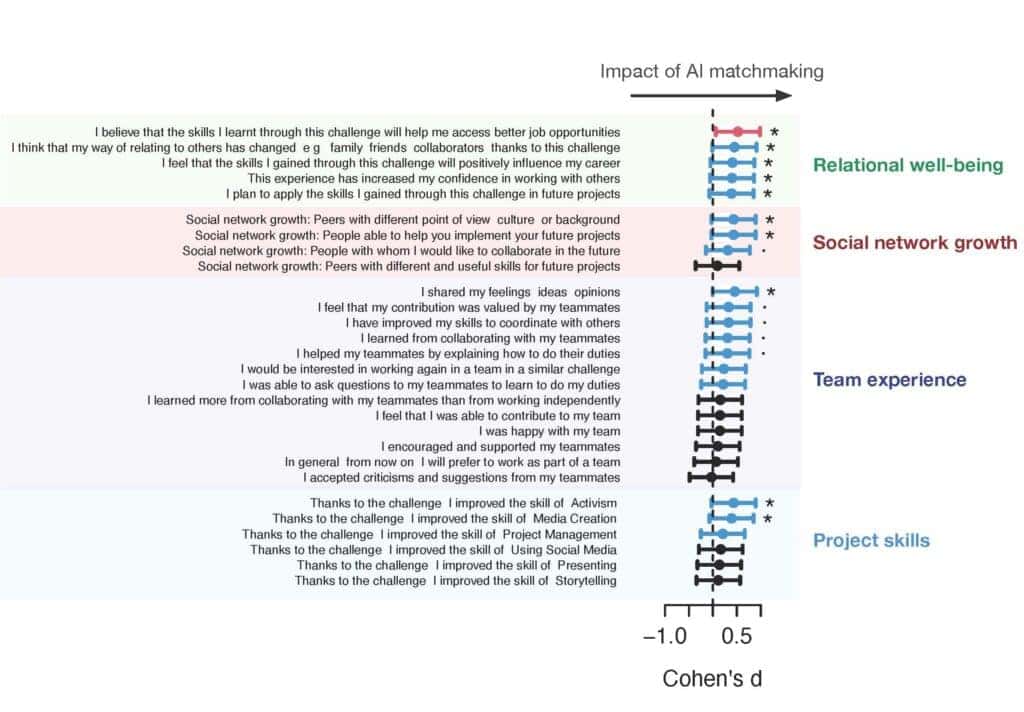
One of the key findings of our study is the significant improvement in the relational well-being of participants in AI-trained teams compared to those in randomly trained teams. As shown in Figure 1, AI-trained teams reported feeling closer to their teammates, expressing greater satisfaction with the collaborative process and feeling more valued for their contributions. These results underline the importance of intentional team composition in collaborative learning environments, where the quality of interactions is as crucial as the end results.
In addition to relational well-being, AI-trained teams showed stronger growth in their social network. Participants reported making more meaningful connections with peers from different cultural and professional backgrounds. This result is particularly important for the Yoma project, one of whose main aims is to create lasting networks among young people that can support their future projects, both personally and professionally.
AI-trained teams also demonstrated greater development of project-specific skills, particularly in areas such as media creation and activism. These teams recorded significantly higher skill gains than their counterparts in the control group. This finding is all the more relevant given that the challenge required teams to produce media content promoting the Yoma initiative, offering participants both the opportunity to complete the task and to develop valuable practical skills for use in future projects.
In terms of psychological safety - an essential component of relational well-being - participants in AI-trained teams consistently reported feeling more comfortable expressing themselves, sharing ideas and providing feedback within their group. These findings are in line with wider research on team dynamics, which suggests that when team diversity is managed well, it fosters a more inclusive environment. Participants feel more comfortable taking risks and engaging more deeply in their tasks, which improves team dynamics and enriches the collaborative experience.
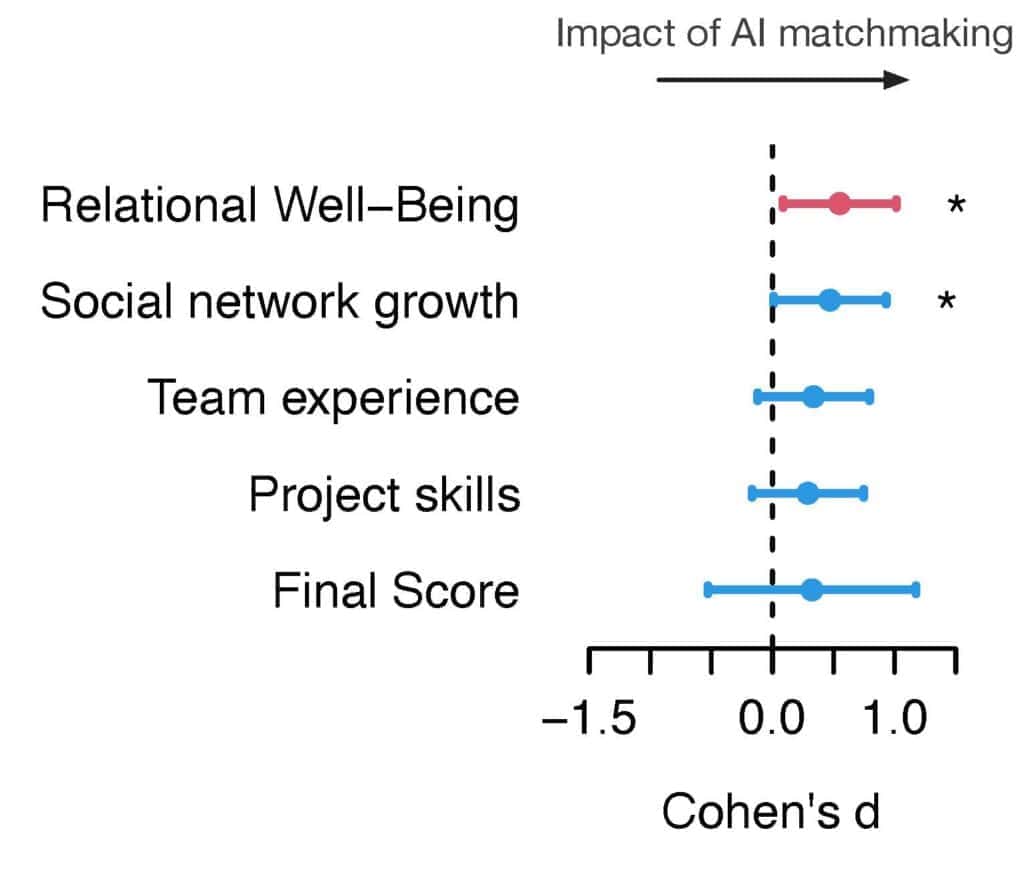
While AI-trained teams perform significantly better in terms of relational well-being and social network growth, the impact on final project results is less pronounced (Figure 2). Although the overall quality of projects produced by AI-trained teams is slightly higher, the difference is not as significant as in other areas. This suggests that while effective team composition plays a key role in enhancing participants' experience and skill development, the quality of the end result may also depend on other factors, such as task complexity or external pressures like time constraints.
Extending research to the Yoma ecosystem
Based on these results, we are currently focusing on the wider Yoma ecosystem. Our next phase of analysis includes data from over 250 stakeholders in various African countries, gathered through surveys and in-depth interviews. This expanded dataset will enable us to explore what promotes relational well-being across a wider range of challenge-based activities within the Yoma platform, and whether these positive outcomes are sustained over time and across different types of challenge. For example, we will investigate whether the social networks formed during these challenges continue to function as support systems for participants, and whether the skills developed during Yoma challenges translate into tangible benefits in their educational or professional lives.
Conclusion: The role of AI in improving collaborative learning
The results of our study show that AI can play a key role in improving relational well-being in challenge-based learning environments, particularly by creating teams that are both diverse and complementary in terms of skills and personality. By fostering stronger social networks, enhancing team experiences and developing key project-related skills, AI-enabled team-building can have a significant impact on the long-term success and commitment of participants in initiatives such as Yoma. This study is closely linked to the mission of the’Learning Transitions research unit (UR LT), which focuses on systemic approaches to planetary transitions by leveraging AI, collective intelligence and interdisciplinarity. Our work on AI-driven team dynamics supports UR LT's broader goals of transforming education and organizational structures, empowering individuals and communities to manage transitions more effectively. This study is currently under review.
As we move forward with our research, we want to continue to explore how these findings can be applied more broadly within the Yoma ecosystem and help create more effective, supportive and inclusive environments for young people to learn, develop and make meaningful contributions to their communities.
An article by the Interaction Data Lab team (Marc Santolini and Olga Kokshagina) at the Learning Planet Institute.

which has become a group of friends/collaborators
Find out more about :
- The Yoma project
- Team and projects‘Interaction Data Lab
- Learning Transitions Research Unit of Learning Planet Institute